NGC 869 & NGC 884
Common Name: Double Cluster in Perseus
Also Known as: Caldwell 14, h Persei (NGC 869), x Persei (NGC 884)
Object Type: Open Clusters
Constellation: Perseus
Distance from Earth: 7,460 light years (NGC 869), 7,660 light years (NGC 884)
Apparent Magnitude: 3.7 (NGC 869), 3.8 (NGC 884)
Coordinates: RA 02H 19.1M 0S DEC 57 deg 09 min 0 sec
Actual Size: 33.15 light years (NGC 869)
Apparent Dimensions: 60 arc-minutes (combined NGC 869 & NGC 884)
Discovered by: The Double Cluster has been known since ancient times, but first catalogued only around 130 BC, when the Greek astronomer Hipparchos mentioned it as a “nebula” or “cloudy spot”
in his writings.
Ptolemy listed the cluster as of the seven “nebulosities” in his Almagest.
It was not until much later that the cluster’s true nature was recognized, after the invention of the telescope in the early 17th century.
Charles Messier did not include the cluster in his catalogue, but it is listed in the Caldwell catalogue of deep sky objects not included in the Messier catalogue.
German-British astronomer William Herschel was the first to recognize that the object in fact consisted of two separate clusters.
Description: The Double Cluster is the name for two open clusters – NGC 869 and NGC 884. Each cluster contains 300 to 400 stars and the brightest stars shine at 7th magnitude.
The clusters were likely formed in the same star forming cloud in the Perseus Arm of the Milky Way and both belong to the Perseus OB1 association, a group of exceptionally massive stars.
The westernmost cluster, NGC 869, appears slightly brighter, richer and more compact than NGC 884. Both open clusters are about 14 million years old.
The clusters are both located in the Perseus OB1 association.
Located in the Perseus OB1 association, both clusters are located physically close to one another, only a few hundred light years apart.
The Double Cluster occupies a total area of 60 arc minutes of apparent sky, which is twice the size of a full Moon.
Individually, the clusters have a mass of 3,700 solar masses (NGC 869) and 2,800 solar masses (NGC 884), but as each cluster is surrounded by an extended halo of stars,
the total mass of the Double Cluster is at least 20,000 solar masses.
Both clusters are blueshifted: NGC 869 is approaching us at a speed of 39 km/s, while NGC 884 is moving in Earth’s direction at 38 km/s.
In mythology, the Double Cluster represents the jeweled handle of Perseus’ sword, given to the hero by the gods, along with a shield and a helmet, to help him in his challenges.
Click Below Image(s) for Full Size:
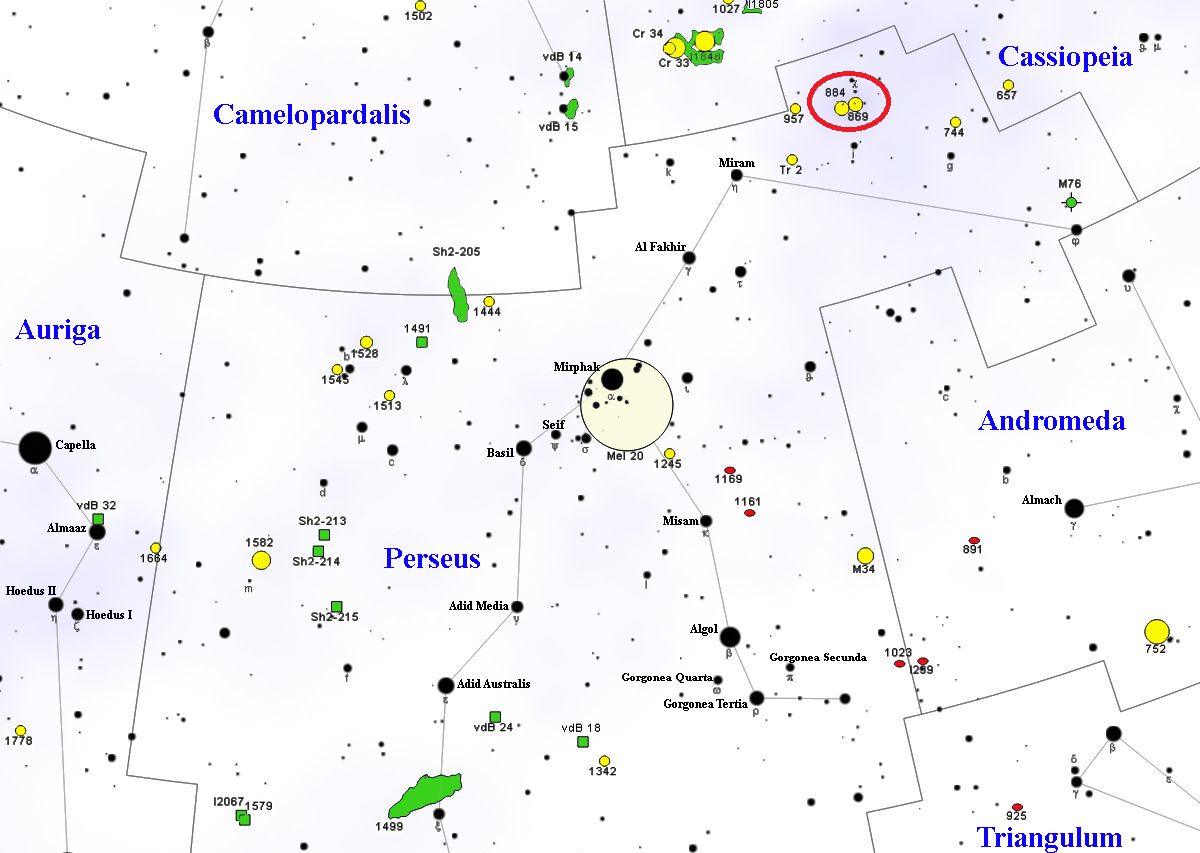
With an apparent magnitude of 3.7/3.8, the Double Cluster is visible even without binoculars in good conditions, but best observed with binoculars or small telescopes.
It is easy to find in the sky because it lies just to the east of the familiar W asterism in Cassiopeia constellation, between the stars Ruchbah (Delta Cassiopeiae) in Cassiopeia and Miram (Eta Persei), which marks the pointed top of Perseus.
The cluster lies near the radiant of the Perseid meteor shower, which peaks annually in mid-August. It is circumpolar from most northern locations. The Double Cluster is often photographed and observed with small telescopes.
The clusters are visible with the unaided eye between the constellations of Perseus and Cassiopeia as a brighter patch in the winter Milky Way.
In small telescopes the cluster appears as an assemblage of bright stars located in a rich star field. Dominated by bright blue stars, the cluster also hosts a few orange stars.
The double cluster is best viewed in late fall or early winter.
Platesolve
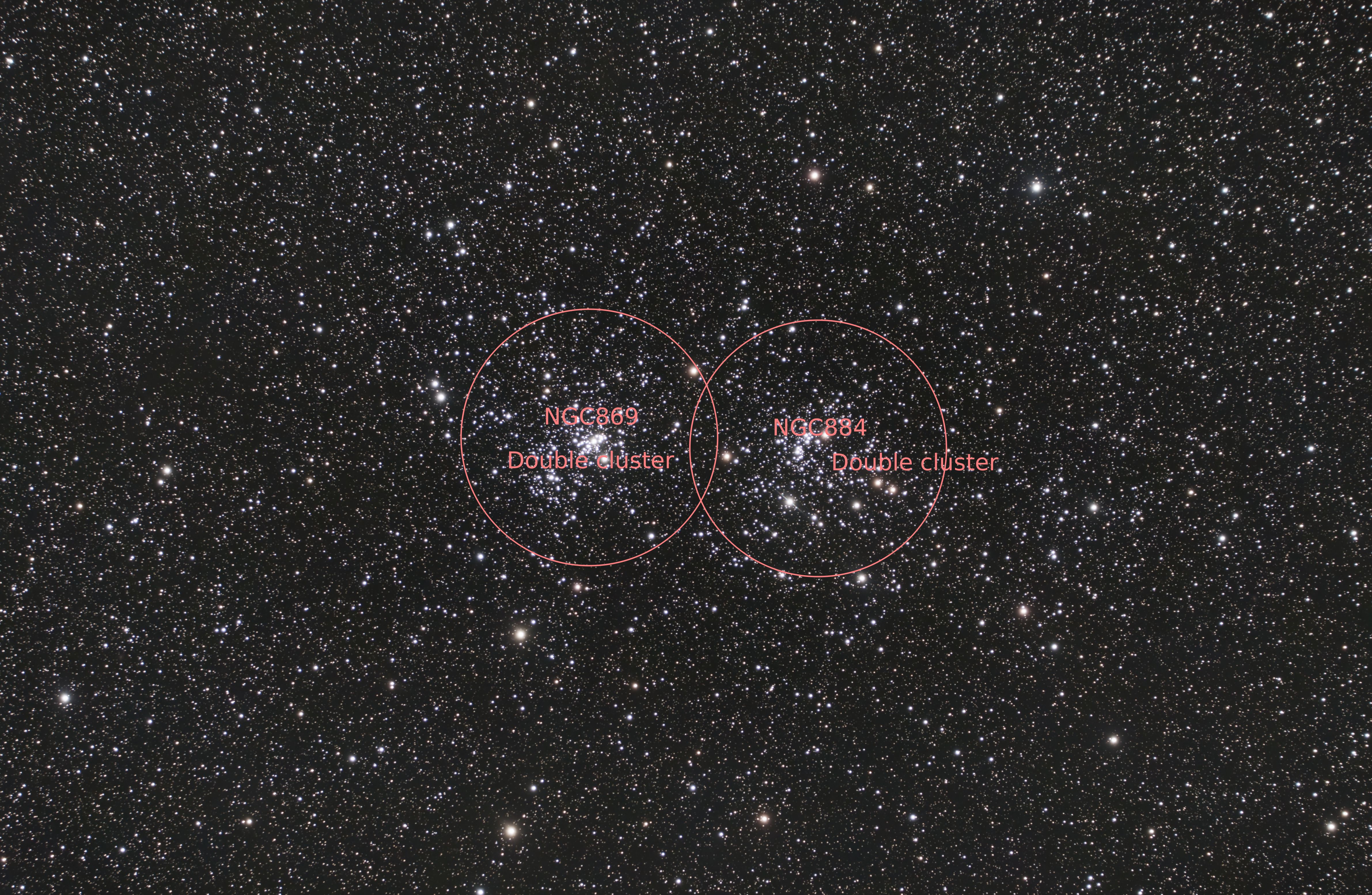
NGC 869 & NGC 884 Open Clusters

Imaging Details
Click to Return to Home Page