NGC 7129
Also Known as: Cr 441
Object Type: Reflection Nebula
Constellation: Cepheus
Distance from Earth: 3,300 light years
Apparent Magnitude: 11.5
Coordinates: RA 21H 42M 56S DEC 66 deg 06 min 12 sec
Actual Size: 6 light years in diameter
Apparent Dimensions: 7 arc-minutes x 7 arc-minutes
Discovered by: NGC 7129 was discovered in 1794 by William Herschel with an 18.7-inch f/13 speculum telescope. He described it as "three stars about 9m involved in nebulosity".
Description: NGC 7129 is a reflection nebula located 3,300 light years away in the constellation Cepheus.
A young open cluster is responsible for illuminating the surrounding nebula.
A recent census of the cluster reveals the presence of 130 young stars less than 1 million years old.
The stars formed from a massive cloud of gas and dust that contains enough raw materials to create a thousand Sun-like stars.
In a process that astronomers still poorly understand, fragments of this molecular cloud became so cold and dense that they collapsed into stars.
Most stars in our Milky Way galaxy are thought to form in such clusters.
NGC 7129 is located just half a degree from nearby cluster NGC 7142.
The nebula is rosebud-shaped; the young stars have blown a large, oddly shaped bubble in the molecular cloud that once surrounded them at their birth.
The rosy pink color comes from glowing dust grains on the surface of the bubble being heated by the intense light from the young stars within.
The ultra-violet and visible light produced by the young stars is absorbed by the surrounding dust grains.
They are heated by this process and release the energy at longer infrared wavelengths.
The reddish colors in the false-color infrared image suggest the distribution of hydrocarbon rich molecular material.
Three very young stars near the center of the nebula are sending jets of supersonic gas into the cloud.
The collision of these jets heats carbon monoxide molecules in the nebula. This produces the complex nebulosity that appears like a stem of a rosebud.
Within the astronomically brief period of a million years, the stars have managed to blow a large,
irregular bubble in the molecular cloud that once enveloped them like a cocoon.
Not all stars are formed in clusters. Away from the main nebula and its young cluster are two smaller nebulae, to the left and bottom of the central "rosebud,"
each containing a stellar nursery with only a few young stars.
Click Below Image(s) for Full Size:
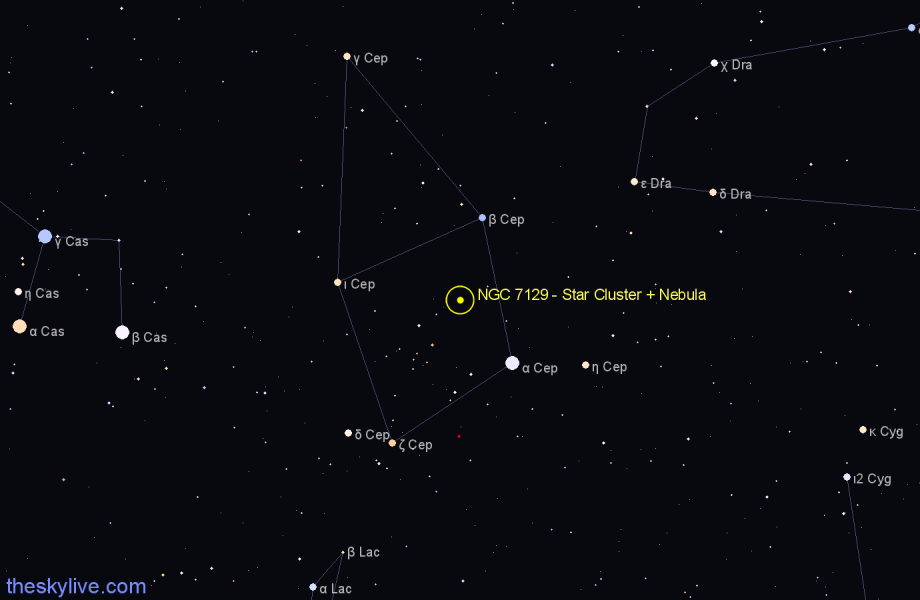
NGC 7129 is situated close to the northern celestial pole and, as such, it is visible for most part of the year from the northern hemisphere.
Platesolve
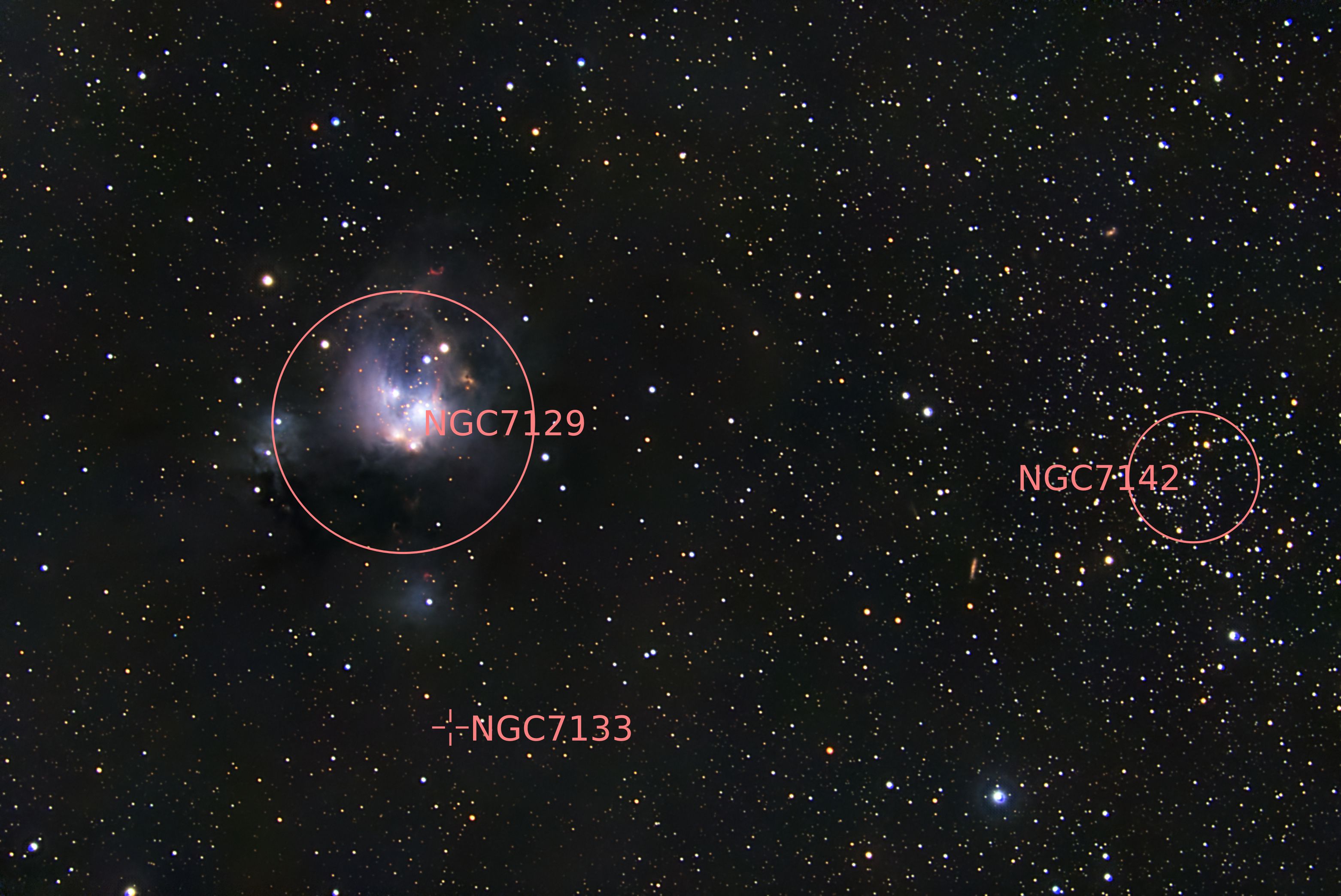
NGC 7129 Nebula

Imaging Details
Click to Return to Home Page