NGC 654, NGC 663, and IC 166
Also Known as: Cr 18, Caldwell 10 (NGC 663), Cr 20 (NGC 663)
Object Type: Open Cluster
Constellation: Cassiopeia
Distance from Earth: 7,830 Light years (NGC 654), 6,850 (NGC 663)
Apparent Magnitude: 6.5 (NGC 654), 7.1 (NGC 663)
Coordinates: RA 01H 44M 0.0S DEC 61 deg 53 min 06 sec
Actual Size: 11.4 light years (NGC 654)
Apparent Dimensions: 5 arc-minutes (NGC 654)
Discovered by: NGC 654 was discovered by William Herschel in 1787.
Description: NGC 654 is an open cluster in the constellation Cassiopeia.
It surrounds a 7th magnitude yellowish star, an F5Ia supergiant, which is a possible member of the group.
It is a very young cluster, aged approximately 15 million years, but it could be as old as 40 million years, with a time spread of star formation of at least ∼20 Myr.
NGC 654 is assumed to form part of the stellar association Cassiopeia OB8, that is located in the Perseus arm of the Milky Way, along with the open clusters M103, NGC 663, NGC 659, and some supergiant stars scattered between them, all of them having similar ages and distances.
The central region of the cluster shows less reddening than the rest of the cluster.
One explanation is that between the Solar System and the cluster lie two dust layers, one at 200pc and one more at 1Kpc.
Behind the cluster is one more dust layer. The cluster has approx. 80 members, including three Be stars and a few luminous stars like HD 10494 and F5Ia.
The earliest spectral type is around B0. NGC 654 is assumed to form part of the stellar association Cassiopeia OB8, that is located in the Perseus arm of the Milky Way, along with the open clusters M103,
NGC 663, NGC 659, and some supergiant stars scattered between them, all of them having similar ages and distances.
NGC 663 is a young open cluster in the constellation of Cassiopeia. It has an estimated 400 stars and spans about a quarter of a degree across the sky. It can reportedly be detected with the unaided eye, although a telescope is recommended for best viewing.
The brightest members of the cluster can be viewed with binoculars. Although the listed visual magnitude is 7.1, several observers have reported higher estimates.
This cluster appears to be located in front of a molecular cloud, although the two are not physically associated. This cloud has the effect of blocking background stars from the visual image of the cluster as it lies at a distance of 300 parsecs.
IC 166 is a relatively faint open cluster set amongst a rich star field in Cassiopeia.
At times the dense foreground can make such clusters hard to spot, but on this occasion the profusion of fainter stars makes the cluster stand out even in mono.
IC 166 is about 1 billion years old and while this makes it quite a lot older than most, it is classified as an 'intermediate' age cluster.
Click Below Image(s) for Full Size:
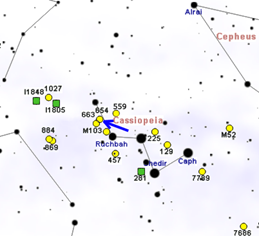
It can be observed by binoculars.
It is located 2,5° northeast of the star Delta Cassiopeiae. In the same low power field can also be seen the open clusters NGC 663 and NGC 659.
Platesolve
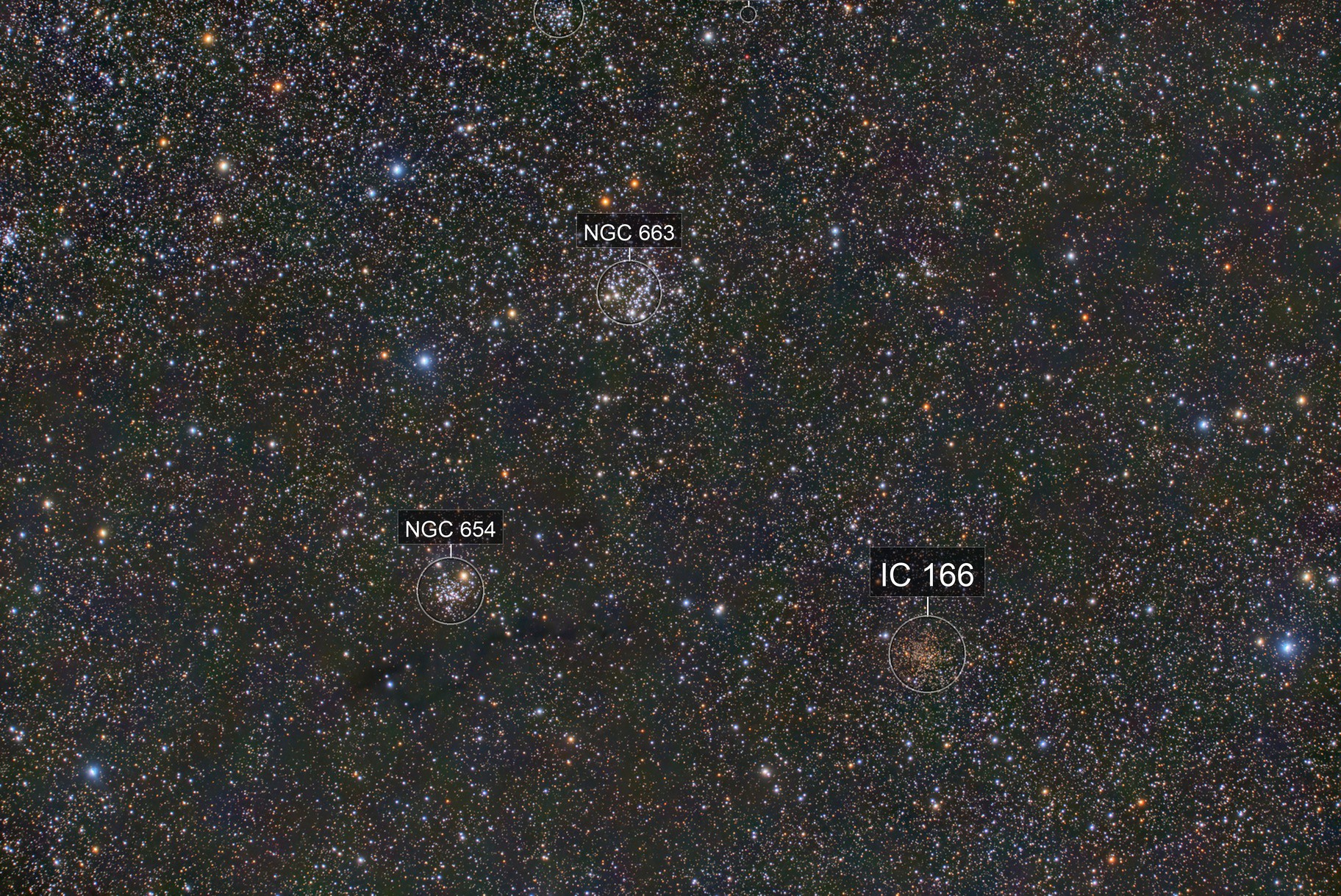
Wide Field

Imaging Details
Click to Return to Home Page