NGC 6384
Also Known as: PGC 60459, UGC 10891
Object Type: Intermediate Barred Spiral Galaxy
Constellation: Ophiuchus
Distance from Earth: 76.6 million light years
Apparent Magnitude: 13.2
Coordinates: RA 17H 32M 24.302 Sec DEC 07 deg 03 min 36.97 sec
Actual Size: 150,000 light years
Apparent Dimensions: 2.45 arcminutes x 1.11 arcminutes
Discovered by: NGC 6384 was discovered by German-British astronomer Albert Marth on 10 June 1863.
Description:
NGC 6384 has a morphological classification of SAB(r)bc, indicating that it is a weakly barred galaxy (SAB) with an inner ring structure (r) orbiting the bar,
and moderate to loosely wound spiral arms (bc).
The galaxy is inclined by an angle of 47° to the line of sight, along a position angle of 40°.
The estimated mass of the stars in this galaxy is 105 billion times the mass of the Sun.
At one time NGC 6384 was considered a normal galaxy with no activity in the nucleus.
However, it is now classified as a transition object (T2), which is thought to be a LINER-type galaxy whose emission-line spectra is contaminated by H II regions in the nucleus.
It is speeding away from us at roughly 1680 kilometers per second.
The galaxy has blue spiral arms laced with dark dust lanes and a yellowish core.
Star formation in the center is being fueled by the galaxy’s bar structure; astronomers think such galactic bars funnel gas inwards, where it accumulates to form new stars.
Click Below Image(s) for Full Size:
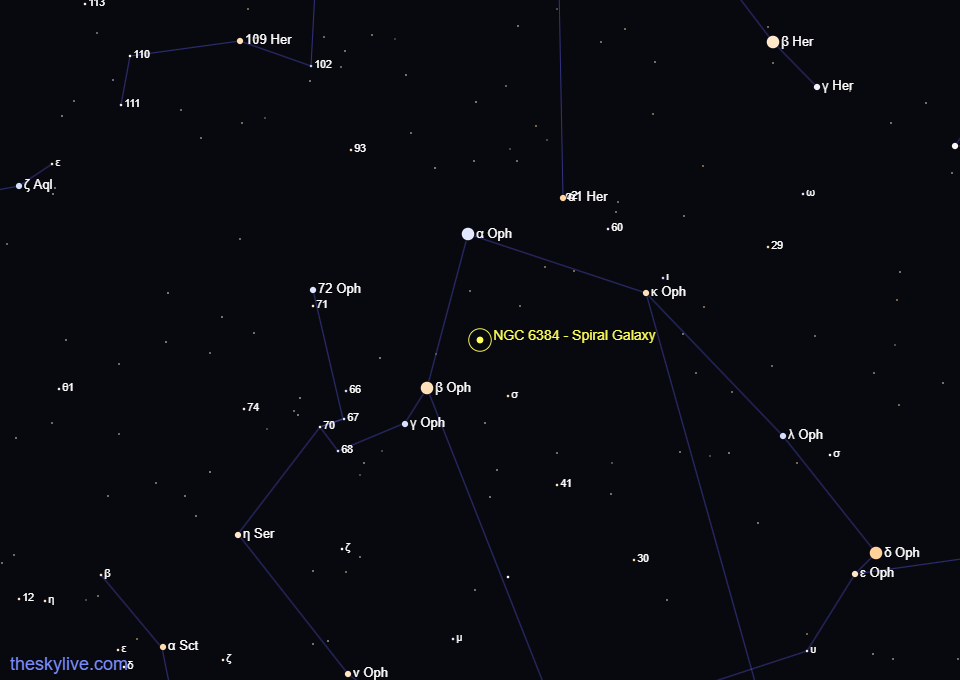
NGC 6384 is a Spiral Galaxy in the Ophiuchus constellation. NGC 6384 is situated close to the celestial equator and, as such, it is at least partly visible from both hemispheres in certain times of the year.
Given its B magnitude NGC 6384 is visible with the help of a telescope having an aperture of 10 inches (250mm) or more.
Platesolve
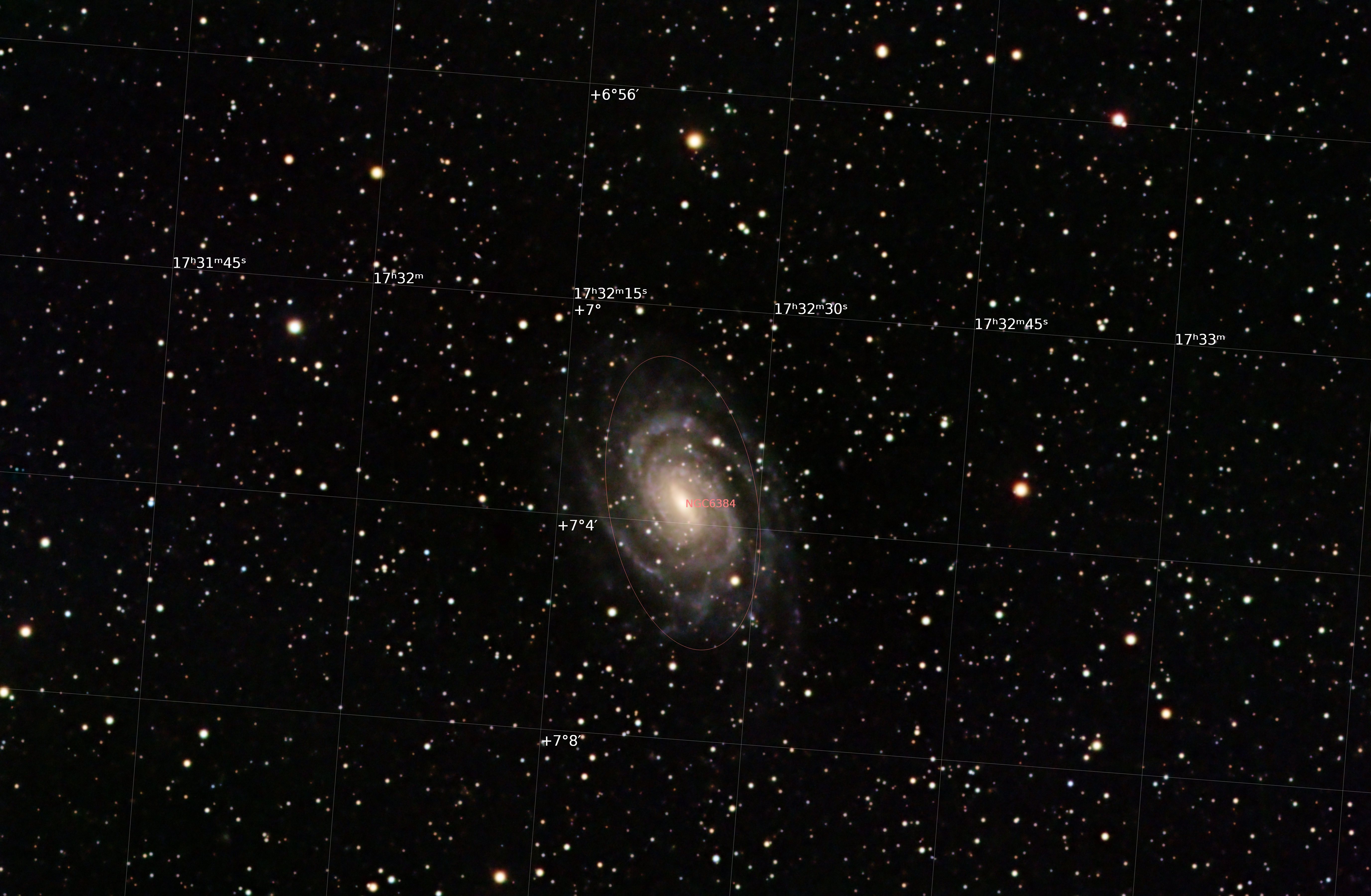
NGC 6384 Galaxy
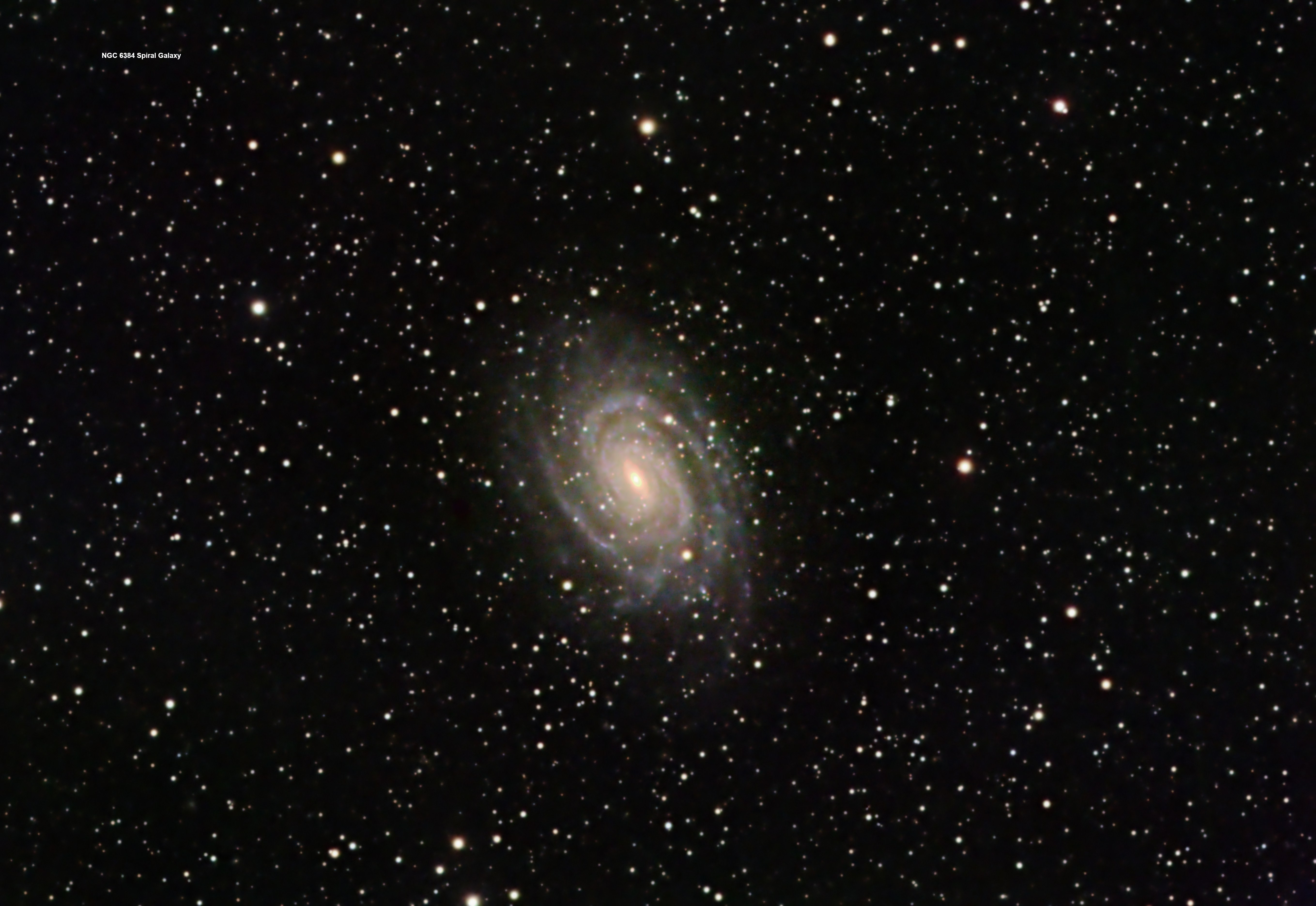
Imaging Details
Click to Return to Home Page