NGC 4631 & NGC 4656
Common Name: Whale Galaxy (NGC 4631) & Hockey Stick Galaxy (NGC 4656)
Also Known as: Caldwell 32 (NGC 4631), Crowbar Galaxy (NGC 4656)
Object Type: Barred Spiral Galaxies
Constellation: Canes Venatici
Distance from Earth: 30 million light years (both)
Apparent Magnitude: 8.9 (NGC4631)... 11.0 (NGC 4656)
Coordinates: RA 12H 42M 08.0S DEC 32 deg 32 min 29 sec
Actual Size: 132,000 light years (NGC 4631), 113,000 light years (NGC 4656)
Apparent Dimensions: 15.5 arc-minutes x 2.7 arc-minutes (NGC 4631)... 12.9 arc-minutes (NGC 4656)
Discovered by: NGC 4631 was discovered by William Herschel in 1787.
Description: This galaxy's slightly distorted wedge shape gives it the appearance of a herring or a whale, hence its nickname.
The Whale Galaxy is the central member of the NGC 4631 Group, a group of galaxies located about 25 million light years away.
The group is part of the Virgo Supercluster. The member galaxies lie both in Canes Venatici and in the neighboring Coma Berenices. They include NGC 4627, the companion of NGC 4631, and the relatively bright Hockey Stick Galaxies (NGC 4656 and NGC 4657).
Estimates of the number of galaxies in this group range from 5 to 27, and all studies identify very different member galaxies for this group.
This nearby galaxy is seen edge-on from Earth. NGC 4631 contains a central starburst, which is a region of intense star formation.
The strong star formation is evident in the emission from ionized hydrogen and interstellar dust heated by the stars formed in the starburst.
The most massive stars that form in star formation regions only burn hydrogen gas through fusion for a short period of time, after which they explode as supernovae.
So many supernovae have exploded in the center of NGC 4631 that they are blowing gas out of the plane of the galaxy.
NGC 4631 has a nearby companion dwarf elliptical galaxy, NGC 4627. NGC 4627 and NGC 4631 together were listed in the Atlas of Peculiar Galaxies as an example of a "double galaxy" or a galaxy pair.
NGC 4631 and NGC 4627 are part of the NGC 4631 Group, a group of galaxies that also includes the interacting galaxies NGC 4656 and NGC 4657. However, exact group identification is problematic because this galaxy and others lie in a part of the sky that is relatively crowded.
NGC 4656/57 is a highly warped edge-on barred spiral galaxy located in the local universe 30 million light years away from earth in the constellation Canes Venatici.
NGC 4656 galaxy is sometimes called the Hockey Stick Galaxy or the Crowbar Galaxy. Its unusual shape is thought to be due to an interaction between NGC 4656, NGC 4631, and NGC 4627. The galaxy is a member of the NGC 4631 Group.
Click Below Image(s) for Full Size:
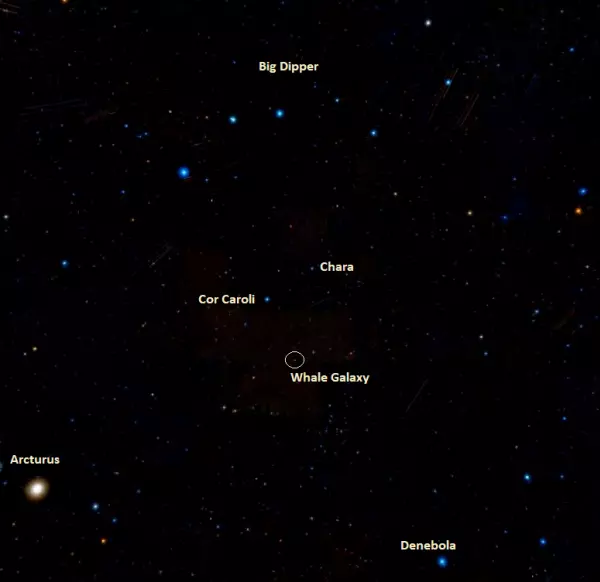
NGC 4631 and NGC 4656 are situated north of the celestial equator and, as such, it is more easily visible from the northern hemisphere.
This galaxy is difficult to observe visually in small telescopes.
The Whale Galaxy (NGC 4631) is not too difficult to find because it lies in the area between two bright stars: Cor Caroli and Denebola at the tail of Leo.
NGC 4631 is best observed in the spring months.
Platesolve
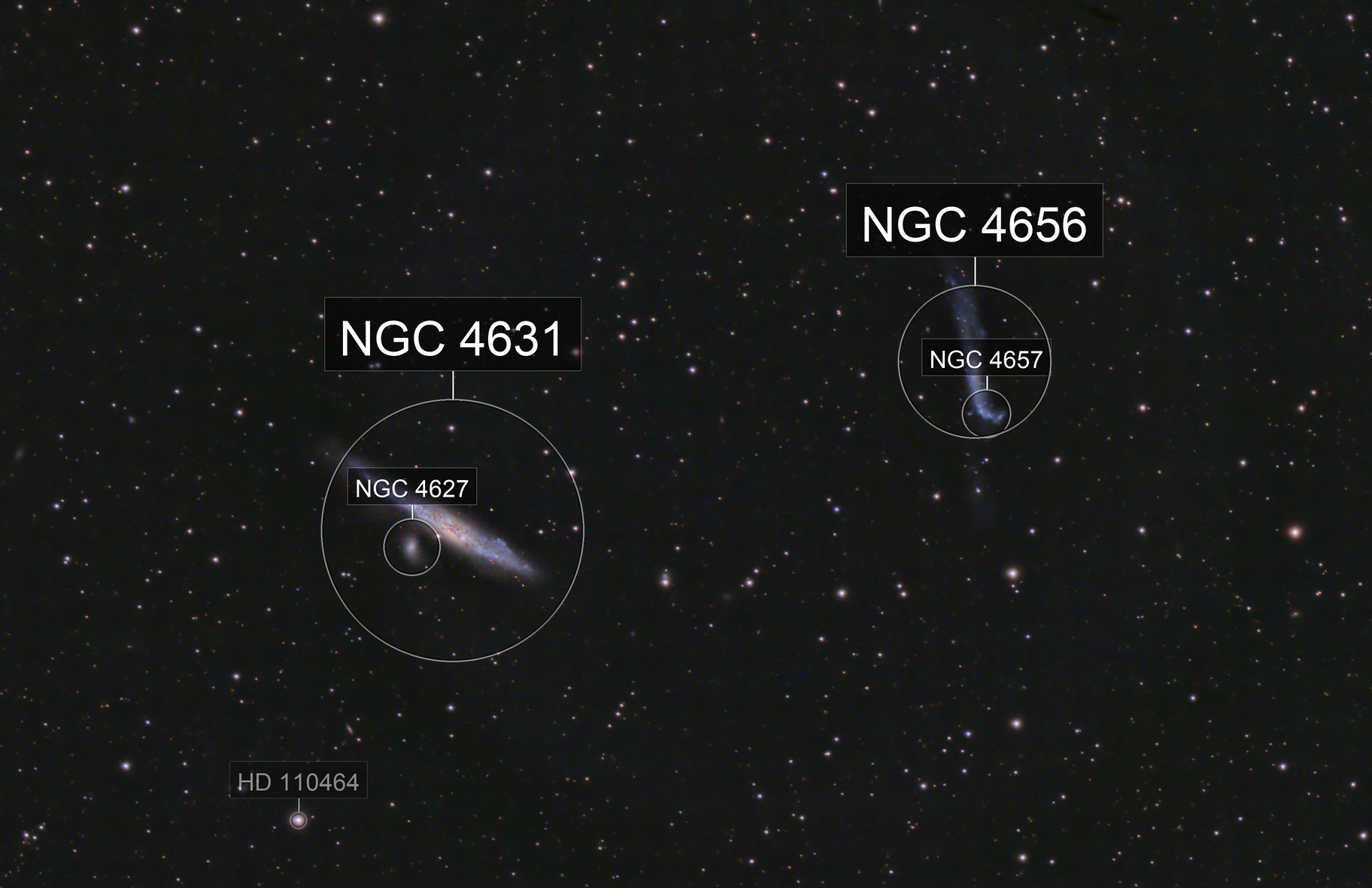
NGC 4631 & NGC 4656 Galaxies

Imaging Details
Click to Return to Home Page