SuperNova SN2025rbs in galaxy NGC 7331
Also Known as: Caldwell 30
Object Type: Unbarred Spiral Galaxy
Constellation: Pegasus
Distance from Earth: 39.8 million light years
Apparent Magnitude: 10.4
Coordinates: RA 22H 37M 04.1S DEC 34 deg 24 min 56 sec
Actual Size: 120,000 light years in diameter.
Apparent Dimensions: 10.5 arc-minutes x 3.7 arc-minutes
Supernova Background: A supernova is a powerful and luminous explosion of a star.
A supernova occurs during the last evolutionary stages of a massive star or when a white dwarf is triggered into runaway nuclear fusion.
The original object, called the progenitor, either collapses to a neutron star or black hole, or is completely destroyed to form a diffuse nebula.
The peak optical luminosity of a supernova can be comparable to that of an entire galaxy before fading over several weeks or months.
Supernovae may be divided into two broad classes, Type I and Type II, according to the way in which they detonate.
Type I supernovae may be up to three times brighter than Type II; they also differ from Type II supernovae in that their spectra contain no hydrogen lines and they expand about twice as rapidly.
Type II supernovae:
The so-called classic explosion, associated with Type II supernovae, has as progenitor a very massive star (a Population I star) of at least eight solar masses that is at the end of its active lifetime.
Until this stage of its evolution, the star has shone by means of the nuclear energy released at and near its core in the process of squeezing and heating lighter elements such as hydrogen or helium into successively heavier elements—i.e.,
in the process of nuclear fusion.
Forming elements heavier than iron absorbs rather than produces energy, however, and, since energy is no longer available, an iron core is built up at the center of the aging, heavyweight star.
When the iron core becomes too massive, its ability to support itself by means of the outward explosive thrust of internal fusion reactions fails to counteract the tremendous pull of its own gravity.
Consequently, the core collapses. If the core’s mass is less than about three solar masses, the collapse continues until the core reaches a point at which its constituent nuclei and free electrons are crushed together into a hard, rapidly spinning core.
This core consists almost entirely of neutrons, which are compressed in a volume only 20 km (12 miles) across but whose combined weight equals that of several Suns.
A teaspoonful of this extraordinarily dense material would weigh 50 billion tons on Earth. The supernova detonation occurs when material falls in from the outer layers of the star and then rebounds off the core,
which has stopped collapsing and suddenly presents a hard surface to the infalling gases. The shock wave generated by this collision propagates outward and blows off the star’s outer gaseous layers.
The amount of material blasted outward depends on the star’s original mass.
If the core mass exceeds three solar masses, the core collapse is too great to produce a neutron star; the imploding star is compressed into an even smaller and denser body—namely, a black hole.
Infalling material disappears into the black hole, the gravitational field of which is so intense that not even light can escape.
The entire star is not taken in by the black hole, since much of the falling envelope of the star either rebounds from the temporary formation of a spinning neutron core or misses passing through the very center of the core and is spun off instead.
Such an object is called a neutron star.
Type I supernovae:
Type I supernovae can be divided into three subgroups—Ia, Ib, and Ic—on the basis of their spectra.
The exact nature of the explosion mechanism in Type I generally is still uncertain, although Ia supernovae, at least, are thought to originate in binary systems consisting of a moderately massive star and a white dwarf,
with material flowing to the white dwarf from its larger companion.
A thermonuclear explosion results if the flow of material is sufficient to raise the mass of the white dwarf above the Chandrasekhar limit of 1.44 solar masses.
Unlike the case of an ordinary nova, for which the mass flow is less and only a superficial explosion results, the white dwarf in a Ia supernova explosion is presumably destroyed completely.
Radioactive elements, notably nickel-56, are formed. When nickel-56 decays to cobalt-56 and the latter to iron-56, significant amounts of energy are released, providing perhaps most of the light emitted during the weeks following the explosion.
Description: SN2025rbs is a Type Ia supernova that was discovered in the galaxy NGC 7331 on July 14, 2025.
It's located approximately 40 million light-years away in the constellation Pegasus.
The supernova reached a peak brightness of around magnitude 14.0 and is visibly brighter than the galaxy's core.
The supernova is expected to be fading over time as it is a Type Ia supernova.
SN2025rbs is notable for being a bright supernova in a prominent galaxy that was easily captured with relatively small telescopes and even compact, all-in-one devices.
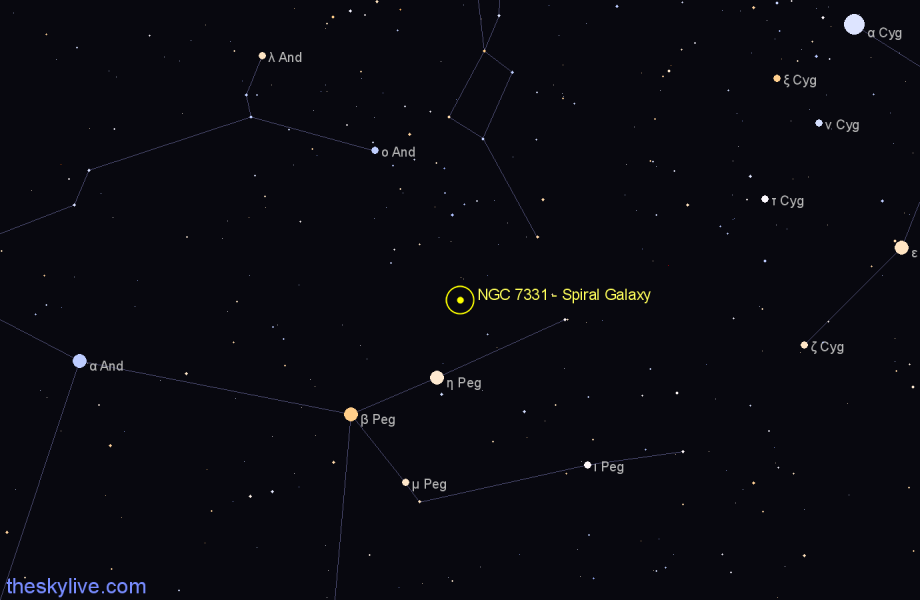
Wide Field Supernova SN2025rbs
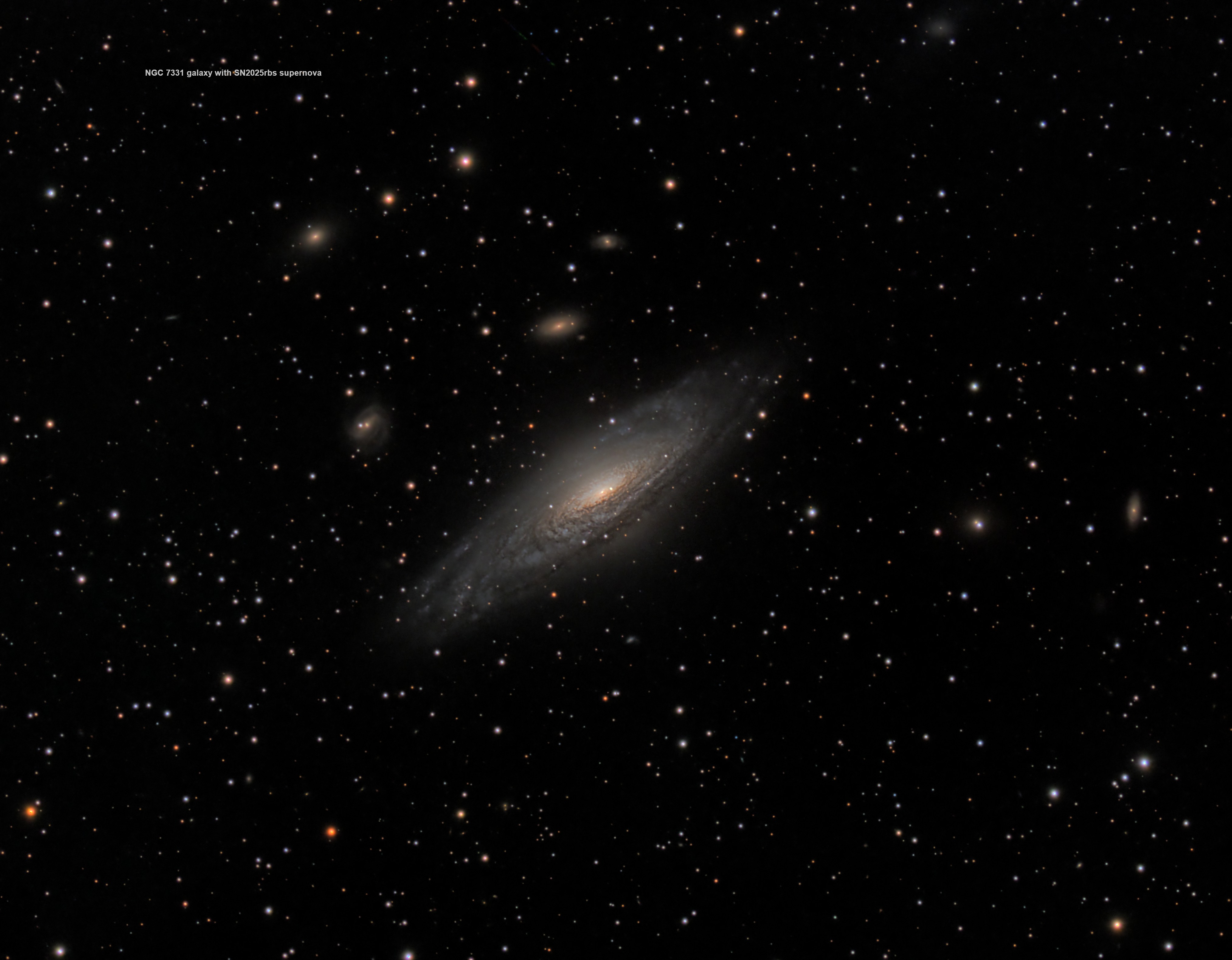
Closeup of Supernova SN2025rbs
 Imaging Details
Click to Return to Home Page