Messier 63 (M63)
Common Name: Sunflower Galaxy
Also Known as: NGC 5055
Object Type: Spiral Galaxy
Constellation: Canes Venatici
Distance from Earth: 37 million light years
Apparent Magnitude: 9.3
Coordinates: RA 13H 15M 49.3S DEC 42 deg 01 min 45/0 sec
Actual Size: 98,000 light years in diameter
Apparent Dimensions: 12.6 arc-minutes x 7.2 arc-minutes
Discovered by: The Sunflower Galaxy was discovered by Charles Messier’s friend and colleague Pierre Méchain on June 14, 1779.
This was the first deep sky object discovered by Méchain.
Messier subsequently included the galaxy in his catalogue as the 63rd entry, describing it as a nebula.
Description: The Sunflower Galaxy is one of the four Messier galaxies found in Canes Venatici constellation, along with Messier 51 (the Whirlpool Galaxy), Messier 94 (the Cat’s Eye Galaxy), and Messier 106.
Messier 63 is known for its appearance, for which it was named Sunflower, with a bright yellow central disc and a number of short spiral arm segments dotted with starburst regions and dust lanes.
Infrared observations indicate that M63 has a two-armed spiral structure.
The Sunflower Galaxy is a prototype for a class of galaxies known as flocculent spirals.
It appears to have many spiral arms because the arms appear patchy and discontinuous.
Flocculent spirals are the opposite of grand design spiral galaxies, which have a clearly defined spiral structure.
M63 is roughly the same size as the Milky Way and has a mass of 140 billion times that of our Sun.
Messier 63 is one of the members of the M51 Group, a group of gravitationally bound galaxies located in Canes Venatici, named after the brightest member of the group, Messier 51 (the Whirlpool Galaxy).
The group also includes the edge-on spirals NGC 5023 and NGC 5229, and the irregular galaxy UGC 8331 (DDO 169).
Messier 63 was one of the first spiral galaxies in which the spiral structure was identified. The first to do so was William Parsons, 3rd Earl of Rosse.
Lord Rosse discovered spiral structures in M63 in the mid-19th century and included the object in his list of 14 “spiral nebulae,” discovered until 1850.
Click Below Image(s) for Full Size:
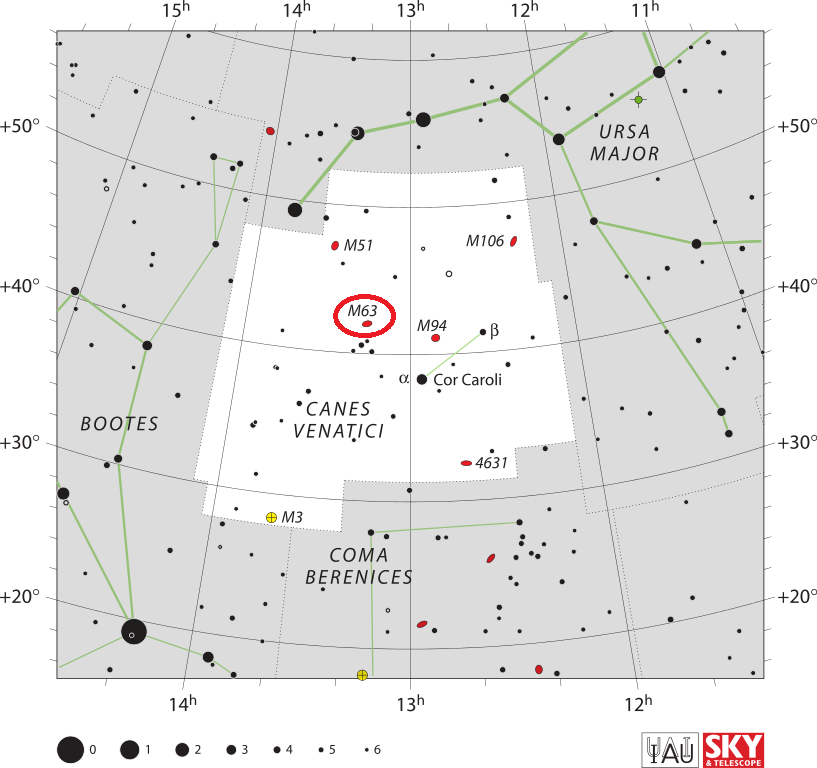
The Sunflower galaxy can be seen with binoculars but it appears as a small, hazy patch of light or an out-of-focus star.
Small telescope reveal the galaxy but larger scopes are necessary to reveal the bright core and oval patch of nebulosity around it.
At least an 8 inch scope is required to see the spiral arms.
The best time of year to observe M63 is late spring.
Platesolve
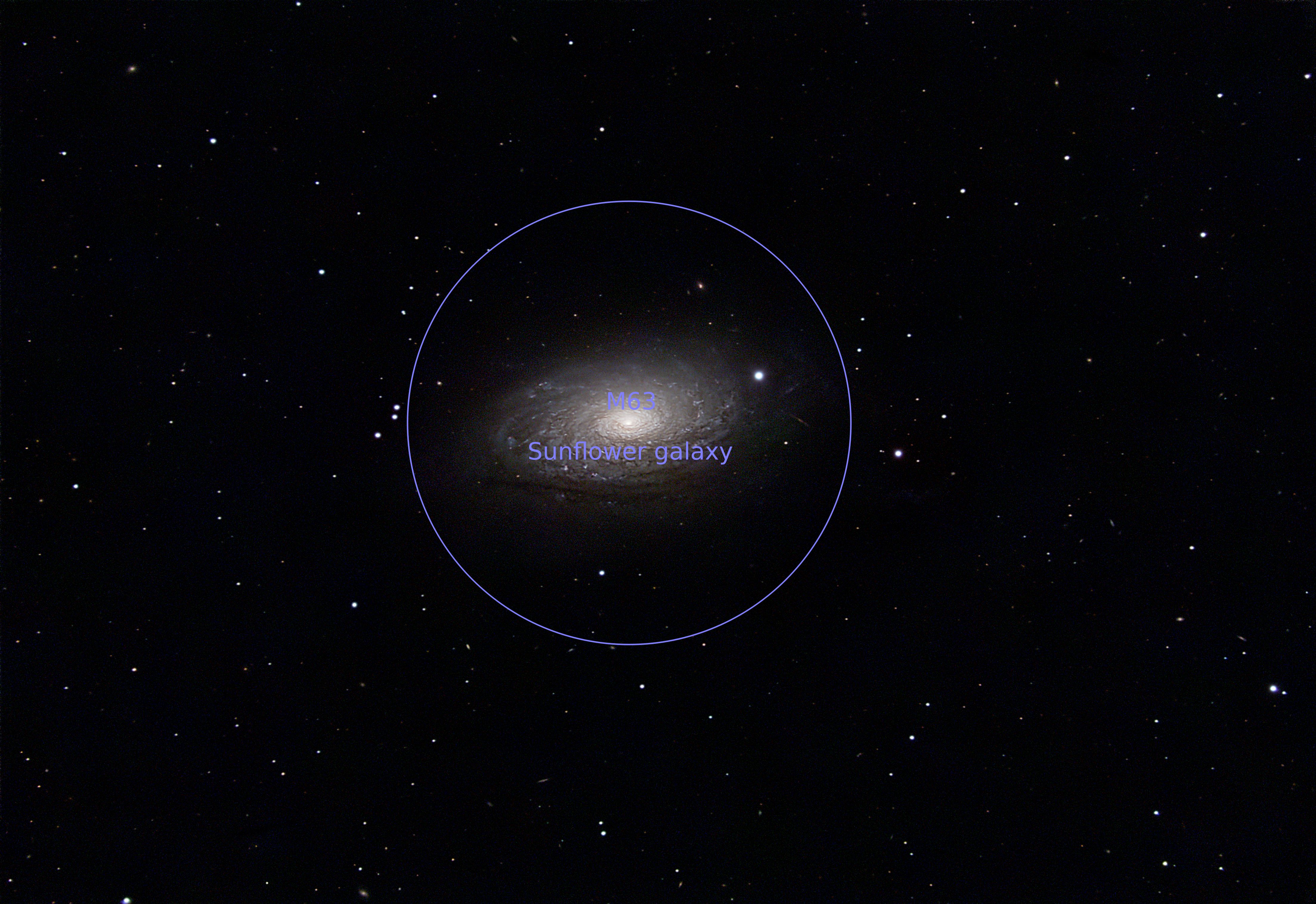
M63 Spiral Galaxy

Imaging Details
Click to Return to Home Page