IC 4677
Common Name: Cat's Eye Nebula
Also Known as: NGC 6543, Snail Nebula, Sunflower Nebula
Object Type: Planetary Nebula
Constellation: Draco
Distance from Earth: 3,300 light years
Apparent Magnitude: 15.7
Coordinates: RA 17H 58M 33.423S DEC 66 deg 37 min 59.52 sec
Actual Size:
Apparent Dimensions: 20 arcminutes x 16 arcminutes (NGC 6543), 1.1 arcminutes x 0.7 acrminutes (IC 4677)
Discovered by: NGC 6543 discovered by William Herschel on February 15, 1786
IC 4677 is the brightest knot of gas in the outer halo of the Cat’s Eye Nebula (NGC 6543). It was discovered on April 24, 1900, by the American astronomer E.E. Barnard
Description:
IC 4677 is a bright, diffuse knot situated in the faint outer halo of the famous Cat's Eye Nebula (NGC 6543) in the constellation Draco. Discovered by E.E. Barnard in 1900,
it was initially misidentified as a background galaxy but is now known to be a dense gas condensation in the nebula's complex shell.
NGC 6543 is a planetary nebula in the northern constellation of Draco.
Its age is estimated to be ~ 1,000 years.
NGC 6543 is among the most complex planetary nebulae. The nebula reveals a complicated structure with concentric shells of gas, high-velocity jets of gas, and unusual shock-wave-induced gas knots. Because of its appearance, NGC 6543 was named the Cat's Eye Nebula.
It was the first planetary nebula whose spectrum was investigated by the English amateur astronomer William Huggins, demonstrating that planetary nebulae were gaseous and not stellar in nature.
Structurally, the object has had high-resolution images by the Hubble Space Telescope revealing knots, jets, bubbles and complex arcs, being illuminated by the central hot planetary nebula nucleus (PNN).
It is a well-studied object that has been observed from radio to X-ray wavelengths. At the center of the Cat's Eye Nebula is a dying Wolf–Rayet star, the sort of which can be seen in the Webb Telescope's image of WR 124.
Its small bright inner nebula subtends an average of 16.1 arcsec, with the outer prominent condensations about 25 arcsec.
The Cat's Eye Nebula's central star shines at magnitude +11.4.
NGC 6543 is 4.4 minutes of arc from the current position of the north ecliptic pole, less than 1⁄10 of the 45 arcminutes between Polaris and the current location of the Earth's northern axis of rotation.
IC 4677 is included in the nebula.
Click Below Image(s) for Full Size:
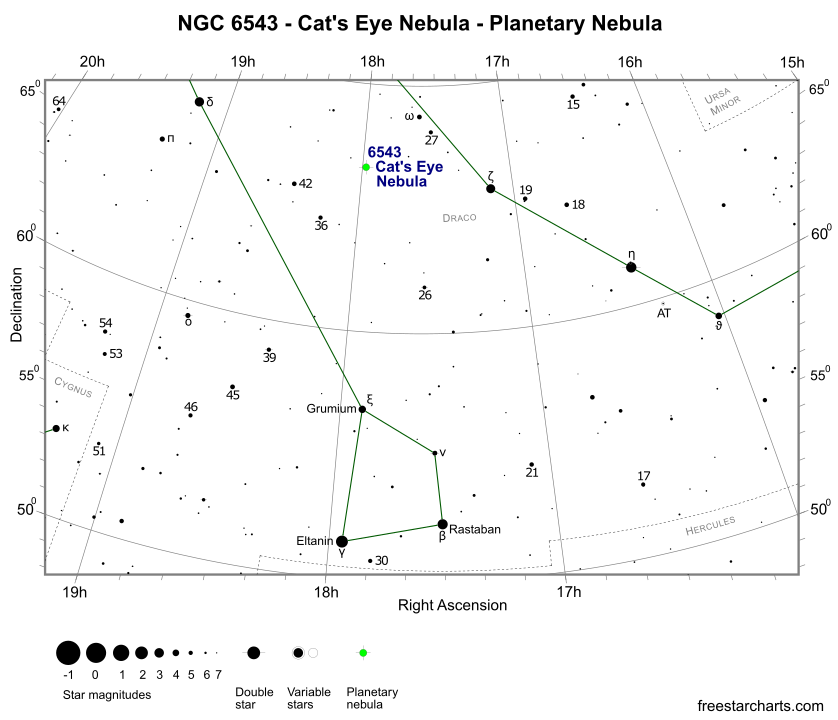
NGC 6543 is a Planetary Nebula in the Draco constellation. NGC 6543 is situated close to the northern celestial pole and, as such, it is visible for most part of the year from the northern hemisphere.
Given its visual magnitude, NGC 6543 is visible with the help of a binocular with a 60-70mm aperture or a small telescope.
In most scopes, NGC 6543 appears as a tiny, bluish green spot of bright nebulosity. An 80mm (3.1-inch) refractor reveals an evenly lit slightly small oval disk that responds well to high power.
On initial inspection it may appear stellar, but higher magnifications easily reveal its true nature. A 200mm (8-inch) scope hints at some color but generally larger instruments of at least 300mm (12-inch) are needed to tease out the finer details.
Although the central star shines at mag. +11.4, it takes a large instrument at high powers to spot it due to the overwhelming brightness of the surrounding nebula.
Visually observing the IC 4677 knot is extremely difficult because the overwhelming brightness of the Cat's Eye core tends to mask the fringes. Dedicated imagers often capture it alongside the neighboring barred spiral galaxy, NGC 6552.
Platesolve
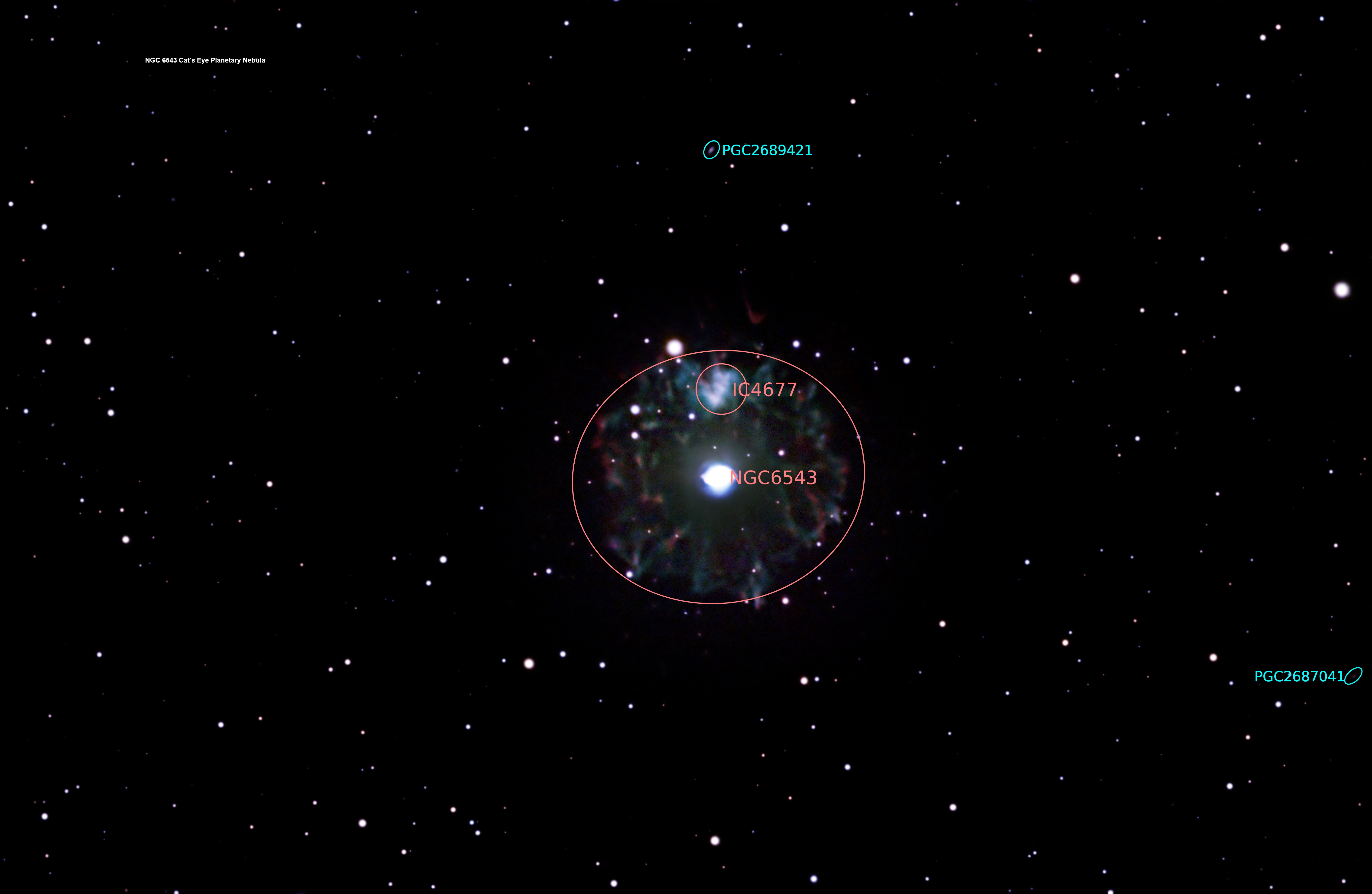
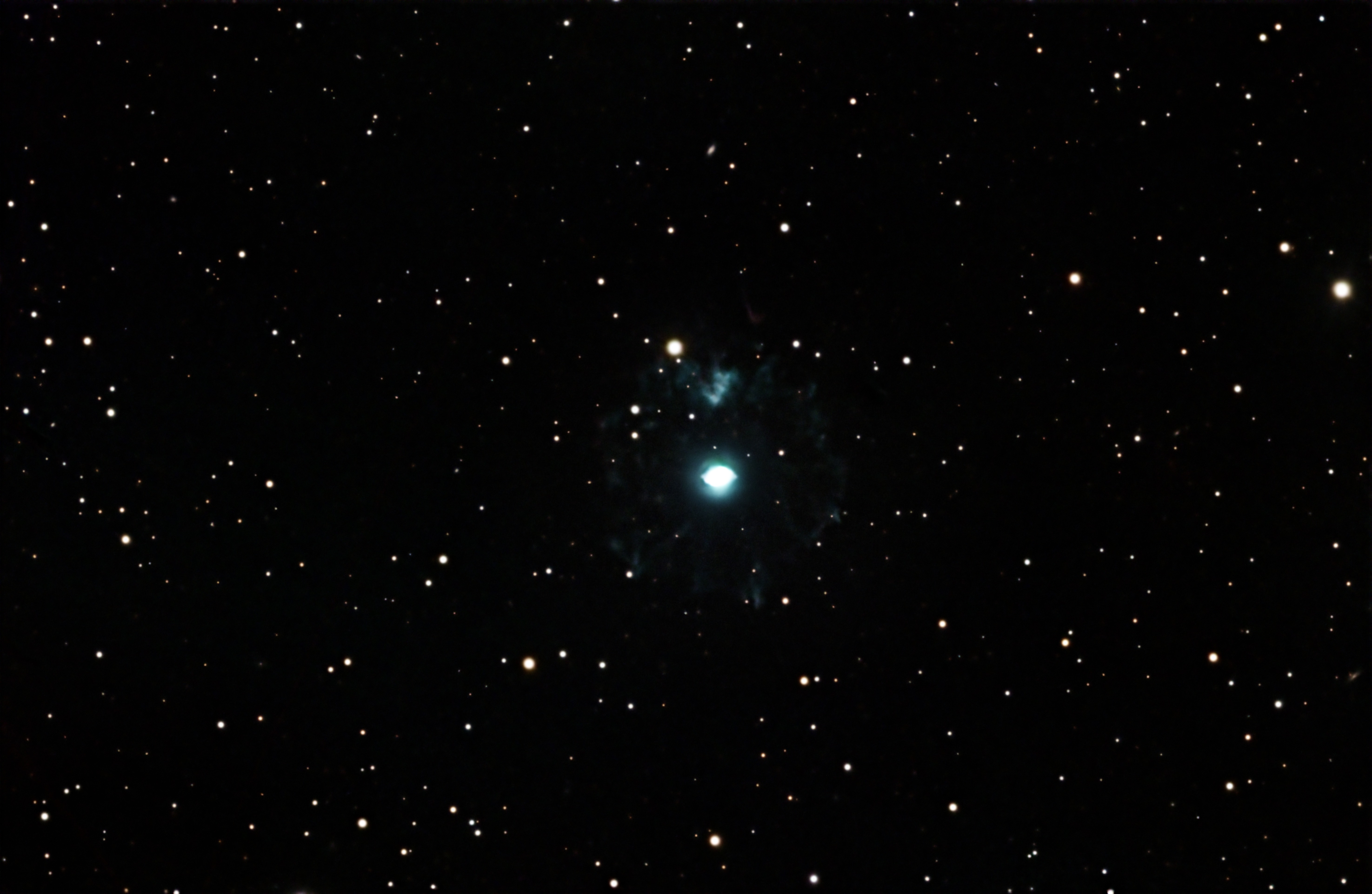
IC 4677 Planetary Nebula in RGB
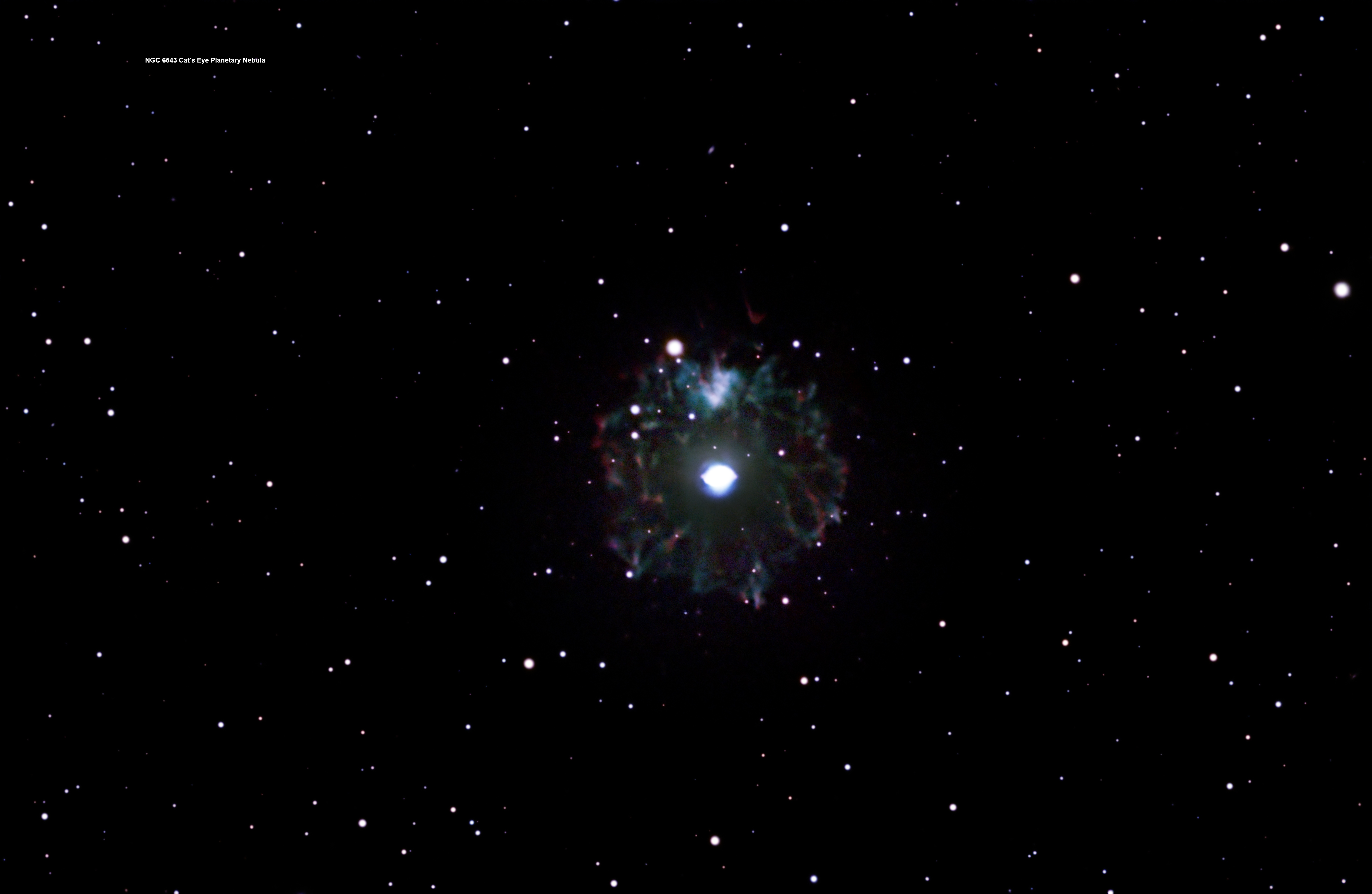
IC 4677 Planetary Nebula RBG plus Ha and Oiii
Imaging Details
Click to Return to Home Page