Caldwell 49
Common Name: Rosette Nebula
Also Known as: NGC 2237, Sharpless 2-275, Skull Nebula
Object Type: Emission Nebula
Constellation: Monoceros
Distance from Earth: 5,200 light years
Apparent Magnitude: 9.0
Coordinates: RRA 06H 33M 45S DEC 04 deg 59 min 54 sec
Actual Size: 130,000 light years in diameter
Apparent Dimensions: 1.3 degrees
Discovered by: In 1830, John Herschel discovered the first nebulous region, NGC 2239.
Next up was NGC 2238, discovered in 1864 by German astronomer Albert Marth. To complete the picture, American astronomer Lewis Swift discovered NGC 2237 in 1871 and NGC 2246 in 1885.
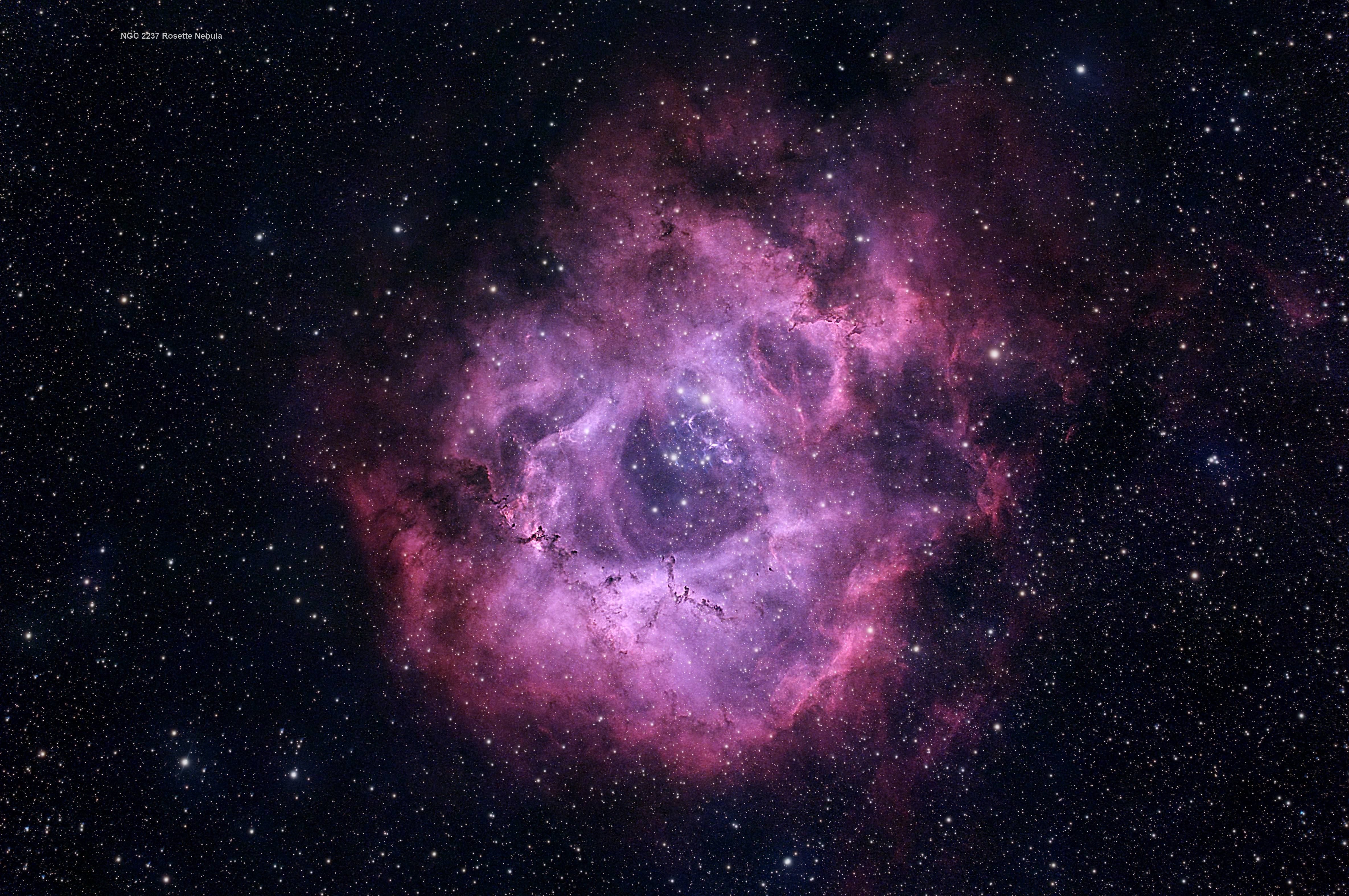
Description: : The Rosette Nebula, catalogued NGC 2237 is a flowery emission nebula composed of hot hydrogen gas, giving it its reddish color.
Inside the nebula lies an open cluster of bright young stars designated NGC 2244.
These stars formed about four million years ago from the nebular material and their stellar winds are clearing a hole in the nebula's center and causing the hydrogen gas to glow.
The radiation from the young stars excites the atoms in the nebula, causing them to emit radiation themselves producing the emission nebula we see.
The mass of the nebula is estimated to be around 10,000 solar masses.
The open cluster NGC 2244 (Caldwell 50) is closely associated with the nebulosity, the stars of the cluster having been formed from the nebula's matter.
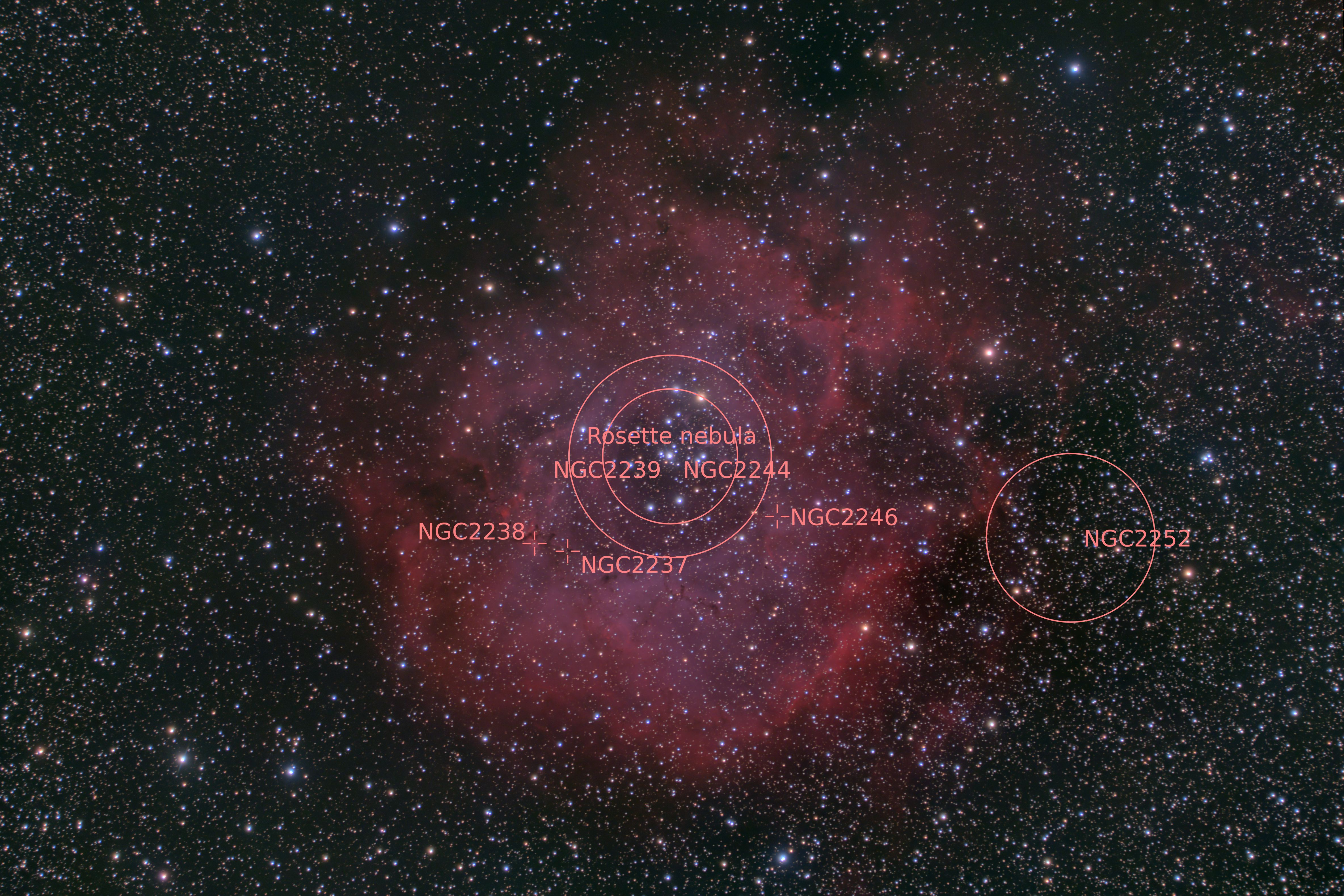
It is large enough that while NGC 2237 refers to the whole round shaped nebula, different parts of the nebula receive different NGC denominations.
The complex has the following New General Catalogue (NGC) designations:
NGC 2237 – Part of the nebulous region (Also used to denote whole nebula)
NGC 2238 – Part of the nebulous region
NGC 2239 – Part of the nebulous region (Discovered by John Herschel)
NGC 2244 – The open cluster within the nebula (Discovered by John Flamsteed in 1690)[citation needed]
NGC 2246 – Part of the nebulous region
While it is quite bright, it has a low surface brightness which makes it difficult to observe.
The young stars in the nebula’s center are gravitationally bound to each other; they are an open cluster formed together from the material of the nebula.
The Rosette Nebula is one of the largest, most beautiful, and also most popular targets for amateur astrophotographers.
The nebula has been noted to be having a shape reminiscent of a human skull, and is sometimes referred to as the "Skull Nebula." It is not to be confused with NGC 246, which is also nicknamed the "Skull Nebula.
A survey of the nebula with the Chandra X-ray Observatory has revealed the presence of numerous new-born stars inside optical Rosette Nebula and studded within a dense molecular cloud.
Altogether, approximately 2500 young stars lie in this star-forming complex, including the massive O-type stars HD 46223 and HD 46150, which are primarily responsible for blowing the ionized bubble.
Most of the ongoing star-formation activity is occurring in the dense molecular cloud to the south east of the bubble.
Click Below Image(s) for Full Size:
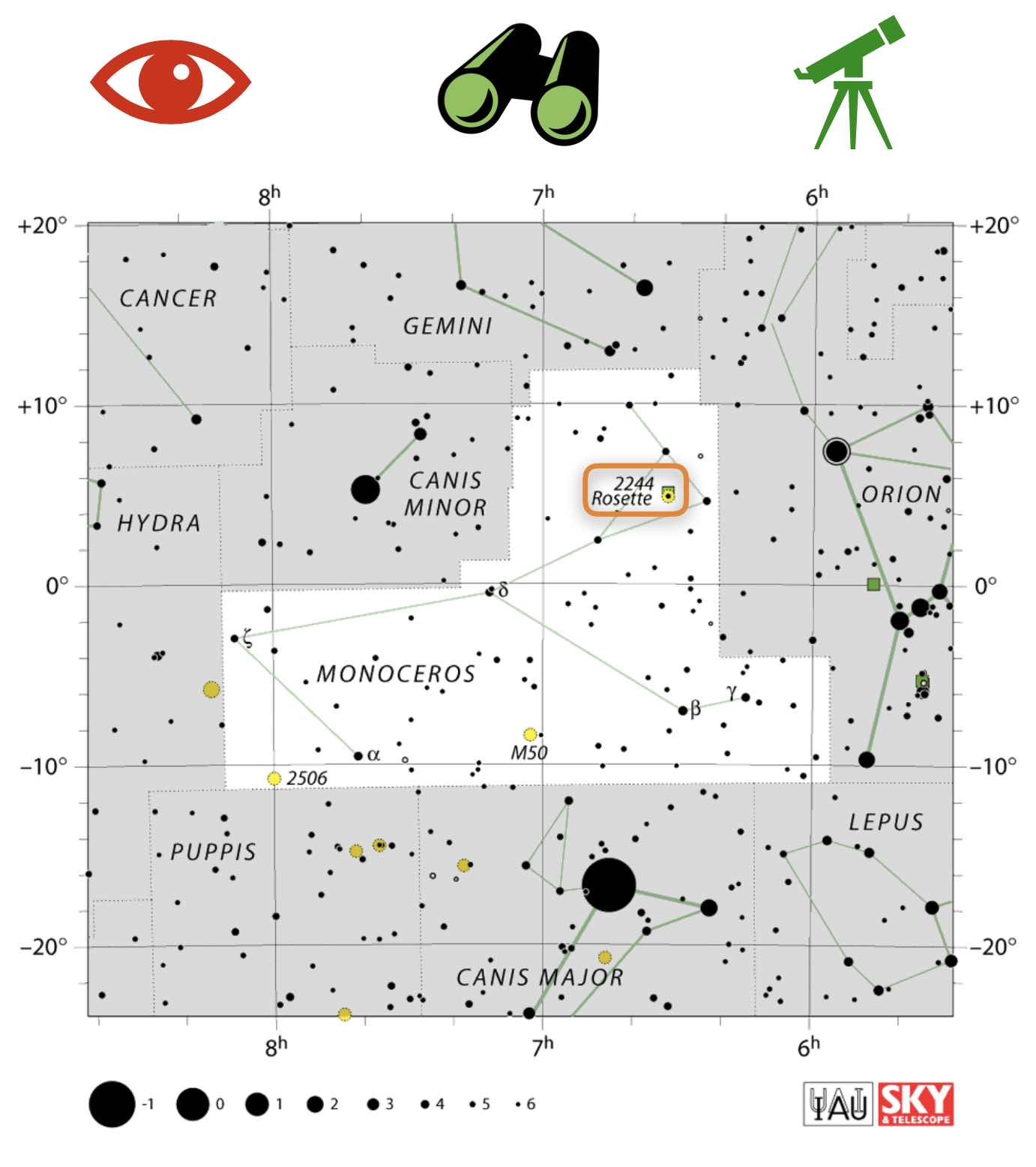
It is best observed in Winter and is located in the constellation of the unicorn: Monoceros.
Platesolve
NGC 2237 Rosette Nebula
Imaging Details
Click to Return to Home Page