Caldwell 48
Also Known as: NGC 2775, PGC 25861, UGC 4820
Object Type: Spiral Galaxy
Constellation: Cancer
Distance from Earth: 67 million light years
Apparent Magnitude: 10.4
Coordinates: RA 09H 10M 20.112S DEC 07 deg 02 min 16.53 sec
Actual Size: 83,805 light years
Apparent Dimensions: 4.3 arcminutes x 3.3 arcminutes
Discovered by: On 19 December 1783 William Herschel found a «bright nebula» which he logged as I 2 (NGC 2775) and noted: «considerably bright, considerably large,
very gradually brighter in the middle, having a nucleus, round»
The other two nearby faint and small galaxies in (NGC 2773 and NGC 2777) were discovered on 6 March 1864 by the German astronomer Albert Marth in Malta, using William Lassell's 48-inch reflector.3
Description:
NGC 2775 has a morphological classification of SA(r)ab, which indicates an unbarred spiral galaxy (SA) with a prominent ring structure (r) and flocculent, tightly wound spiral arms (ab).
The galaxy is inclined by an angle of 44° to the line of sight from the Earth.
The galactic nucleus is not active and the large nuclear bulge, which extends out to an angular radius of 0.4′, is relatively gas free. An explanation for the latter could be a high supernova rate.
Although star formation is taking place in the dusty outer ring, NGC 2775 does not display any current starburst activity, and the galactic nucleus is virtually free of any star formation whatsoever.
The galaxy's hydrogen tail feature indicates a past interaction with a faint companion. A satellite galaxy appears to have orbited NGC 2775 multiple times,
losing mass as it did so and creating faint, shell-like structures.
Nearby irregular galaxy NGC 2777 displays a tidal tail of hydrogen gas that points back to NGC 2775, suggesting the two may be linked.
NGC 2775 belongs to the Antlia-Hydra Cluster of galaxies and is the most prominent member of the NGC 2775 Group (also known as LGG 169), a small galaxy group in the Virgo Super-cluster, along with the Local Group.
Other members of the NGC 2775 Group include NGC 2777 and UGC 4781.
NGC 2775 sports a smooth, featureless center that is devoid of gas, resembling an elliptical galaxy. It also has a dusty ring with patchy star clusters, like a spiral galaxy.
Which is it, then: spiral or elliptical -- or neither?
Because we can only view NGC 2775 from one angle, it's difficult to say for sure. Some researchers have classified NGC 2775 as a spiral galaxy because of its feathery ring of stars and dust,
while others have classified it as a lenticular galaxy. Lenticular galaxies have features common to both spiral and elliptical galaxies.
Click Below Image(s) for Full Size:
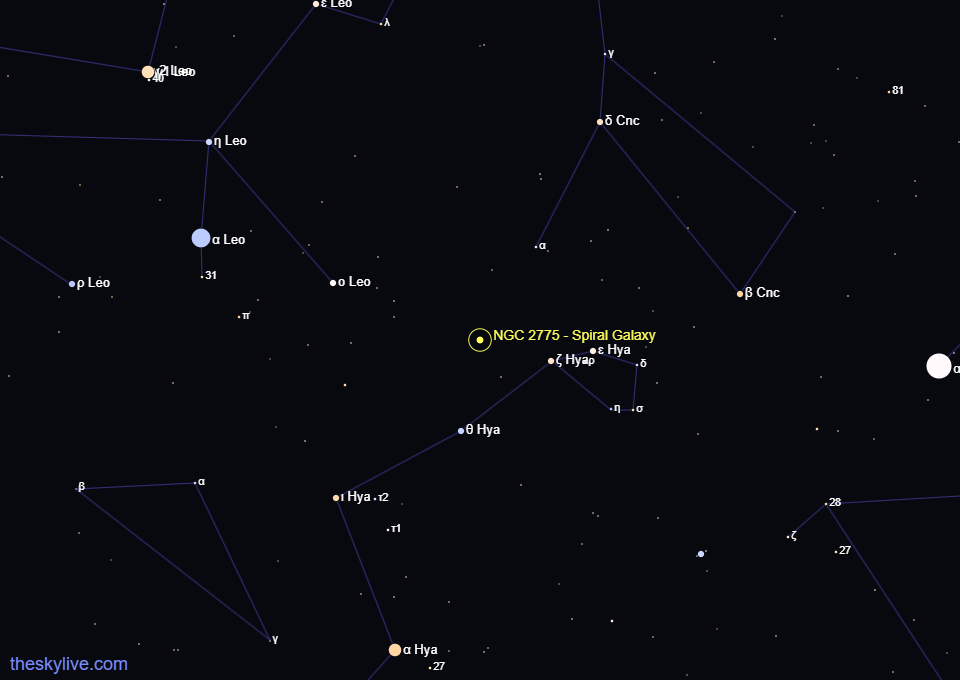
NGC 2775 is a Spiral Galaxy in the Cancer constellation. NGC 2775 is situated close to the celestial equator and, as such, it is at least partly visible from both hemispheres in certain times of the year.
Given its visual magnitude of 10.48, NGC 2775 is visible with the help of a binocular with a 80mm aperture or a small telescope.
Platesolve
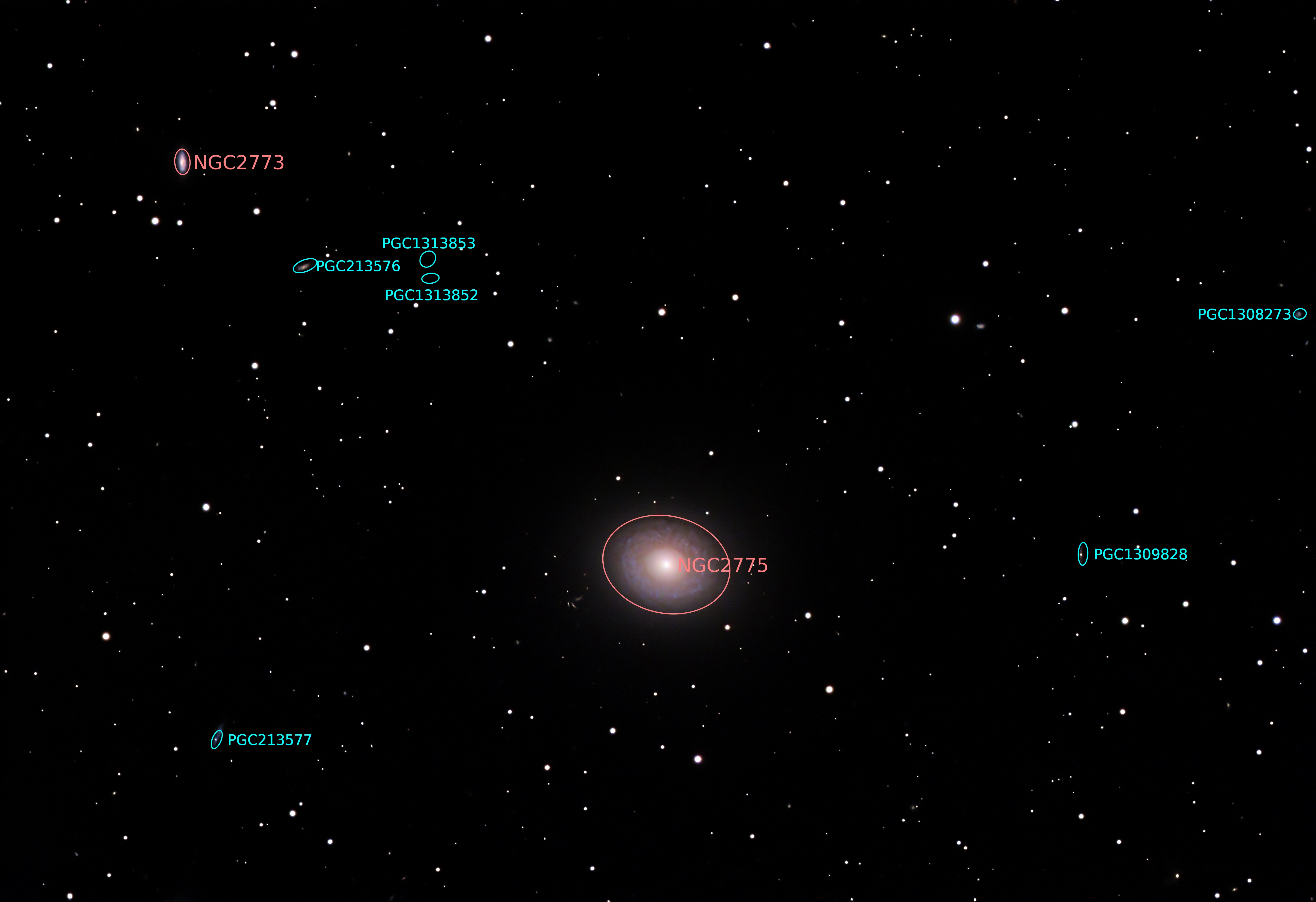
NGC 2775 Galaxy

Imaging Details
Click to Return to Home Page