Caldwell 23
Common Name: Silver Sliver Galaxy
Also Known as: NGC 891, Outer Limits Galaxy, UGC 1831
Object Type: Unbarred Spiral Galaxy
Constellation: Andromeda
Distance from Earth: 27.3 million light years
Apparent Magnitude: 10.8
Coordinates: RA 02H 22M 33.4S DEC 42 deg 20 min 57 sec
Actual Size: 107,000 light years
Apparent Dimensions: 13.5 arc-minutes x 2.5 arc-minutes
Discovered by: NGC 891 was discovered by William Herschel on October 6, 1784.
Description: NGC 891 looks as the Milky Way would look like when viewed edge-on.
Despite this, recent high-resolution images of its dusty disk show unusual filamentary patterns.
These patterns are extending into the halo of the galaxy, away from its galactic disk.
Scientists presume that supernova explosions caused this interstellar dust to be thrown out of the galactic disk toward the halo.
The bulge and the disk are surrounded by a flat and thick cocoon-like stellar structure.
NGC 891 appears alongside M67, the Sombrero Galaxy, the Pinwheel Galaxy, NGC 5128, NGC 1300, M81, and the Andromeda Galaxy in the end credits of the Outer Limits TV series,
which is why it is occasionally called the Outer Limits Galaxy.
These patterns are extending into the halo of the galaxy, away from its galactic disk. Scientists presume that supernova explosions caused this interstellar dust to be thrown out of the galactic disk toward the halo.
The galaxy is a member of a small group of galaxies, sometimes called the NGC 1023 Group. Other galaxies in this group are the NGCs 925, 949, 959, 1003, 1023, and 1058, and the UGCs 1807, 1865 (DDO 19), 2014 (DDO 22), 2023 (DDO 25), 2034 (DDO 24), and 2259.
Its outskirts are populated by multiple low-surface brightness, coherent, and vast substructures, like giant streams that loop around the parent galaxy up to distances of approximately 50 kpc.
The bulge and the disk are surrounded by a flat and thick cocoon-like stellar structure.
These have vertical and radial distances of up to 15 kpc and 40 kpc, respectively, and are interpreted as the remnant of a satellite galaxy disrupted and in the process of being absorbed by NGC 891.
Click Below Image(s) for Full Size:
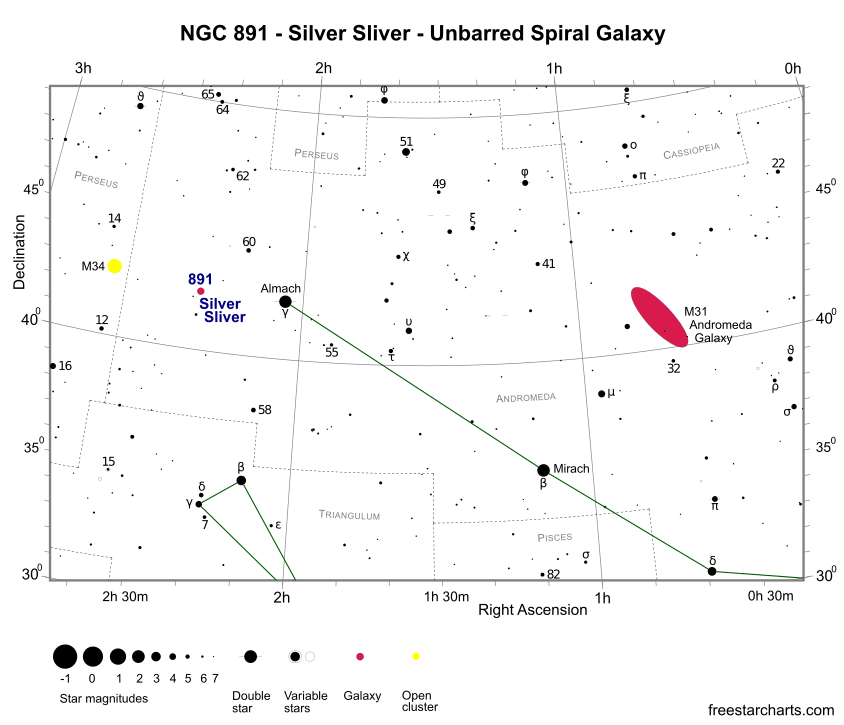
The object is visible in small to moderate size telescopes as a faint elongated smear of light with a dust lane visible in larger apertures.
The best time to observe NGC 891 is October through December
Platesolve
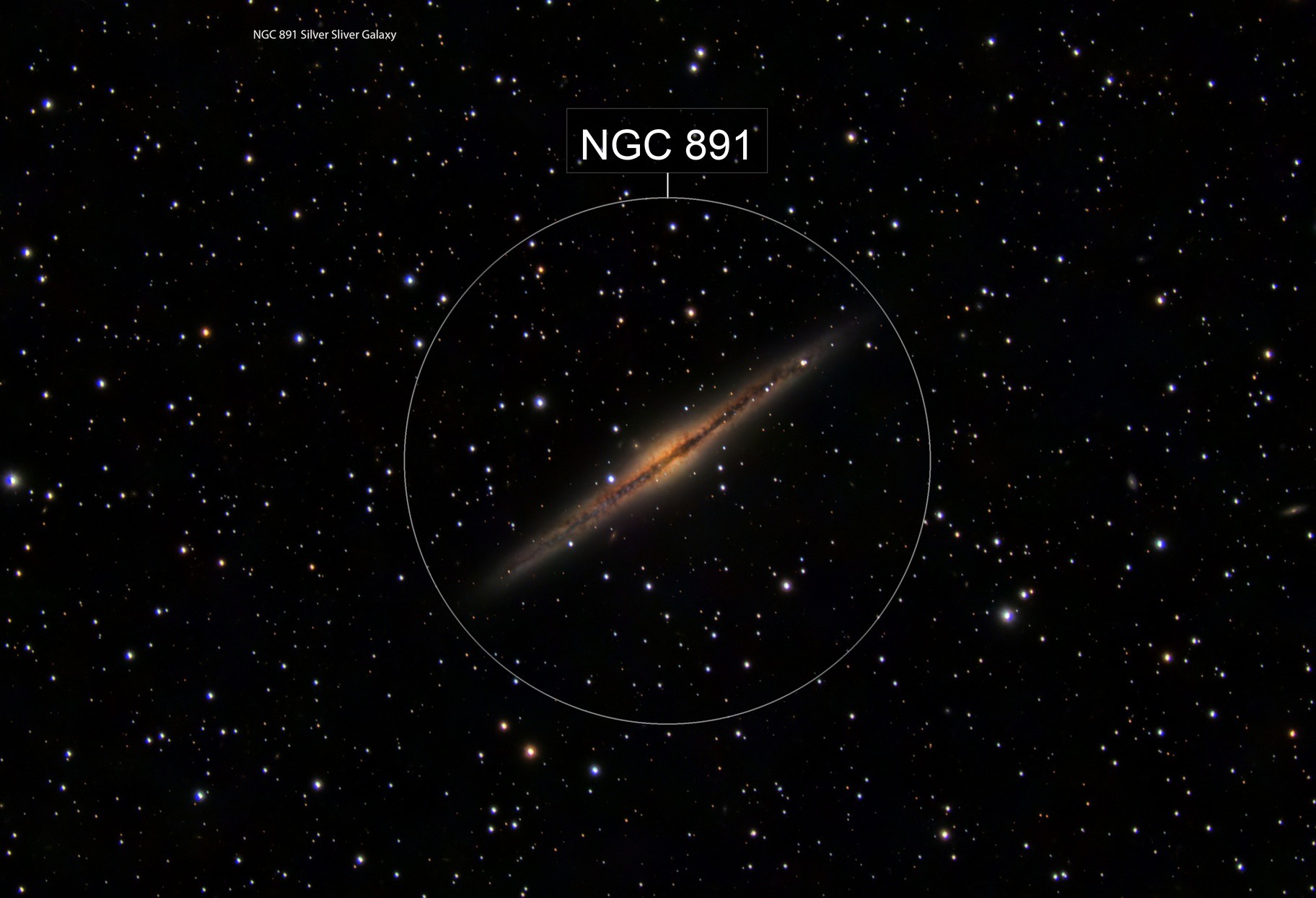
NGC 891 Galaxy

Imaging Details
Click to Return to Home Page