'The Night Sky Observer's Guide' Review
Description of problem: There so many unique deep sky objects it is sometimes difficult to decide which objects I want to either observe or image on any given night. 'The Night Sky Observer's Guide' helps me plan both my observing and imaging sessions.
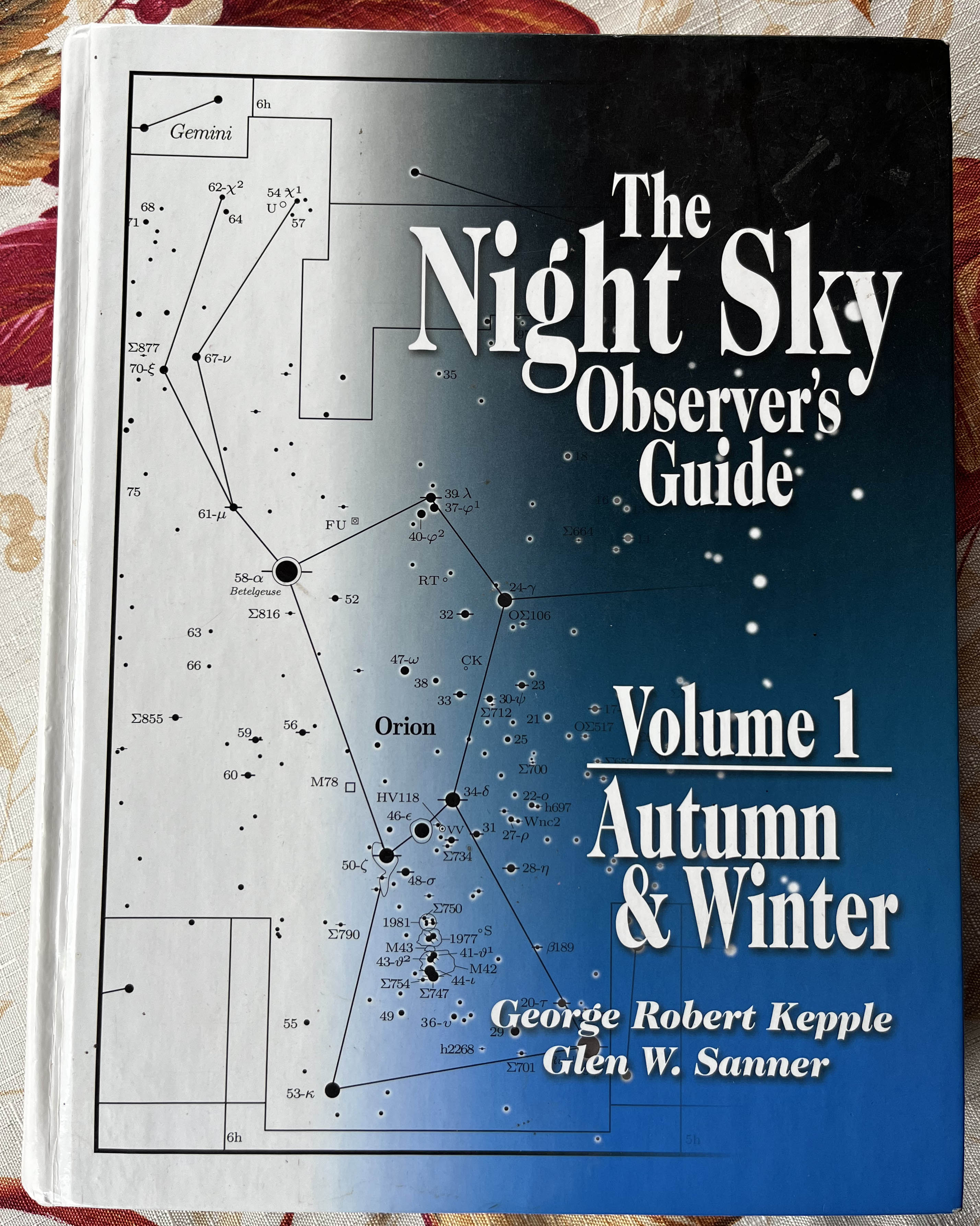
Description of books: 'The Night Sky Obserer's Guide' is a set of four volumes. Volume #1 covers Autumn & Winter, Volumen # 2 covers Spring & Summer, Volume #3 Covers the Southern Sky, and Volume #4 is 'The Glories of the Milky Way to -54 degrees'.
I have Volumes #1, #2, and #4.
The books are hard-bound and each has over 400 pages.
Each volumne costs between $35 and $40.
Author: Volumes #1, #2, and #3 ....George Robert Kepple & Glen W. Sanner. Volume #4 George Robert Kepple.
Details: Volume #1 starts with an introduction describing all of the different types of deep sky objects such as stars, star clusters, nebulae, and galaxies. This section is basically a turorial about each of the types of deep sky objects.
The second section focuses on observation of deep sky objects. This section is basically a primer on how to observe dep sky objects.
The remainder of Volume #1 is in-depth details of everything that is visible in each of the constellations in the autumn and winter months.
Each chapter is a different constellation done in alphabtical order starting with Andromeda and ending with Triangulum.
Each chapter gives and overview of the constellation, a summary of interesting stars, and details on all of the deep sky objects.
Each deep sky object is identified along with either a picture or a drawing, and a writeup which includes position, description, and how it is seen in different telescopes.
Volume #2 is in-depth details of everything that is visible in each of the constellation in the spring & summer months months.
Each chapter is a different constellation done in alphabtical order starting with Antlia and ending with Vulpecula and includes all of the same types of information as Volume #1.
Volume #3 covers the skies in the southern hemisphere.
Volume #4 focusees on the Milky Way. The 1st chapter provides background on observing the Milky Way along with details concerning each type of object.
The following chapters are similar to Volumes #1 and Volume #2 starting with the constellation Antlia and ending with Vulpecula.
How used: I use 'The Night Sky Observer's Guide' Volume #1 and Volume #2 to help me to plan both my observing and imaging sessions.
If I am going to have an observing session, I first determine which constellations will be highest in the sky where the seeing will be best.
I then go to the chapter(s) with the most appropriate constellation(s) and thumb though the pages looking for objects that I may not have seen before... or I may want to re-visit.
I generally make a list of potential interesting targets for the planned night.
If I am going to have an imaging session, the day of the session I will determine the constellations that are most appropriate for that night.
If there is no Moon, I generally start with constellations that are just rising in the East at dusk.
This gives me all night to image any object in that constellation.
If the Moon is going to be a problem, I determine which constellations will be furthest from the Moon.
Again I make a list of potentially interesting targets for the night by scanning thought the appropriate constellations.
Whether I am observing or imaging, I always take 'The Night Sky Observer's Guide' with me to the observatory when I am either observing or imaging to use as a reference or if my plans change.
Summary: I find 'The Night Sky Observer's Guide' to be an invaluable tool to help me decide which objects that I want to either observe or image.
'The Night Sky Observer's Guide' is always with me in my observaotry and I use it as a refernce.
Click Below Image(s) for Full Size:
The Night Sky Observer's Guide
Click to Return to Home Page