NGC 7788 & NGC 7790 Open Clusters
Also Known as:
Object Type: Open Cluster
Constellation: Cassiopeia
Distance from Earth: 5,000 light years (NGC 7788) & 10,800 light years (MGC 7790)
Apparent Magnitude: 9.4 (NGC 7788) & 8.5 (NGC 7790)
Coordinates: RA 23H 56M 0S DEC 61 deg 24 min 00 sec (NGC 7788) ... RA 23H 58M 24.2S DEC 61 deg 12 min 30 sec (NGC 7790)
Actual Size: 5 light years in diameter (NGC 7788) ... 15 light years in diameter (NGC 7790)
Apparent Dimensions: 2.4 arc minutes (NGC 7788) .. 7.4 arc-minutes (NGC 7790)
Discovered by: On 16 December 1788, William Herschel discovered an open star cluster with his 18.7 inch reflector and recorded it as VII 56.
(class VII = pretty much compressed clusters of large or small stars).
He noted: «A pretty compressed cluster of small stars of several sizes, considerably rich, extended near in the direction of the parallel of declination. 5 or 6' long.
That cluster was later added as NGC 7790 to Dreyer's «New General Catalogue
Description: Although they appear similar, they lie at different distances from us.
NGC 7788 is closer at 5,000 light years away, while NGC 7790 is just over 10,000 light years away.
Both clusters look similar, with many bright blue stars, a sprinkle of orange stars, and similar star densities.
The brightest orange star in NGC 7790 is a binary star and appears as a slight oval in the image.
The open star cluster NGC 7788 is of the Trumpler type I2p. The age of this relatively young star cluster is estimated at 20-40 million years.
It is of a surrounded by a stellar halo extending out to a radius of 5 arc minutes (about 3.4 pc) from an early mass ejection.
It is slightly older than its neighbor NGC 7788 with an estimated age of 60-80 million years Evidence of a halo.
Both star clusters are believed to have originated in the same star-forming region but not in the same molecular cloud.
NGC 7790 has been the subject of numerous studies, largely due to three Cepheid variables making the cluster an important rung in the cosmic distance ladder.
NGC 7790 has a Trumpler class rating of II2m[2] and the estimated age is 60–80 million years. It contains three cepheid variables: CEa Cas, CEb Cas, and CF Cas.
Click Below Image(s) for Full Size:
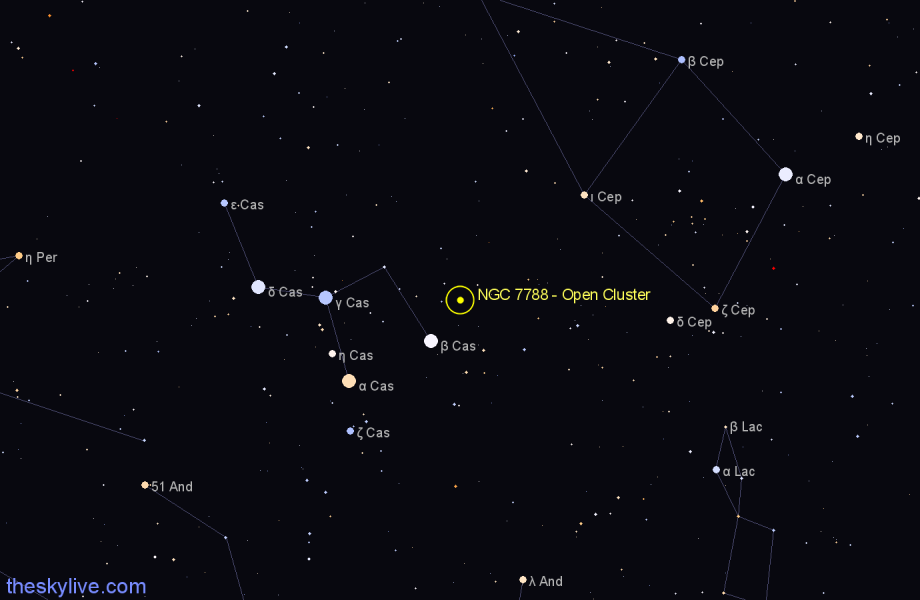
NGC 7788 is situated close to the northern celestial pole and, as such, it is visible for most part of the year from the northern hemisphere.
NGC 7788 & NGC 7790 is best viewed late fall through winter.
Platesolve
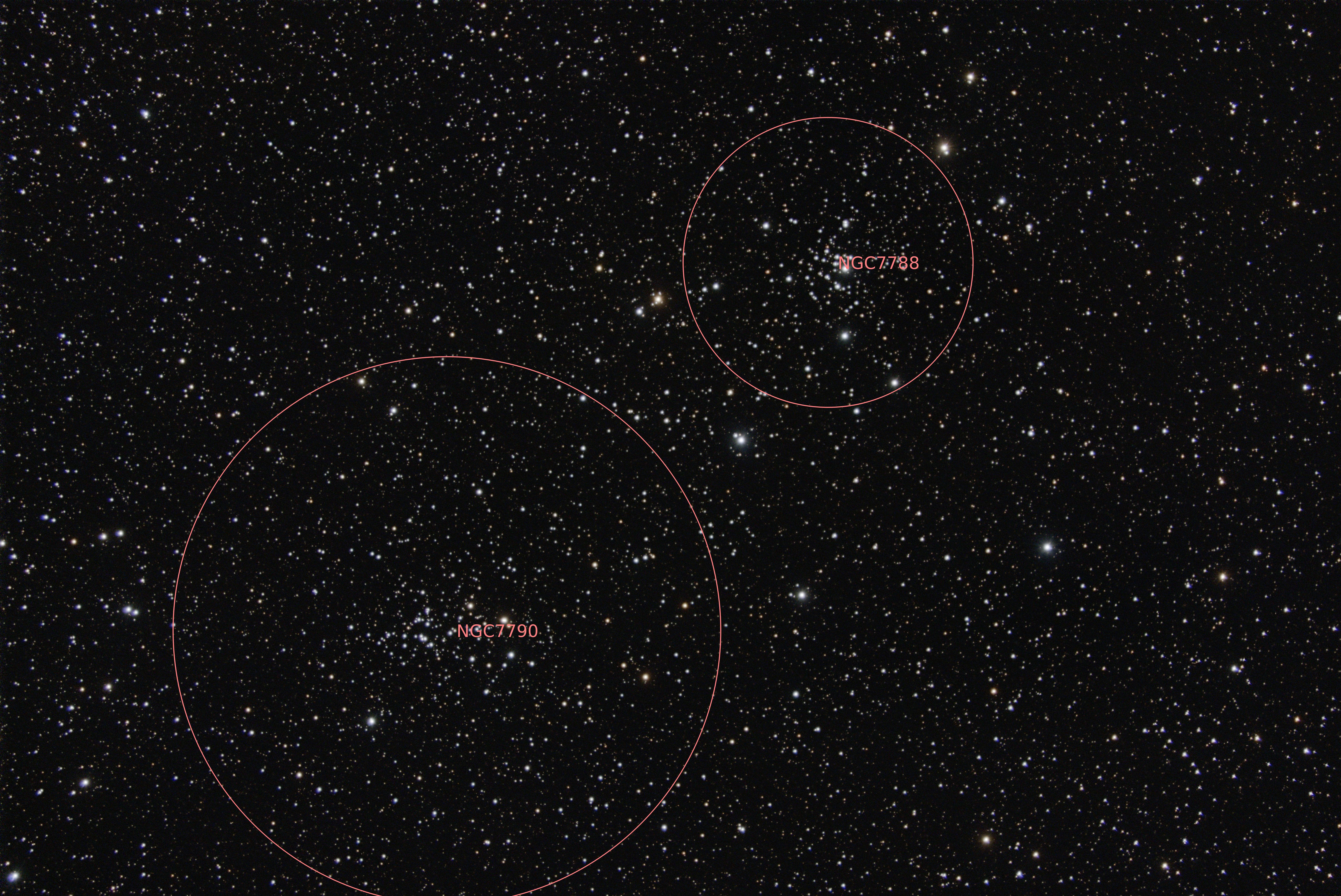
NGC 7788 & NGC 7790 Open Clusters

Imaging Details
Click to Return to Home Page