NGC 7769, NGC 7770, NGC 7771
Also Known as:
Object Type: Galaxies
Constellation: Pegasus
Distance from Earth: 200 million light years
Apparent Magnitude: 12.3 (NGC 7771), 14.4 (NGC 7770), 12.8 (NGC 7769)
Coordinates: RA 23H 51M 24.6S DEC 20 deg 06 min 44 sec (NGC 7771)
Actual Size: 75,000 light years in diameter (NGC 7771)
Apparent Dimensions: 3.2 arc-minutes x 2.7 arc-minutes (NGC 7769), 0.7 arc-minutes x 0.4 arc-minutes (NGC 7770), 2.4 arc-minutes x 1.1 arc-minutes (NGC 7771).
Discovered by: The three galaxies were discovered on 18 September 1784 by the German-British astronomer William Herschel with his 18.7 inch reflecting telescope.
He cataloged them as II 230 (NGC 7769) and II 231 (NGC 7770 and NGC 7771). Herschels class II stood for faint nebulae.
The group, visible in the constellation Pegasus, was discovered by Édouard Stephan in 1877 at the Marseille Observatory.
Description: NGC 7771 is the large, edge-on spiral near center, about 75,000 light-years across, with two smaller galaxies near by.
Large spiral NGC 7769 is seen face-on to the right.
Galaxies of the NGC 7771 group are interacting, making repeated close passages that will ultimately result in galaxy-galaxy mergers on a cosmic timescale.
The interactions can be traced by distortions in the shape of the galaxies themselves and faint streams of stars created by their mutual gravitational tides.
But a clear view of this galaxy group is difficult to come by as the deep image also reveals extensive clouds of foreground dust sweeping across the field of view.
The dim, dusty galactic cirrus clouds are known as Integrated Flux Nebulae. The faint IFN reflect starlight from our own Milky Way Galaxy and lie only a few hundred light-years above the galactic plane.
NGC 7771 is undergoing a massive star formation spurt, which may have been caused by the dwarf galaxy NGC 7770.
This appears to be in the early stages of a merger with NGC 7771. The resulting tidal disturbances may have caused the apparent two-armed spiral pattern and forced a significant portion of the disk gas inward.
Both NGC 7770 and NGC 7771 appear to be slightly distorted from a gravitational interaction. All three appear to be spiral galaxies with all of them appearing to have a lot of star formation going on from the brightness in the UV images from GALEX.
NGC 7771 is also classified as a luminous infrared galaxy (LIRG) starburst which also suggests that a lot of star formation going on is hidden by dust.
The group appears to have been interacting for some time as there are numerous star streams in the group. Over cosmic time all three galaxies are likely to merge.
Click Below Image(s) for Full Size:
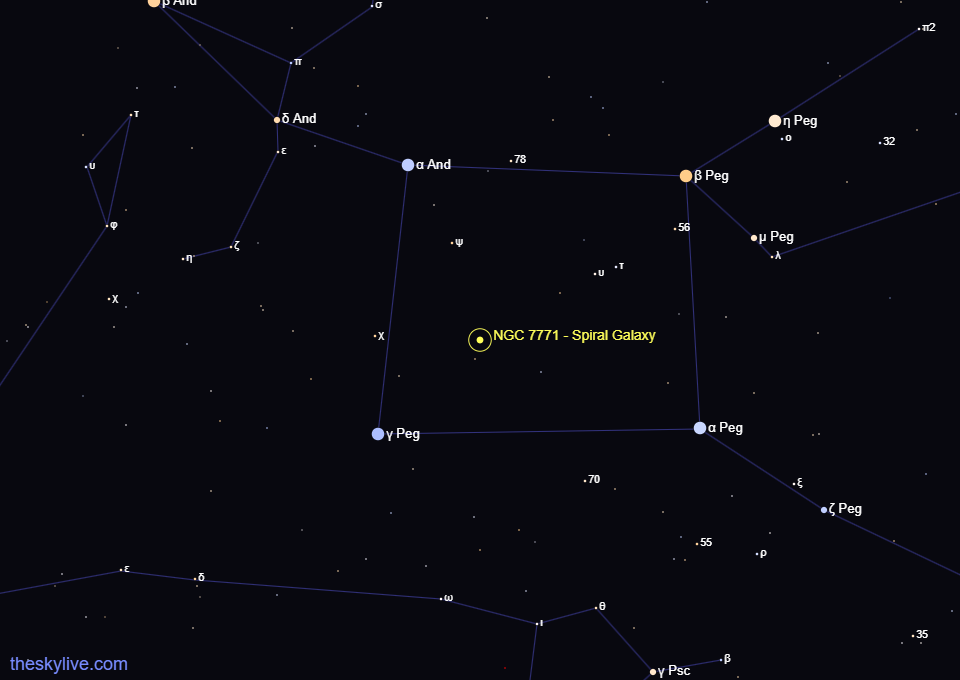
NGC 7771 is situated close to the celestial equator and, as such, it is at least partly visible from both hemispheres in certain times of the year.
Given its visual magnitude, NGC 7771 is visible with the help of a telescope having an aperture of 8 inches (200mm) or more.
Given its visual magnitude, NGC 7320 is visible with the help of a telescope having an aperture of 10 inches (250mm) or more.
The best observation time is June to March, when it is highest at night.
Platesolve
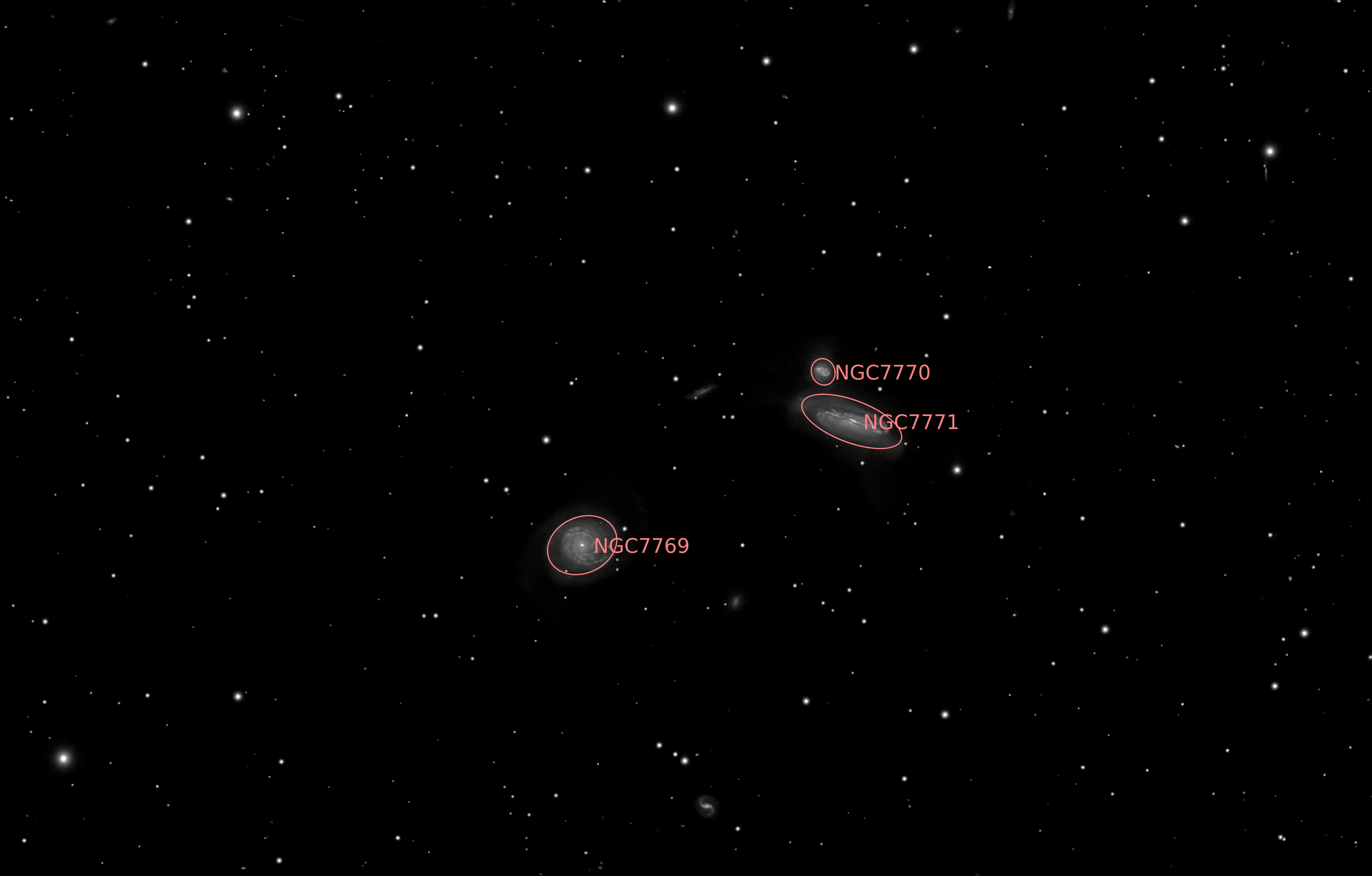
NGC 7769, NGC 7770, NGC 7771 Galaxies

Imaging Details
Click to Return to Home Page