NGC 772 and NGC 770
Common Name: Fiddlehead Galaxy (NGC 772)
Also Known as: PGC 7525, UGC 1466, Arp 78 (NGC 772), UGC 1463, PGC 7517 (NGC 770)
Object Type: Unbarred Spiral Galaxy (NGC 772), Elliptical (NGC 770)
Constellation: Aries
Distance from Earth: 105.7 million light years (NGC 772), 120 million light years (NGC 770)
Apparent Magnitude: 11.4 (NGC 772), 13.49 (NGC 770)
Coordinates: RA 01H 59M 19.5443S DEC 19 deg 00 min 27.751 sec (NGC 772), RA 01H 59M 13.6426S DEC 18 deg 57 min 16.7211 sec (NGC 770)
Actual Size: 200,000 light years in diameter (NGC 772), 36,000 light years (NGC 770)
Apparent Dimensions: 7.2 arc-minutes x 4.3 arc-minutes (NGC 772), 0.587 arcminutes x 0.399 arcminutes (NGC 770)
Discovered by: NGC 772 was discovered by German-British astronomer William Herschel on 29 November 1785.
NGC 770 was discovered on November 3, 1855 by R. J. Mitchell.
Description: At around 200,000 light years in diameter, NGC 772 is somewhat larger than the Milky Way Galaxy, and is surrounded by several satellite galaxies – including the dwarf elliptical,
NGC 770 – whose tidal forces on the larger galaxy have likely caused the emergence of a single elongated outer spiral arm that is much more developed and stronger than the others arms.
Halton Arp includes NGC 772 in his Atlas of Peculiar Galaxies as Arp 78, where it is described as a "Spiral galaxy with a small high-surface brightness companion".
The spiral galaxy named NGC 772 has much in common with our home galaxy, the Milky Way. Each boasts a few satellite galaxies, small galaxies that closely orbit and are gravitationally bound to their parent galaxies.
One of NGC 772’s spiral arms has been distorted and disrupted by one of these satellites, leaving it elongated and asymmetrical.
However, the two are also different in a few key ways. For one, NGC 772 is both a peculiar and an unbarred spiral galaxy; respectively, this means that it is somewhat odd in size, shape, or composition,
and that it lacks a central feature known as a bar, which we see in many galaxies throughout the cosmos — including the Milky Way.
These bars are built of gas and stars, and are thought to funnel and transport material through the galactic core, possibly fueling and igniting various processes such as star formation.
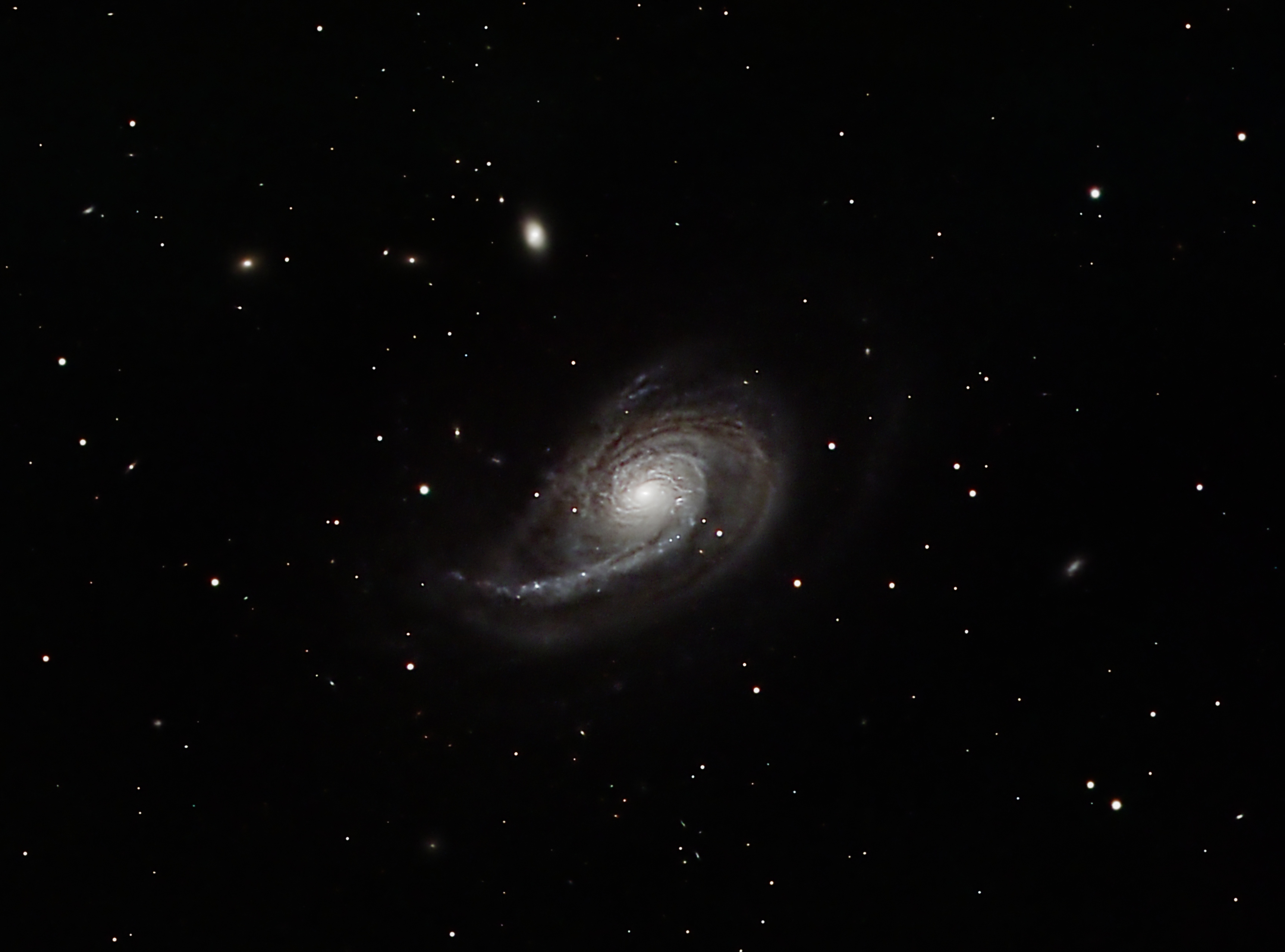
The inner disk reveals tightly wound dust lanes wrapped around a bright central bulge, with small pockets of star-forming activity embedded within the spiral arms.
These inner regions show only modest star birth, while the dominant activity is concentrated in the tidal arm where the gravitational influence of NGC 770 has enhanced gas density and ignited new star formation.
Surrounding the main galaxy is a deep background filled with distant galaxies of many types—elongated edge-on disks, orange ellipticals, and faint high-redshift systems—adding depth and structure to the field.
The combination of tidal distortion, asymmetric star-forming regions, and extensive faint outer debris makes NGC 772 a vivid example of how even a small companion can reshape the evolution of a massive spiral galaxy.
Click Below Image(s) for Full Size:
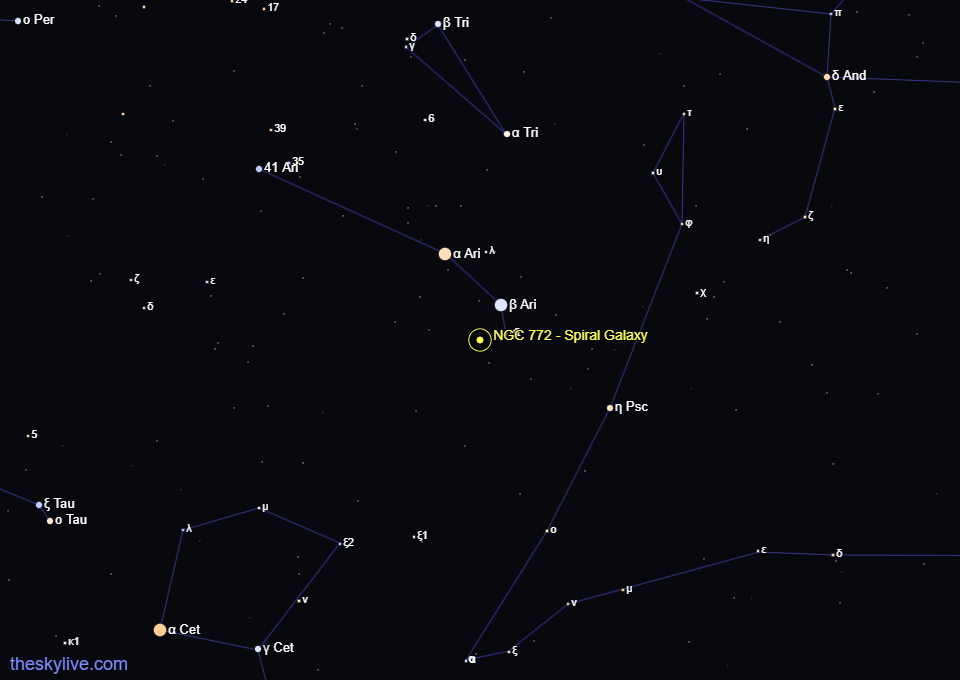
NGC 772 is situated close to the celestial equator and, as such, it is at least partly visible from both hemispheres in certain times of the year.
Given its visual magnitude, NGC 772 is visible with the help of a binocular with a 80mm aperture or a small telescope.
NGC 770 is a Elliptical Galaxy in the Aries constellation. NGC 770 is situated close to the celestial equator and, as such, it is at least partly visible from both hemispheres in certain times of the year.
Given its visual magnitude, NGC 770 is visible with the help of a telescope having an aperture of 10 inches (250mm) or more.
The best time of year to observe NGC 772 and the nearby galaxies is during the fall.
Platesolve
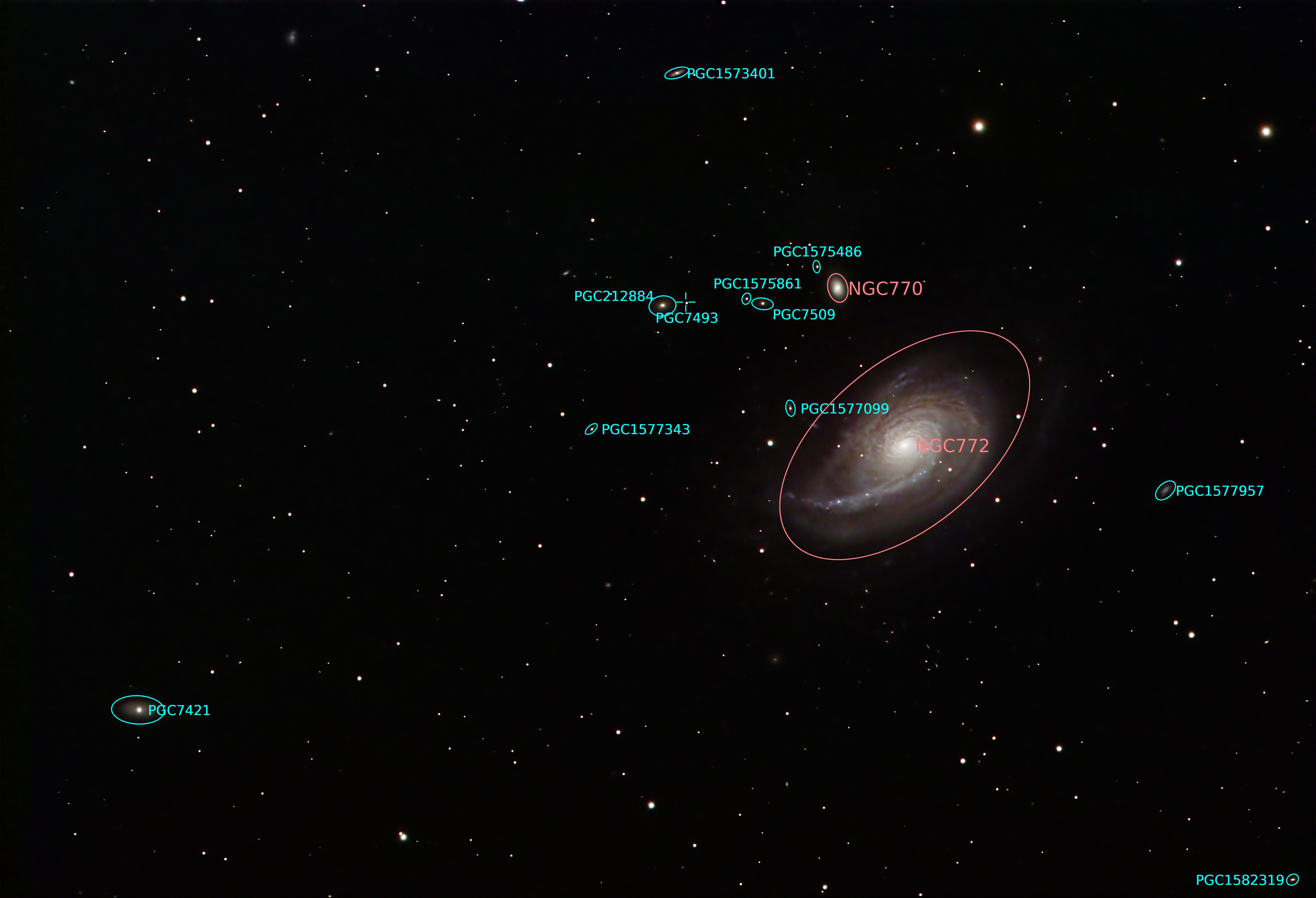
NGC 772-NGC 770 Galaxies wide field

NGC 772-NGC 770 Galaxies
Imaging Details
Click to Return to Home Page