NGC 7263, NGC 7264, NGC 7265 Galaxies
Also Known as: PGC 68642 (NGC 7263),
Object Type: Lenticular Galaxy (NGC 7263 & NGC 7265), Spiral Galaxy (NGC 7264)
Constellation: Lacerta
Distance from Earth: 270 to 283 million light years (NGC 7263), 250 million light years (NGC 7264), 220 million light years (NGC 7265)
Apparent Magnitude: 15.7 (NGC 7263), 14.7 (NGC 7264)
Coordinates: RA 22H 22M 53S DEC 36 deg 28 min 48 sec (NGC 7263), RA 22H 23M 22S DEC 36 deg 31 min 02 sec (NGC 7264), RA 22H 23M 22S DEC 36 deg 31 min 02 sec (NGC 7264)
Actual Size: 235,000 light year in diameter (NGC 7265)
Apparent Dimensions: 0.94 arc-minutes x 0.76 arc-minutes (NGC 7263), 1.99 arc-minutes x 0.3 arc-minutes (NGC 7264)
Discovered by: NGC 7263 and NGC 7264 were discovered by the German astronomer Albert Marth on September 9, 1863. At the time, Marth was working at the observatory of William Lassell on the island of Malta.
NGC 7265 itself was discovered by Edouard Stephan in 1876 using a 31” sliver on glass reflector.
Description: NGC 7265 itself is an E/S0 galaxy with an active core. NED currently leans towards giving NGC 7265 a classification of S0 (lenticular).
This type of galaxy is normally only found in galaxy clusters so it must be possible that the NGC 7265 group is or has been associated with a much larger group.
The distance to the group is probably of the order of 73 Mpc. The whole group appears to be associated with the Perseus super cluster of galaxies.
NGC 7263 does not appear to be part of the same group of galaxies.
Click Below Image(s) for Full Size:
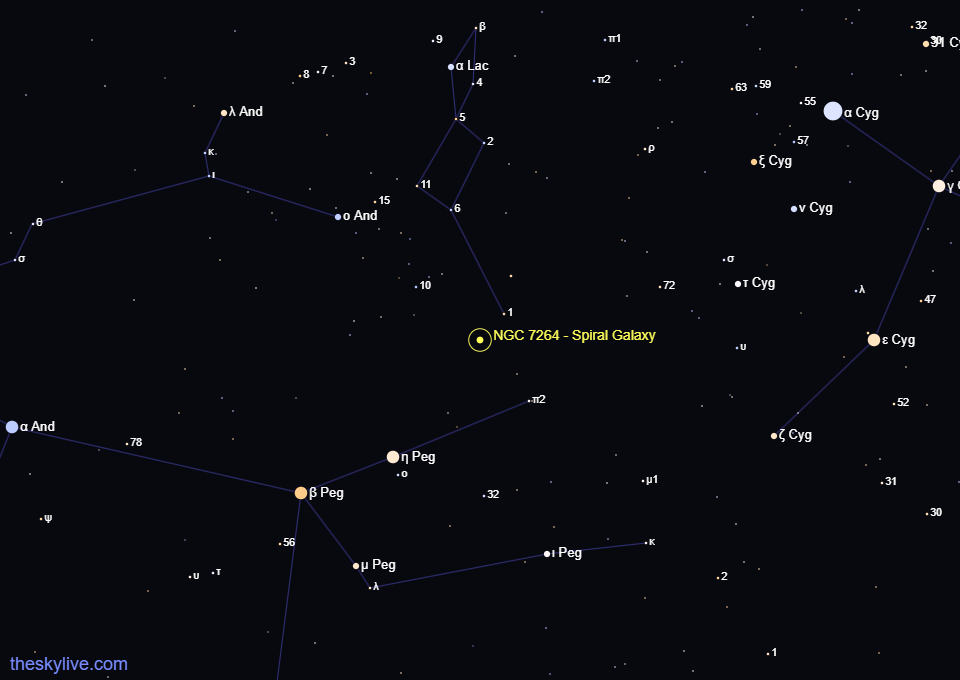
NGC 7263 is a Lenticular Galaxy in the Lacerta constellation. NGC 7263 is situated north of the celestial equator and, as such, it is more easily visible from the northern hemisphere.
Given its B magnitude of 15.7, NGC 7263 is visible only through long exposure photography.
NGC 7264 is a Spiral Galaxy in the Lacerta constellation. NGC 7264 is situated north of the celestial equator and, as such, it is more easily visible from the northern hemisphere.
Given its B magnitude of 14.7, NGC 7264 is visible with the help of a telescope having an aperture of 20 inches (500mm) or more.
The galaxies is best observed in late summer to early winter months when Lacerta is high in the night sky.
Platesolve
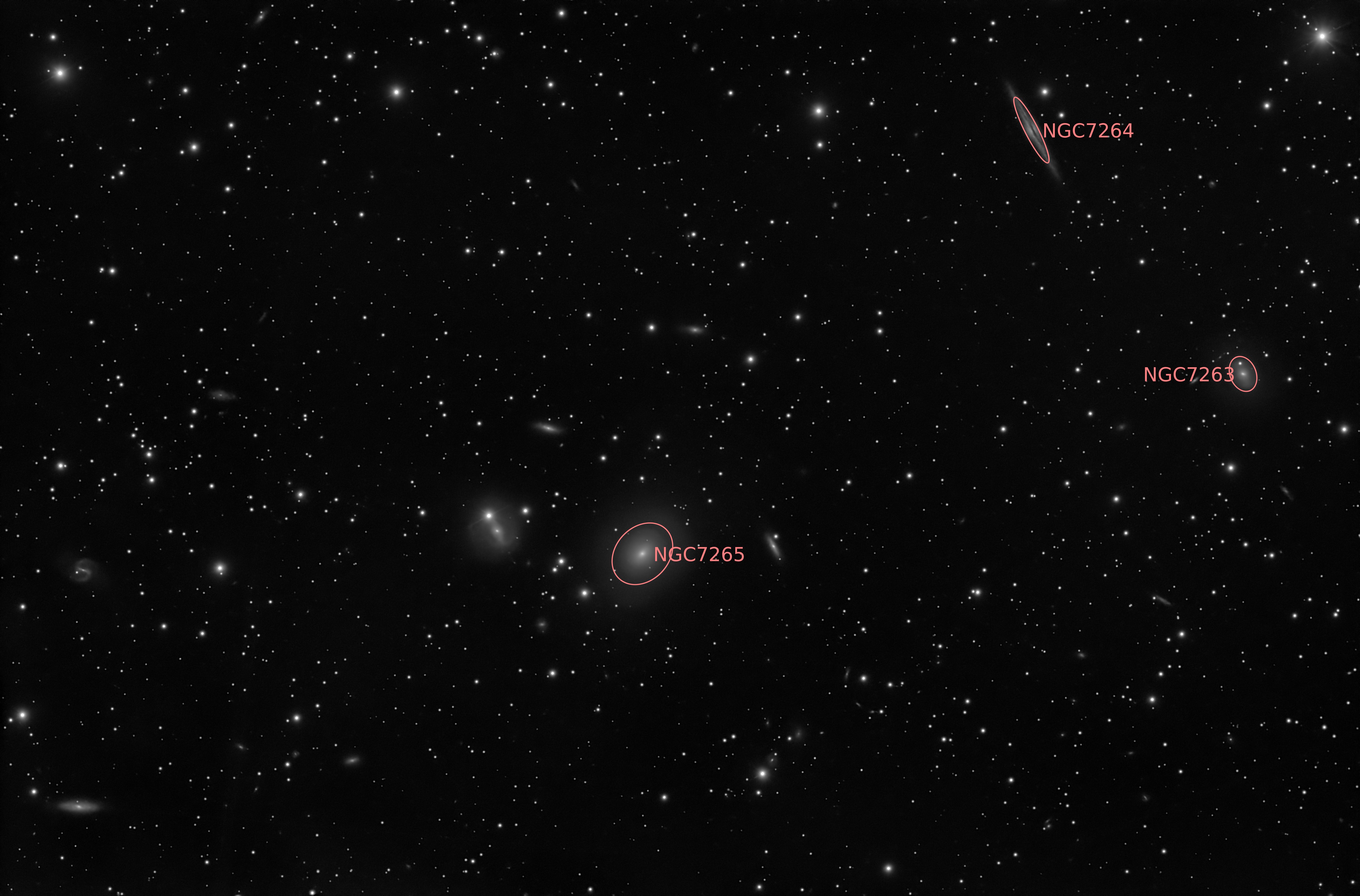
NGC 7263, NGC 7264, NGC 7265 Galaxies

Imaging Details
Click to Return to Home Page