NGC 6939 & NGC 6946
Common Name: Fireworks Galaxy (NGC 6946)
Also Known as: NGC 6939 Melotte 231, NGC 6946 Caldwell 12, UGC 11597
Object Type: Open Cluster (NGC 6939), Intermediate Spiral Galaxy (NGC 6946)
Constellation: Boundary of Cepheus and Cygnus
Distance from Earth: 3,830 light years (NGC 6939), 25.2 million light years (NGC 6946)
Apparent Magnitude: 7.8 (NGC 6939), 9.6 (NGC 6946)
Coordinates: RA 20H 31M 30S DEC 60 deg 39 min 42 sec (NGC 6939), RA 20H 34M 52.3S DEC 60 deg 09 min 14 sec (NGC 6946)
Actual Size: 87,300 light years in diameter (NGC 6946)
Apparent Dimensions: 7 arc-minutes (NGC 6939), 16 arc-minutes x 11.2 arc-minutes (NGC 6946)
Discovered by: NGC 6939 is an open cluster in the constellation Cepheus. It was discovered by William Herschel in 1798.
NGC6946 was discovered by William Herschel on 9 September 1798
Description: NGC 6939 is an old open cluster, located 400 parsec above the galactic plane and 8.400 parsec away from the galactic center.
The age of the cluster was estimated to be between 1.0 and 1.3 billion years.
NGC 6946 is a face-on galaxy, which means that we see the galaxy “facing” us, rather than seeing it from the side (known as edge-on).
The Fireworks Galaxy is further classified as an intermediate spiral galaxy and as a starburst galaxy.
The former means the structure of NGC 6946 sits between a full spiral and a barred spiral galaxy, with only a slight bar in its center,
and the latter means it has an exceptionally high rate of star formation. NGC 6946 is a marvelously handsome-looking galaxy, with its enticing ‘pinwheel’ spiral structure
set in a star-sparkling field for those imagers looking for the prettiest of pictures.
Yet, it’s also of supreme interest to science-seeking amateurs and professional astronomers alike, with its extraordinary propensity to yield exploding stars.
The galaxy NGC 6946 is nothing short of spectacular. In the last century alone, NGC 6946 has experienced 10 observed supernovae, earning its nickname as the Fireworks Galaxy. In comparison, our Milky Way averages just 1-2 supernova events per century.
This has led to its very apt nickname of ‘The Fireworks Galaxy’.
Its distance is similar to the distance of M101.
Both were once considered to be part of the Local Group, but are now known to be within the Virgo Supercluster.
Due to its prodigious star formation it has been classified as an active starburst galaxy.
NGC 6946 has also been classified as a double-barred spiral galaxy, with the inner, smaller bar presumably responsible for funneling gas into its center.
Various unusual celestial objects have been observed within NGC 6946.
This includes the so-called 'Red Ellipse' along one of the northern arms that looks like a super-bubble or very large supernova remnant.
There are also two regions of unusual dark lanes of nebulosity, while within the spiral arms several regions appear devoid of stars and gaseous hydrogen.
A third peculiar object is now known as "Hodge's Complex".
This was once thought to be a young supergiant cluster, but in 2017 it was conjectured to be an interacting dwarf galaxy superimposed on NGC 6946. .
Click Below Image(s) for Full Size:
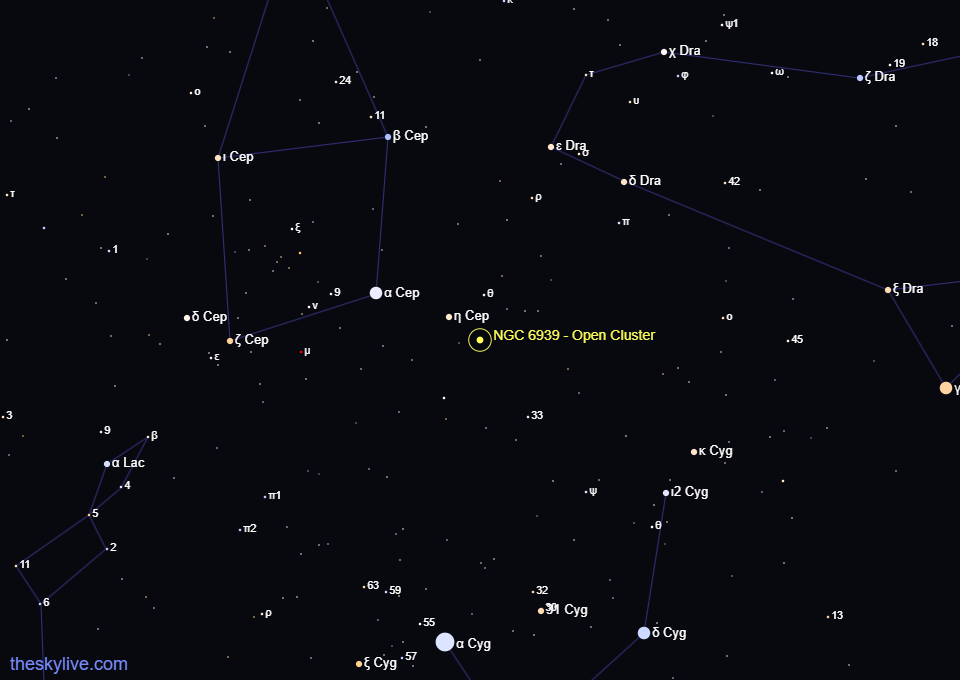
Straddling the boundary between the constellations of Cygnus and Cepheus on August nights it’s splendidly placed for observation.
NGC 6939 can be seen and glimpsed with 7x35 binoculars where as 25x200 binoculars are required to start resolve the cluster. The cluster can be glimpsed with 4 inches telescope and is resolved at x72 magnification.
Platesolve
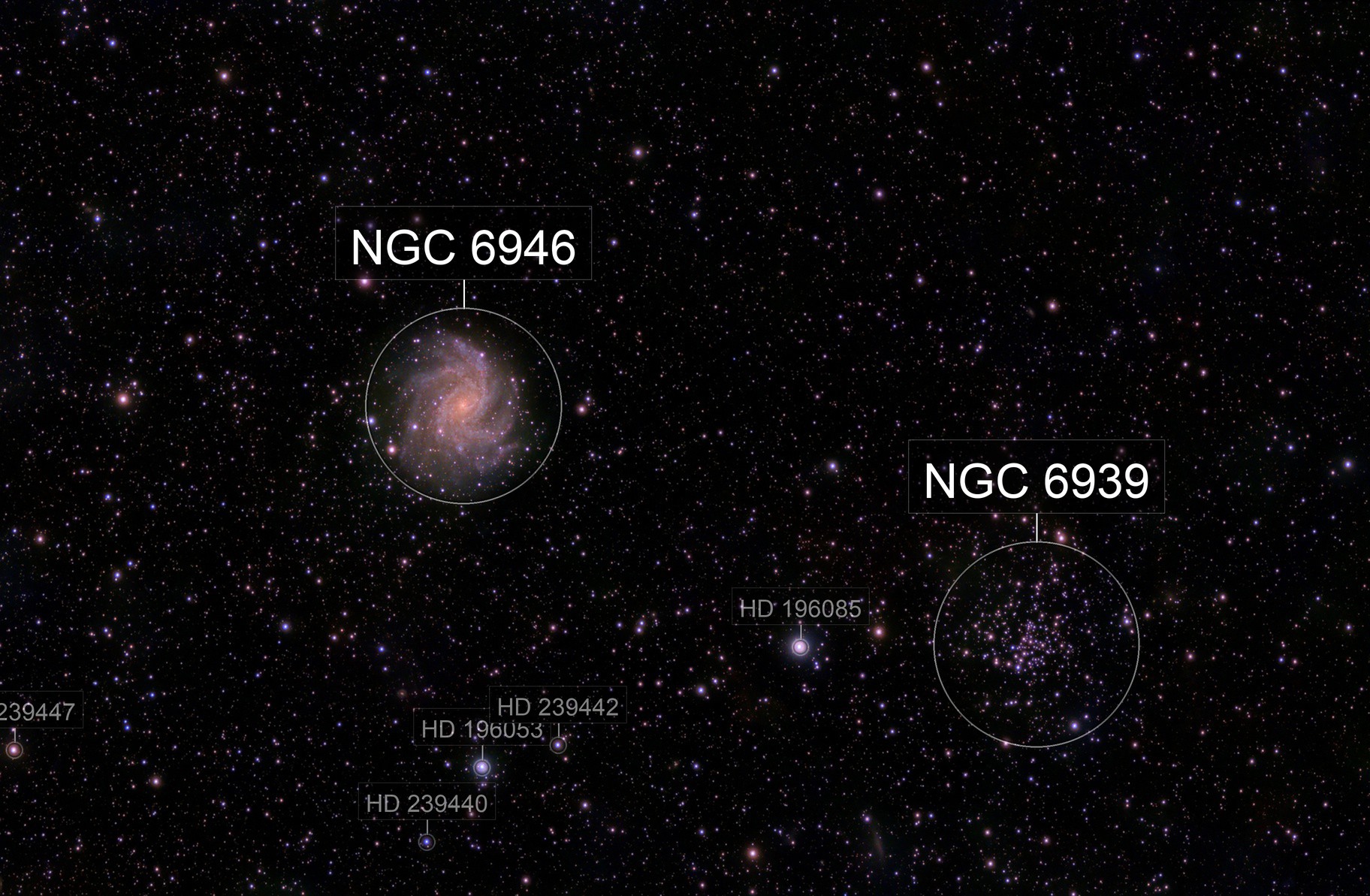
NGC 6939 Open Cluster and NGC 6946 Galaxy

Imaging Details
Click to Return to Home Page