NGC 6749
Also Known as: Berkeley 42, GLC 107, GC 4466, h 2029
Object Type: Globular Cluster
Constellation: Aquila
Distance from Earth: 25,000 light years
Apparent Magnitude: 12.4
Coordinates: RA 19H 05M 15.3 Sec DEC 1 deg 54 min 05 sec
Actual Size: 36 light years
Apparent Dimensions: 5 arcminutes
Discovered by: NGC 6749 was discovered by John Herschel on 15th July 1827.
He cataloged it as h 2029 (GC 4466). He noted: «A cluster of loose small stars of various magnitudes; fills the field.»
In his «General Catalogue» appeared in 1864 he described GC 4466 as «Cluster; large; little compressed; stars large & small.»
John L. E. Dreyer added it as NGC 6749 in 1888.
The cluster is also known as Berkeley 42 and was first misclassified as open star cluster of classification I3r consisting of «very faint stars».
Description:
NGC 6749 is a faint, loosely packed globular cluster located in the constellation Aquila at a distance of about 25,000 light-years.
Its blue horizontal branch indicates that the stars are metal-poor, which is typical for globular clusters.
It is a halo globular cluster close to the disc plane.
Because it lies behind thick clouds of interstellar dust near the galactic plane, its light is heavily scattered.
This extinction makes it one of the most challenging globular clusters to observe
Click Below Image(s) for Full Size:
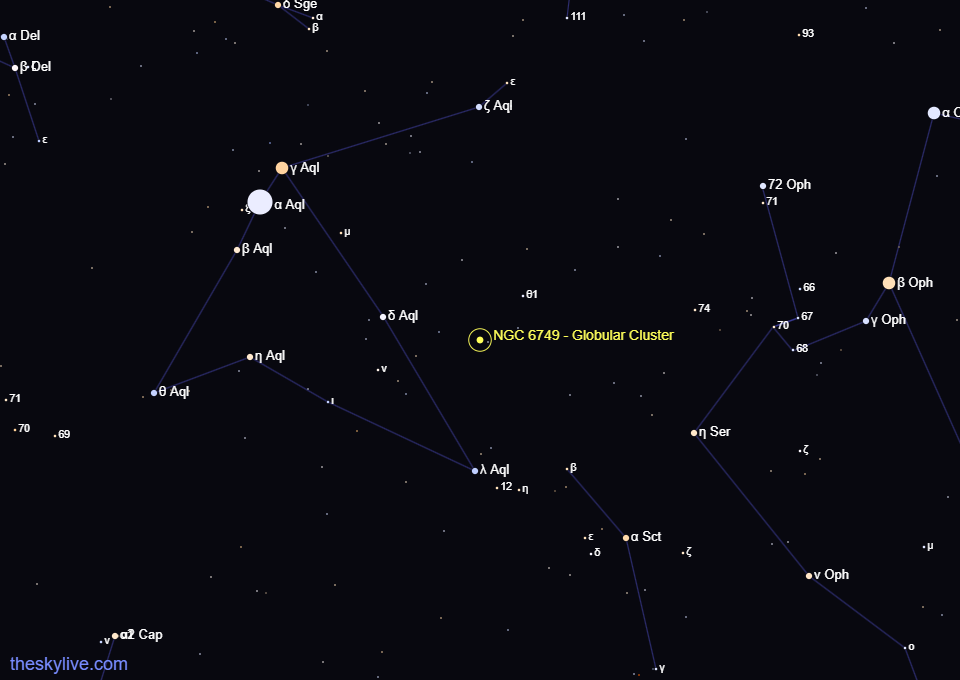
Due to its heavy surface brightness and a rich background starfield, visual observation requires a telescope with an aperture of at least 8 inches (200 mm).
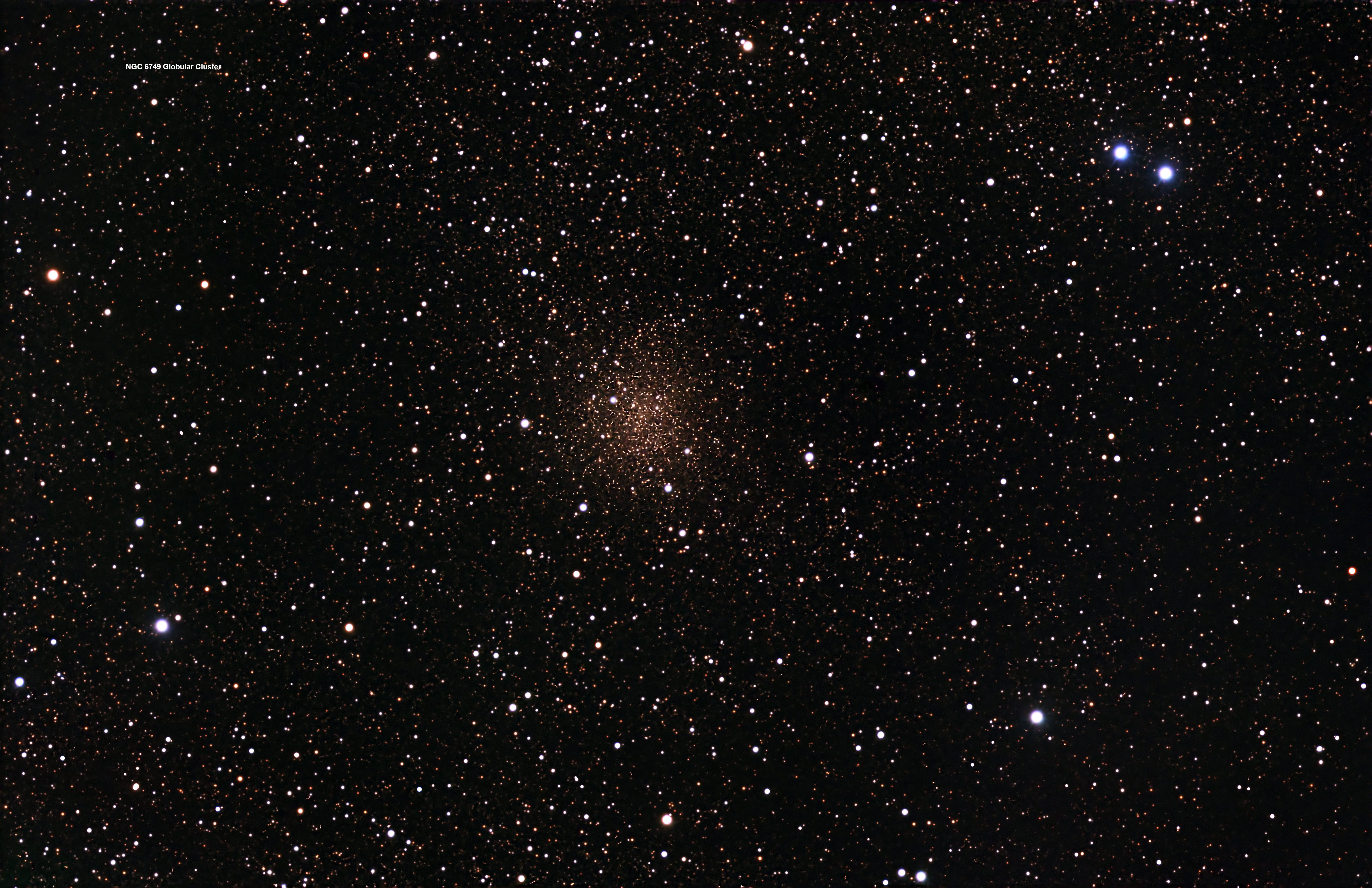
Its location near the galactic disk causes blue light to scatter, resulting in a distinctly red appearance similar to the Sun at sunset.
Platesolve
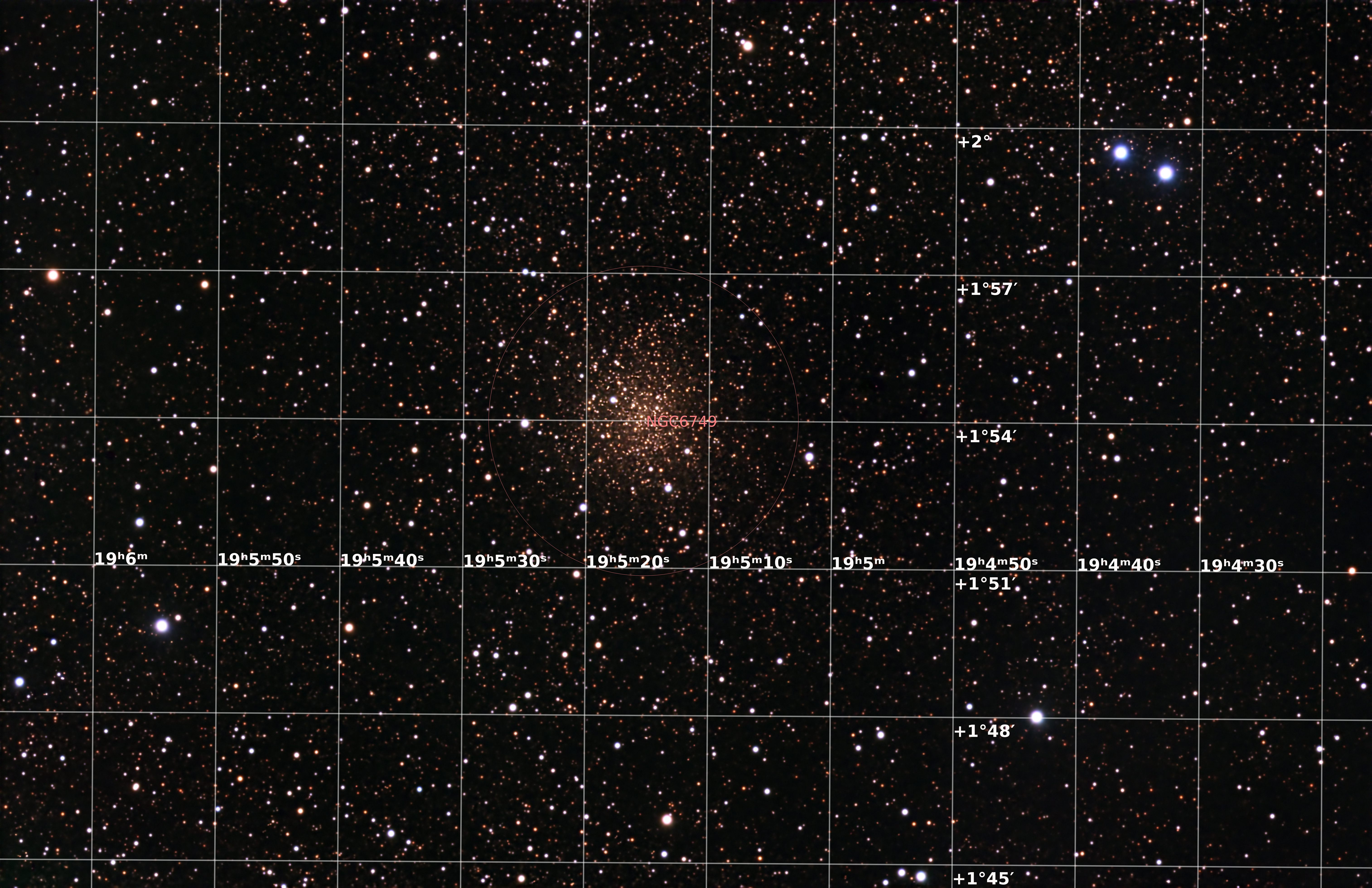
NGC 6749 Globular Cluster
Imaging Details
Click to Return to Home Page