NGC 5963 & NGC 5965
Common Name: The Needle Galaxy (NGC 5965)
Also Known as: : UGC 9914
Object Type: Spiral Galaxy
Constellation: Draco
Distance from Earth: 148 million light years
Apparent Magnitude: 11.9
Coordinates: RA 15H 34M 02.5S DEC 56deg 41min 08sec
Actual Size: 50,000 light years (NGC 5963) .... 260,000 light years in diameter (NGC 5965)
Apparent Dimensions: 3.14 arc-minutes x 2.47 arc-minutes (NGC 5963) .... 6.16 arc-minutes x 0.84 arc-minutes (NGC 5965)
Discovered by: Both NGC 5963 and NGC 5965 were discovered by William Herschel in 1788
Description: NGC 5965 is seen nearly edge-on, with an inclination of 80 degrees.
NGC 4565 has been nicknamed the Needle Galaxy because, when seen in full, it appears as a very narrow streak of light on the sky. The edgewise view into the Needle Galaxy shown here looks very similar to the view we have from our Solar System into the core of the Milky Way.
Dust is seen across the galactic disk, while there is also a red dust lane at the nucleus.
The bulge is X-shaped, that suggests that the galaxy is actually barred.
NGC 5965 along with another edge-on galaxy, NGC 5746, were the galaxies used to confirm that peanut shaped bulges are associated with the presence of a bar,
by spectrographically observing the disturbance caused at the velocity distributions of the galaxies.
The galaxy features some level of disk disturbance, like a warp, as the outer part of the disk along with a ring-like dust lane appear to be on a different plane from the bulge,
but it could also be a projection effect.
When observed in K band, the galaxy features a stellar ring.
NGC 5965 lies in a galaxy filament which also includes NGC 5987 and its loose group, which includes NGC 5981, NGC 5982, NGC 5985, three galaxies known as the Sampler.
NGC 5963 is a Intermediate Spiral Galaxy in the Draco constellation.
NGC 5963, nearly face-on, is just about 50,000 light-years across.
This galaxy is receding from us at approximately 655 kilometers per second.
It has a rather bright center with several dust lanes in it.
Its extraordinarily faint blue spiral arms which extend some distance out from the bright core, mark it as a low surface brightness galaxy.
But, although the stars of its spiral arms are not so bright, the arms are blue and must be dominated by young blue and relatively bright stars.
And there probably is a good deal of star formation going on inside them.
The reason why the arms are still so faint is that there just aren’t very many stars in them (yet), and certainly not very many intermediate or old stars.
NGC 5963 and NGC 5965 are two spiral galaxies in the northern constellation of Draco, which are far apart and unrelated, and are just by chance appearing close on the sky.
Click Below Image(s) for Full Size:
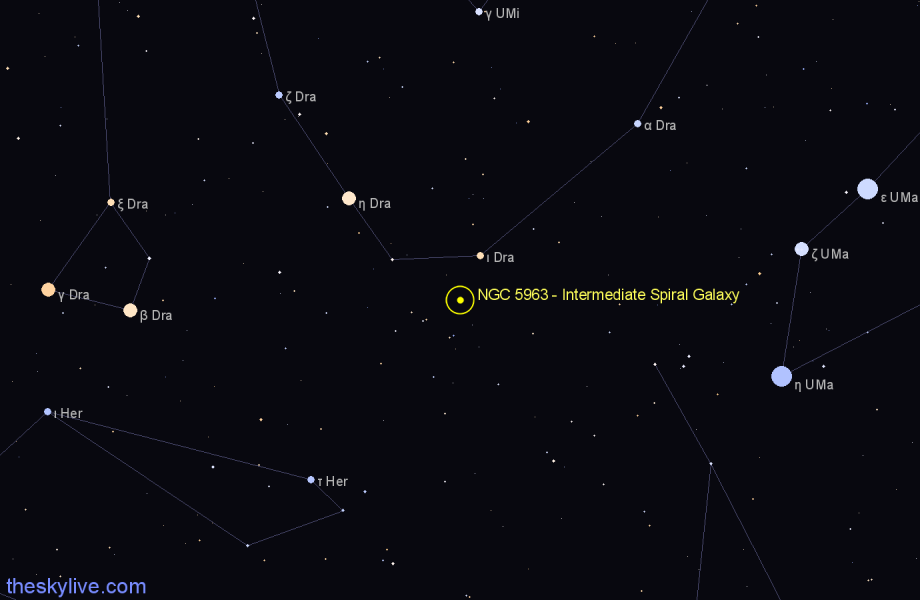
NGC 5963 and NGC 5965 are situated north of the celestial equator and, as such, it is more easily visible from the northern hemisphere in the spring.
Platesolve
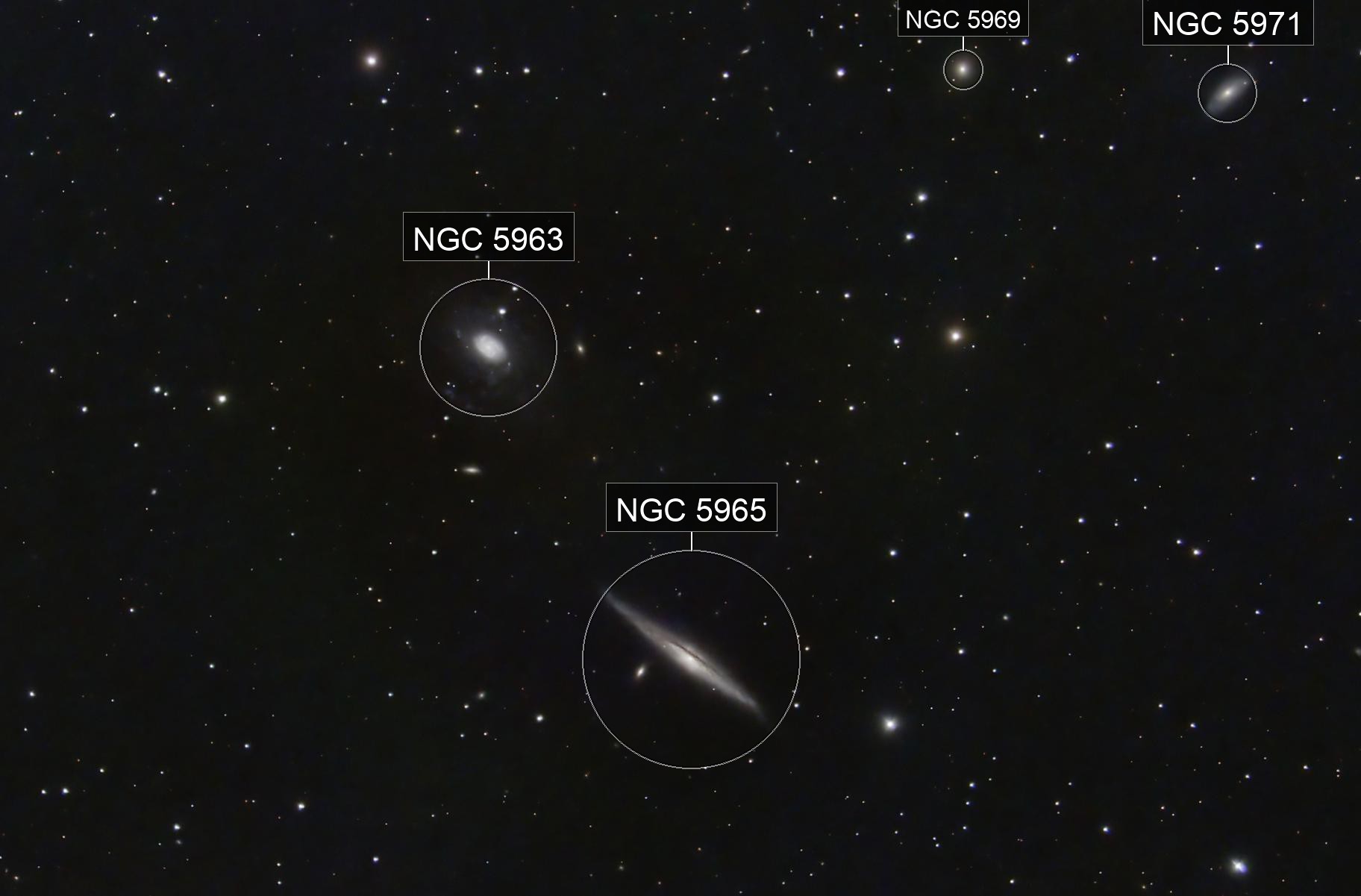
NGC 5963 & NGC 5965 Galaxy

Imaging Details
Click to Return to Home Page