NGC 488
Also Known as: UGC 907, PGC 4946
Object Type: Spiral Galaxy
Constellation: Pisces
Distance from Earth: 98.3 million light years
Apparent Magnitude: 10.4
Coordinates: RA 01H 21M 46.79S DEC 05 deg 15 min 24.7 sec
Actual Size: 185,000 light years
Apparent Dimensions: 5.4 arcminutes x 3.9 arcminutes
Discovered by: The galaxy NGC 488 was discovered on 13 December 1784 by the German-British astronomer William Herschel with his self-made 18.7 inch f/12.8 reflector telescope in Slough, England.
He logged it as III 252 and noted: «Very faint, pretty large, irregularly round, little brighter in the middle.»
On 6 December 1850, the engineer Bindon Stoney roamed the 72 inch reflector telescope at Birr Castle, Ireland «Leviathan» of his employer William Parsons,
the 3rd Earl of Rosse this region of the starry sky and came across the small galaxies NGC 486, NGC 490, NGC 492 and NGC 500.
Description:
NGC 488 is a face-on spiral galaxy in the constellation Pisces.
The galaxy has a large central bulge, and is considered a prototype galaxy with multiple spiral arms. Its arms are tightly wound. Star forming activity has been traced within the arms.
The nucleus of NGC 488 has been found to be chemically decoupled, being twice as metal rich as the central bulge of the galaxy.
NGC 488, with the exception of its smaller companions, form the NGC 488 group; a relatively isolated galaxy group.
NGC 488 is a regular spiral galaxy of morphological type Sb.
Stellar population in the nucleus is twice richer in metals that of the central bulge. This could be the result of accretions of stars or gas from outside.
NGC 488 is surrounded by a swarm of dwarf satellites. It could have devoured such a dwarf galaxy.
Click Below Image(s) for Full Size:
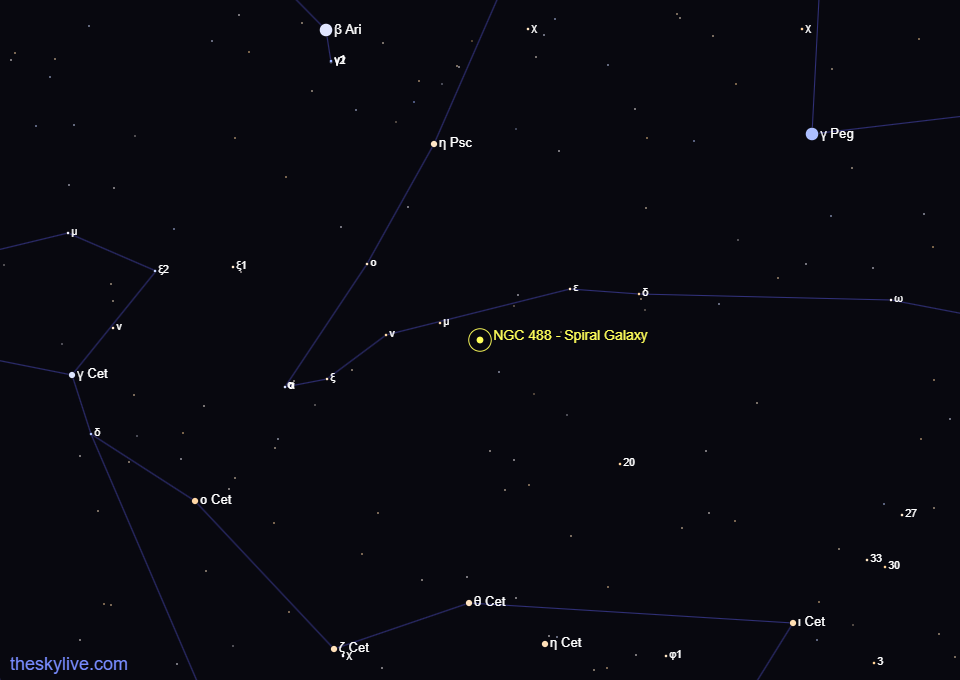
NGC 488 is a Spiral Galaxy in the Pisces constellation. NGC 488 is situated close to the celestial equator and, as such, it is at least partly visible from both hemispheres in certain times of the year.
Given its B magnitude of 15, NGC 488 is visible with the help of a telescope having an aperture of 20 inches (500mm) or more.
NGC 488 has a central hub of very high surface brightness. Nevertheless, it’s still out of range of 10
Platesolve
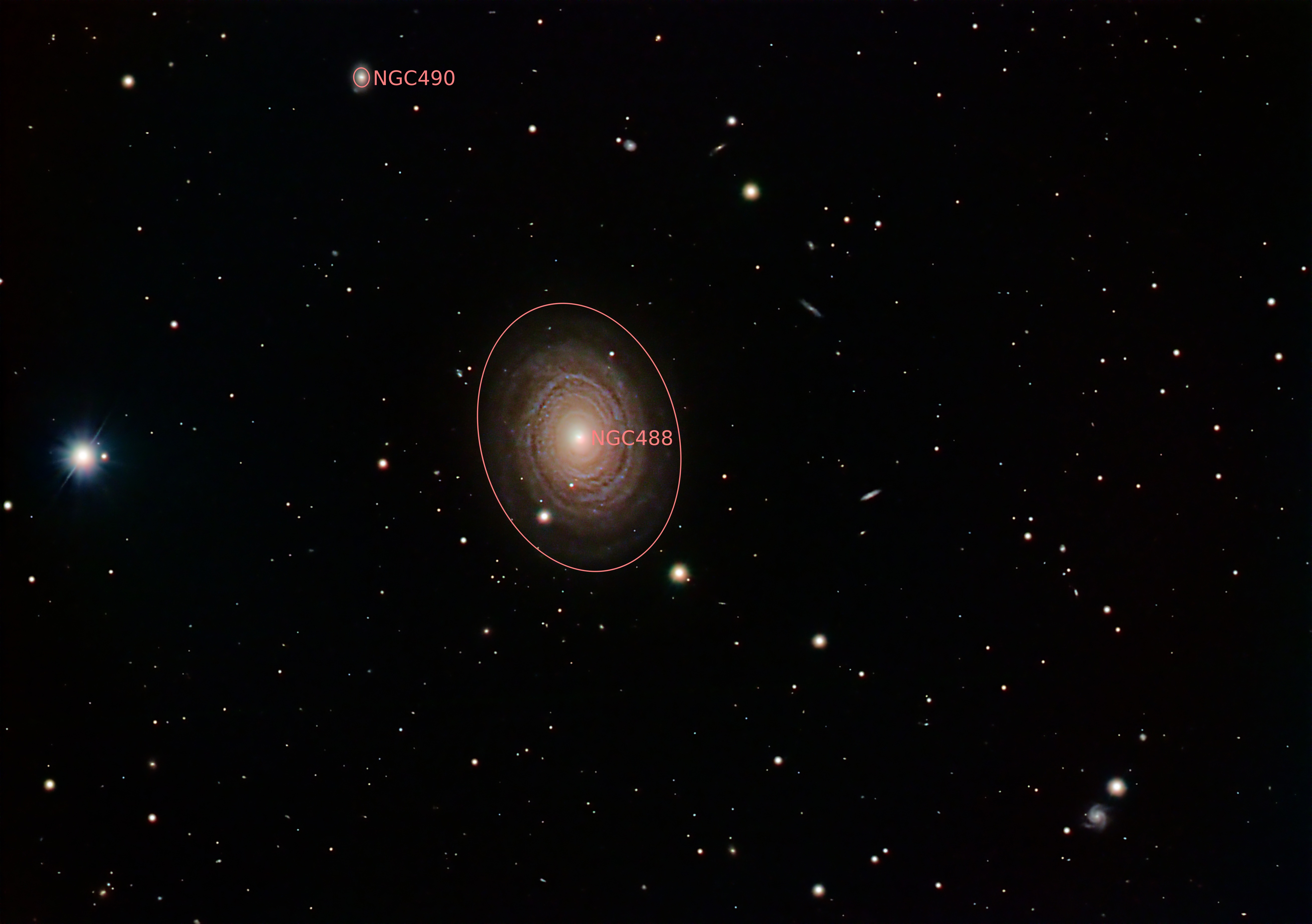
NGC 488 Spiral Galaxy

Imaging Details
Click to Return to Home Page