NGC 4621 & NGC 4649
M59 Also Known as: NGC 4621 ... M60 Also Known as: NGC 4649
Both Object Type: Elliptical Galaxy
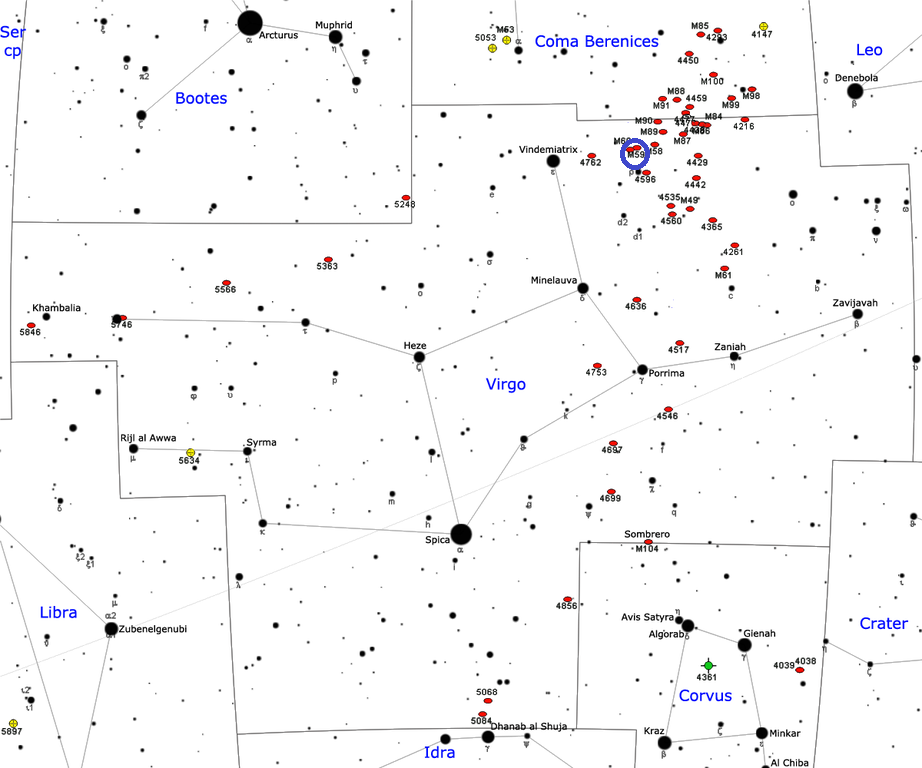
Constellation: Virgo
M59 Distance from Earth: 60 million light years ... M60 Distance from Earth: 56.7 million light years
M59 Apparent Magnitude: 10.6 ... M60 Apparent Magnitude: 9.8
M59 Coordinates: RA 12H 42M 02.322S DEC 11deg 38min 48.95sec
M60 Coordinates: RA 12H 43M 40.008S DEC 11deg 33min 09.40sec
M59 Actual Size:: 92,000 light years in diameter... M60 Actual Size:: 120,000 light years in diameter.
M59 Apparent Dimensions:: 5.4 arc-minutes x 3.7 arc-minutes ... M60 Apparent Dimensions:: 7.4 arc-minutes x 6 arc-minutes
Both Discovered by: Messier 59 and its close neighbor Messier 60 were discovered by the German astronomer Johann Gottfried Koehler on April 11, 1779.
Koehler described the pair as “two very small nebulae, hardly visible in a 3-foot telescope: The one above the other.”
Charles Messier added the two elliptical galaxies together with the nearby Messier 58 to his catalogue a few days after Koehler’s discovery, on April 15.
M59 Description: Messier 59 is a member of the Virgo Cluster, a group of about 1,300 galaxies (and possibly many more) that form the heart of the Virgo Supercluster, a larger grouping that also contains the Local Group, which in turns contains the Andromeda Galaxy (Messier 31), the Triangulum Galaxy (Messier 33), and our own galaxy, the Milky Way.
M59 is one of the larger ellipticals in the Virgo Cluster, but it is still significantly fainter and less massive than Messier 87, Messier 49 and Messier 60.
Messier 59 contains a supermassive black hole with a mass about 270 million times that of the Sun at its core, which is almost 100 times more massive than the black hole at the center of the Milky Way.
The galaxy’s central region – the inner 200 light years – rotates in the opposite direction to the rest of M59 and is the smallest ever region in a galaxy known to do so.
Messier 59 has an exceptionally large number of globular clusters. Astronomers have estimated a population of about 2,200 globulars, which is an impressive number.
The main elliptical component appears to be superimposed upon a flatter, disk-like feature, with the entirety embedded within a circular halo.
The nucleus contains an embedded stellar disk that is bluer (younger) than the bulge region. This extended disk feature may be the result of a galactic merger followed by a starburst event.
It has two satellites, the ultra compact dwarf galaxy M59-UCD3 and M59cO, which is a rare example of a galaxy in between compact ellipticals such as Messier 32 and ultra compact dwarfs.
Messier 59 is best seen in larger telescopes.
Smaller instruments will only reveal a small elliptical patch with a brighter core.
The central region of M59 is clearer in medium-sized and large telescopes, but even larger instruments do not reveal much detail.
The best time of year to observe M59 is during the spring.
Click Below Image(s) for Full Size:
M60 Description: Messier 60 has an estimated mass of about a trillion solar masses.
Together with NGC 4647, it forms a pair known as Arp 116.
M60 is the third-brightest giant elliptical galaxy of the Virgo cluster of galaxies, and is the dominant member of a subcluster of four galaxies, the M60 group, which is the closest-known isolated compact group of galaxies.
Messier 60 also has several satellite galaxies. One of these, M60-UCD1, is an ultracompact dwarf galaxy, believed to be the remaining core of a more massive galaxy that lost much of its mass in an encounter with the much larger M60 about 10 billion years ago.
The motion of M60 through the intercluster medium is resulting in ram-pressure stripping of gas from the galaxy's outer halo, beyond a radius of 12 kpc.
In amateur telescopes, observers can only see the galaxy’s bright central region, which is about 4 by 3 arc minutes in diameter.
4-inch telescopes reveal the nearby spiral galaxy NGC 4647, while significantly larger instruments show many faint globular clusters in M60.
The best time of year to observe the galaxy is during the months of March, April and May.
Platesolve
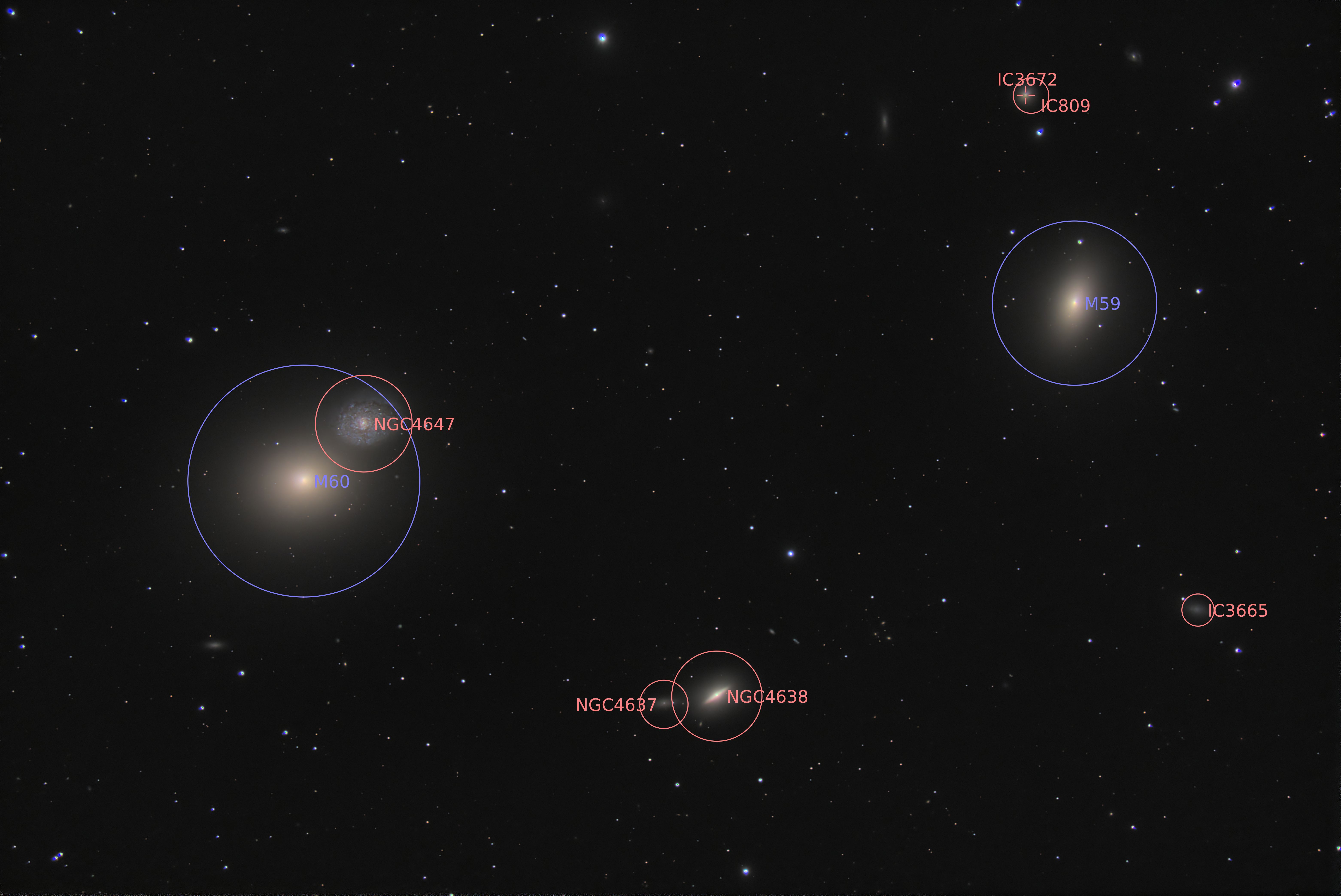
NGC 4621 & NGC 4649 Galaxies

Imaging Details
Click to Return to Home Page