NGC 4217 and NGC 4226
Also Known as: PGC 39241, UGC 7282 (NGC 4217)
Object Type: Spiral Galaxies
Constellation: Canes Venatici
Distance from Earth: 61.1 million light years (NGC 4217), 339 to 394 million light years (NGC 4226)
Apparent Magnitude: 12.4 (NGC 4217), 14 (NGC 4226)
Coordinates: RA 12H 15M 50.9S DEC 47 deg 05 min 30.44 sec (NGC 4217), RA 12H 16M 26.3S DEC 47 deg 01 min 32 sec (NGC 4226)
Actual Size: 89,000 light years (NGC 4217), 99,000 light years (NGC 4226)
Apparent Dimensions: 5.012 arcminutes x 1.479 arcminutes (NGC 4217), 1.0 arcminutes x 0.5 arcminutes (NGC 4226)
Discovered by: The galaxy NGC 4217 was discovered by William Herschel on 10 April 1788.
NGC 4226 was discovered by John Herschel on 19 March 1828.
Description:
NGC 4217 is an edge-on spiral galaxy which lies in the constellation of Canes Venatici.
It is a possible companion galaxy to Messier 106 (NGC 4258). We see it directly from the edge, which is why it is not entirely clear whether it is a classic spiral galaxy or a bar-shaped spiral galaxy.
NGC 4226 appears to have a bar-spiral structure.
Click Below Image(s) for Full Size:
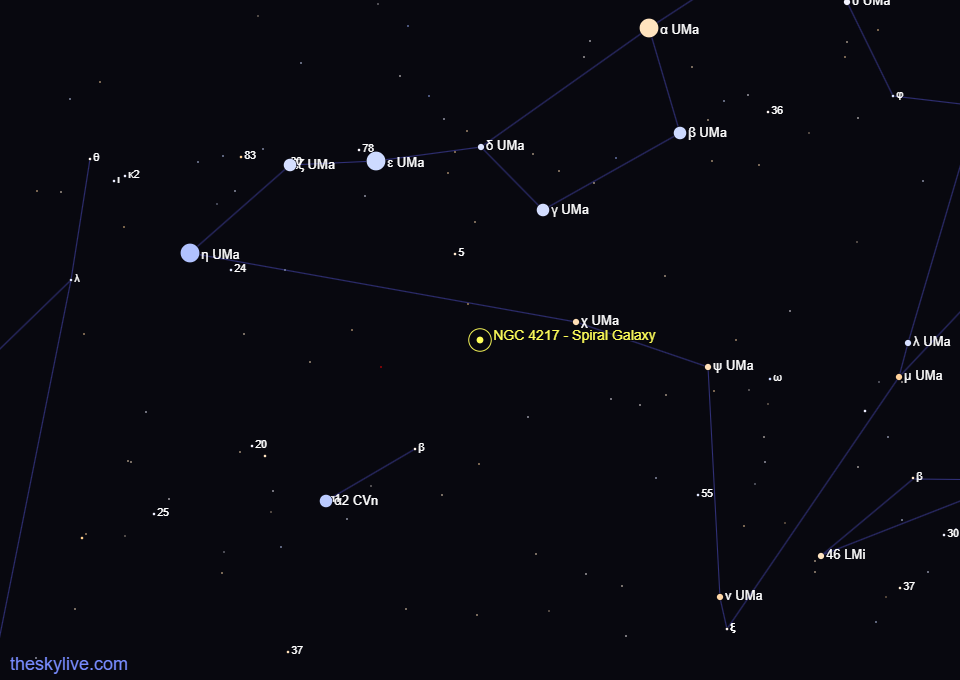
NGC 4217 is a Spiral Galaxy in the Canes Venatici constellation. NGC 4217 is situated north of the celestial equator and, as such, it is more easily visible from the northern hemisphere.
Given its magnitude, NGC 4217 is visible with the help of a telescope having an aperture of 8 inches (200mm) or more.
NGC 4226 is a Barred Spiral Galaxy in the Canes Venatici constellation. NGC 4226 is situated north of the celestial equator and, as such, it is more easily visible from the northern hemisphere.
Given its B magnitude, NGC 4226 is visible with the help of a telescope having an aperture of 14 inches (350mm) or more.
Platesolve
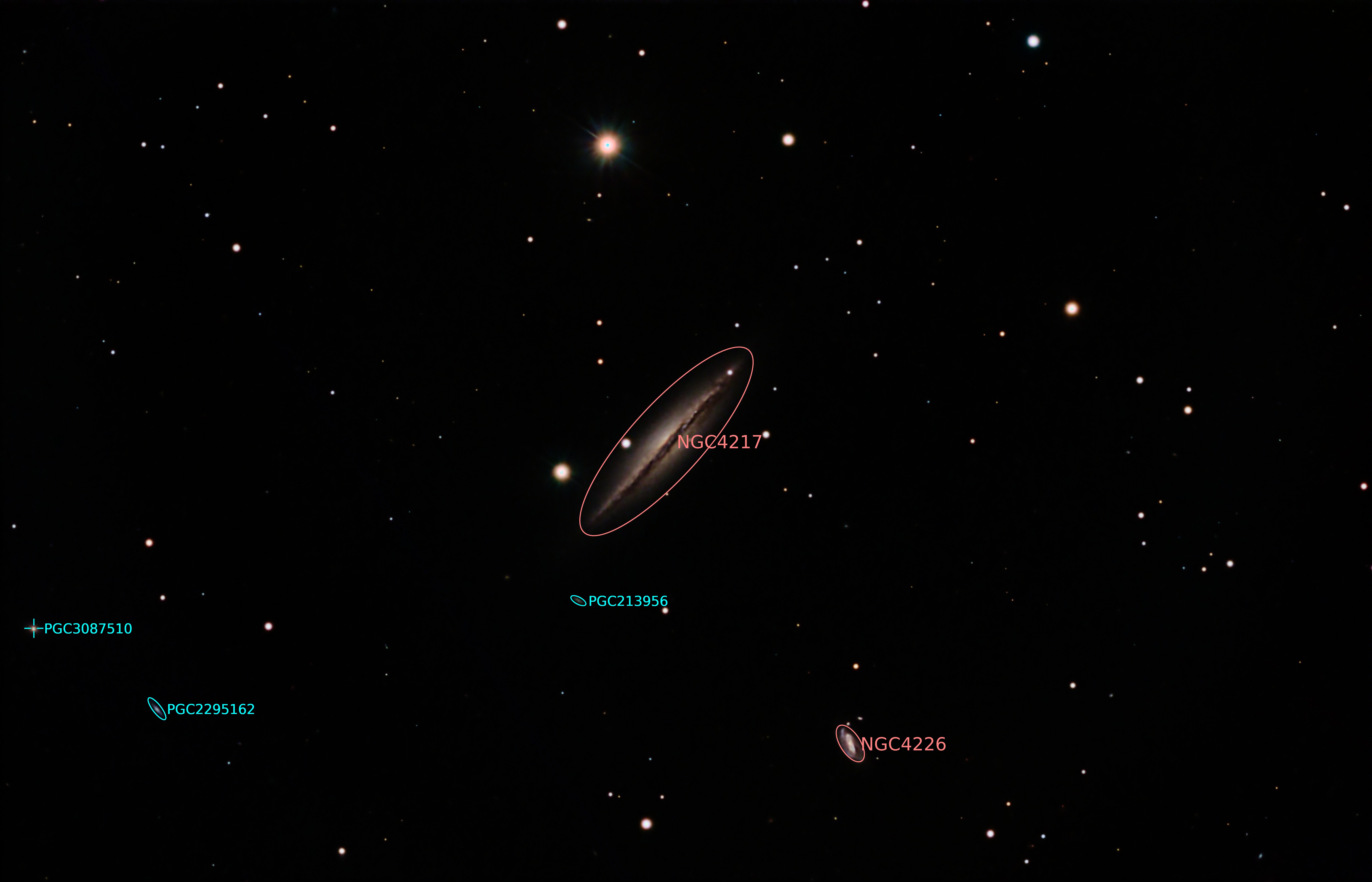
NGC 4217 & NGC 4226 Galaxies

Imaging Details
Click to Return to Home Page