NGC 40
Common Name: Bow-Tie Nebula
Also Known as: Caldweel
Object Type: Planetary Nebula
Constellation: Cepheus
Distance from Earth: 1,619 light years
Apparent Magnitude: 11.6
Coordinates: RA 00H 13M 01.017S DEC 72 deg 31 min 19.03 sec
Actual Size: 1 light year in diameter
Apparent Dimensions: 38 arcseconds x 35 arcseconds
Discovered by: NGC 40 was discovered on 25 November 1788 by William Herschel with its 18.7 inch reflector.
He cataloged it as IV. 58 and logged: «A star of 9m, surrounded with very faint milky nebulosity. The star is either double, or not resolvable. Less than 1' diameter.»
On 20 November 1829, John Herschel described the nebula as «a star 11m with a luminous atmosphere 30" or 40" diameter.»
Later on 29 October 1831 he noted: «A star 10m with strong nebulous atmosphere 15" diameter.
Exactly round and pretty suddenly fading away makes a double star class 5 with a star preceding.»
A third observation on 2 November 1831 reads: «The large star of a double star strongly affectew tih a nebula burr.»
In 1905 American astronomer Williamina Fleming first noted a bright emission spectrum and identified NGC 40 as a true planetary nebula.
She wrote: «Five bright lines or bands appear in the spectrum..[but] the nebular lines near wavelength 5000 are not seen.»
Based on Crossley photographs, Curtis (1918) described, «Central star about mag 10.
The nebula resembles a truncated ring from the ends of which extend much fainter wisps.
The brighter central portion is 38"x35" in PA 14°, while the total length along this axis is about 60".»
Description: NGC 40 is a planetary nebula which is composed of hot gas around a dying star.
Because of its appearance, the nebula was nicknamed 'Bow-Tie Nebula'
The star has ejected its outer layer which has left behind a small, hot star.
Radiation from the star causes the shed outer layer to heat to about 10,000 degrees Celsius and become visible as a planetary nebula.
About 30,000 years from now, scientists theorize that NGC 40 will fade away, leaving only a white dwarf star approximately the size of Earth.
Morphologically, the shape of NGC 40 resembles a barrel with the long axis pointing towards the north-northeast.
There are two additional pairs of lobes around the poles, which correspond to additional ejections from the star.
The central star of NGC 40 has a Henry Draper Catalogue designation of HD 826.
It has a spectral type of [WC8], indicating a spectrum similar to that of a carbon-rich Wolf–Rayet star.
Click Below Image(s) for Full Size:
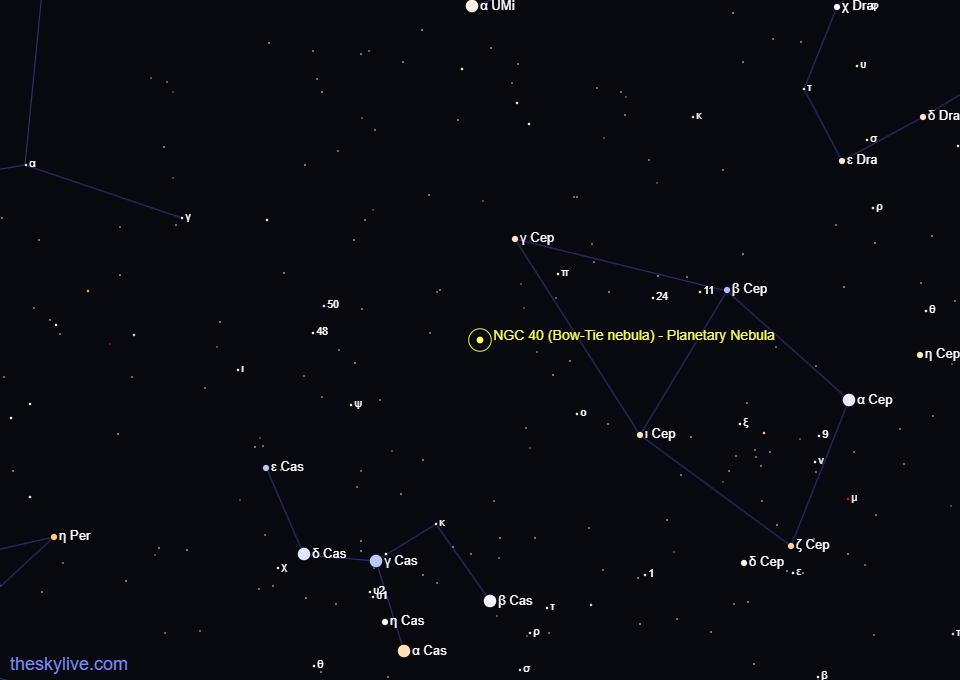
NGC 40 is a Planetary Nebula in the Cepheus constellation. NGC 40 is situated close to the northern celestial pole and, as such, it is visible for most part of the year from the northern hemisphere.
Given its visual magnitude, NGC 40 is visible with the help of a telescope having an aperture of 8 inches (200mm) or more.
The best time to view NGC 40 is in the late summer monts when Cepheus is higher in the sky.
Platesolve
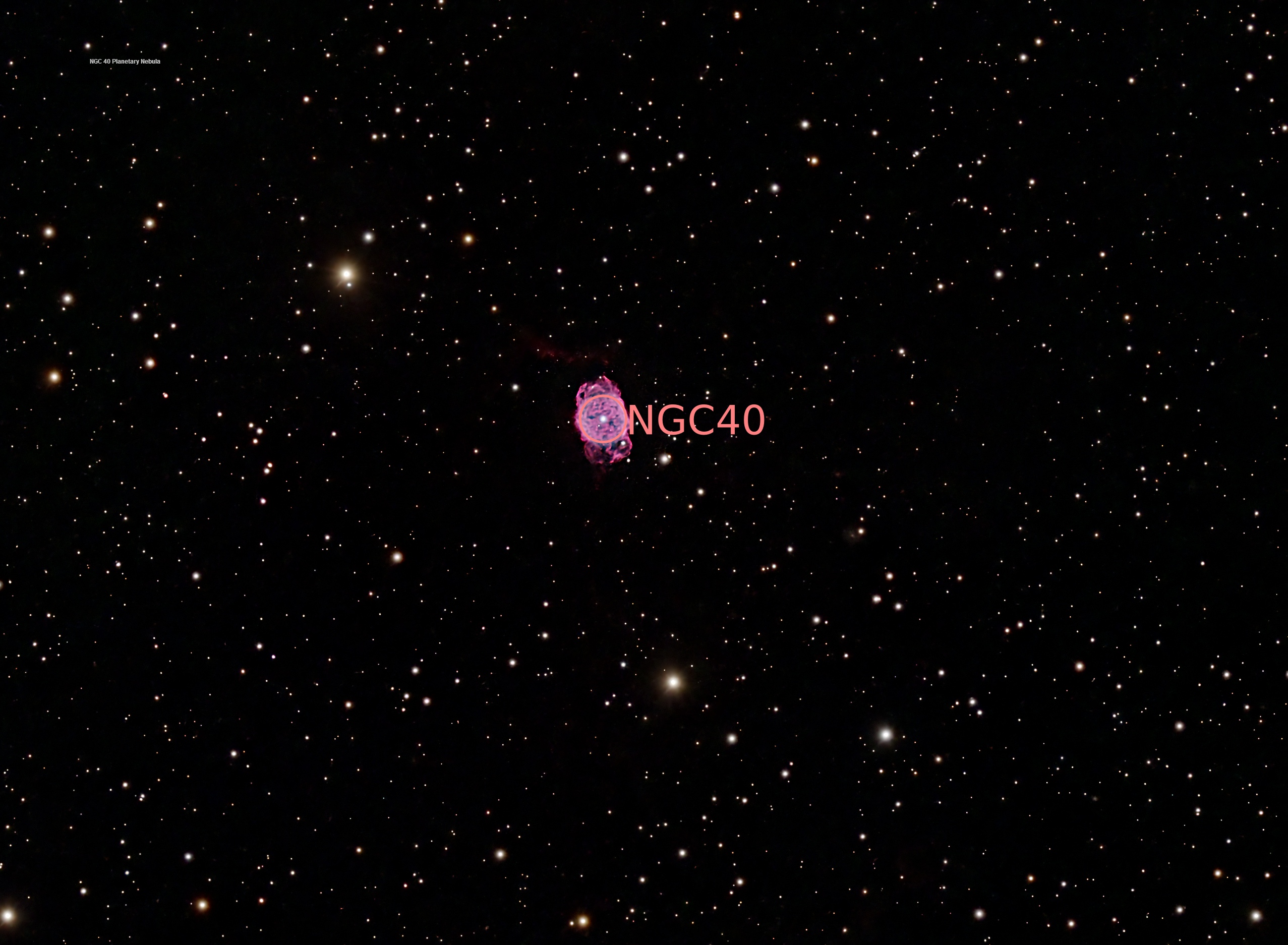
NGC 40 Planetary Nebula
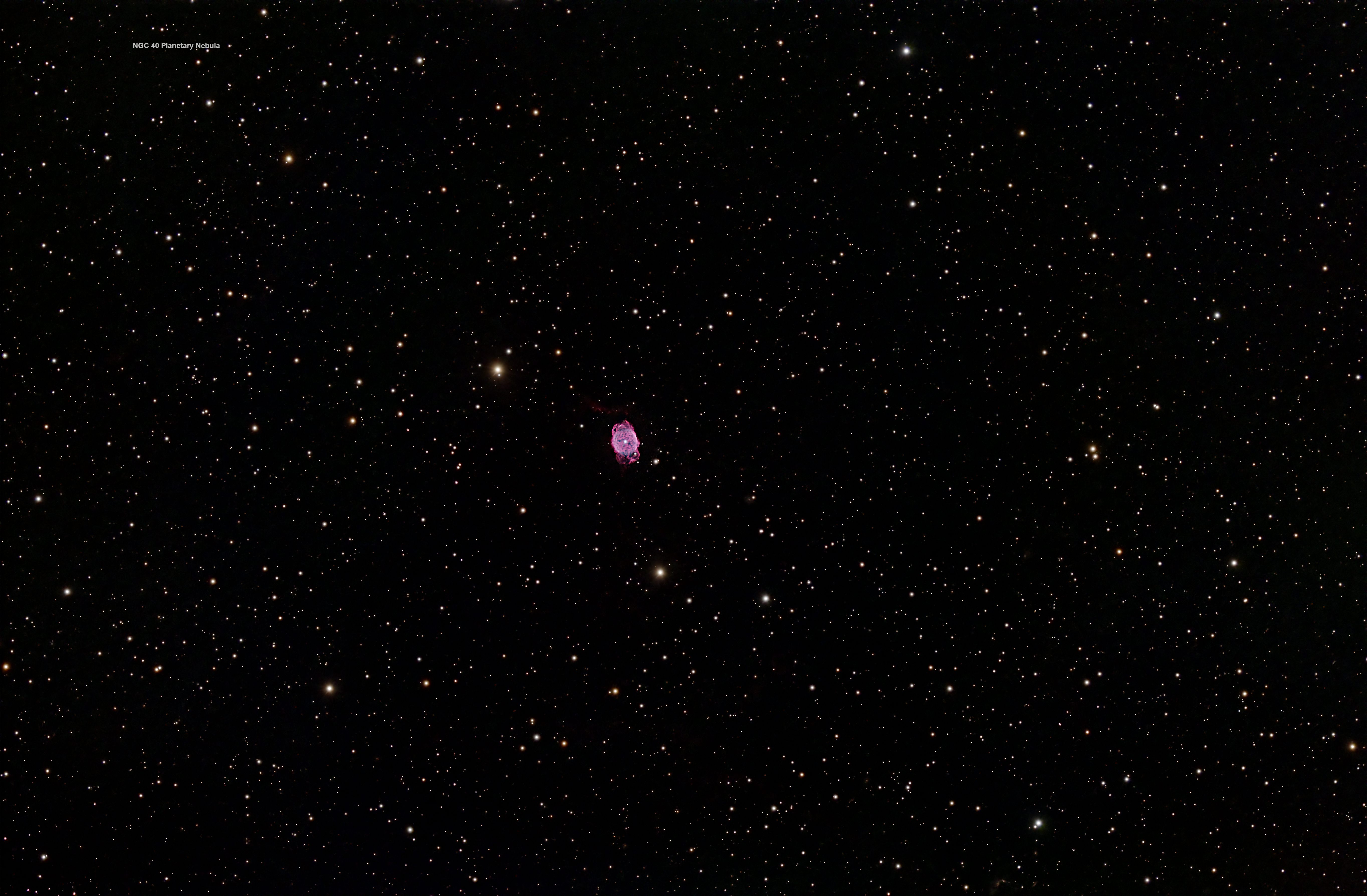
NGC 40 Planetary Nebula Closeup

Imaging Details
Click to Return to Home Page