NGC 3718 and NGC 3729
Also Known as: Arp 214, UGC 6524, PGC 35616 (NGC 351)
Object Type: Spiral Galaxy (NGC 3718) and Barred Spiral Galaxy (NGC 3729)
Constellation: Ursa Major
Distance from Earth: 47.84 million light years (NGC 3718), 65.7 million light years (NGC 3729)
Apparent Magnitude: 10.61 (NGC 3718), 11.0 (NGC 3729)
Coordinates: RA 11H 32M 34.94S DEC 53 deg 04 min 18 sec (NGC 3718), RA 11H 33M 49.3S DEC 53 deg 07 min 32 sec (NGC 3729
Actual Size:
Apparent Dimensions: 2.94 arc-minutes x 2.352 arc-minutes (NGC 3718), 2.8 arc-minutes x 1.8 arc-minutes (NGC 3729)
Discovered by: Both galaxies were discovered by William Herschel on April 12, 1789
Description:
NGC 3718 is a distorted spiral galaxy in the constellation Ursa Major and is located about 59 Million Light Years away.
Its distorted form is thought to be gravitational interaction with the other galaxy seen in this image - NGC 3729 - at some point in the distant past.
These are all part of a group of galaxies known as the Ursa Major Cluster.
Below NGC 3718 you can see a small grouping of elongated shapes, very close together. This is a small group of 5 galaxies known as Hickson 56. These Galaxies are estimated to be about 400 Million Light Years away.
NGC 3718 exhibits a warped, S-shape similar to NGC 6872, possibly a result of gravitational interaction with NGC 3729, another spiral galaxy located 150,000 light-years away.
NGC 3718 is a member of the Ursa Major Cluster.
NGC 3718 is a Type 2 Seyfert AGN.
NGC 3729 has a bright nucleus embedded in a bar which measures 0.5 x 0.1 arcminutes. At the end of the bar lies a ring with knots.
The outer part of the galaxy is formed by an asymmetric faint nebulosity with condensations. It is possible that the condensation is a disturbed satellite galaxy.
In the center of NGC 3729 is predicted to lie an intermediate-mass black hole based on Ks-band bulge luminosity.
NGC 3729 has an inner ring which emits in far ultraviolet and H-alpha, which are considered to be markers of recent star formation activity.
NGC 3729 is member of the M109 Group[8] which is part of the south Ursa Major groups, part of the Virgo Supercluster.
It forms a pair with NGC 3718, which lies 11.5 arcminutes to the west. It is possible the two galaxies interacted in the past.
Click Below Image(s) for Full Size:
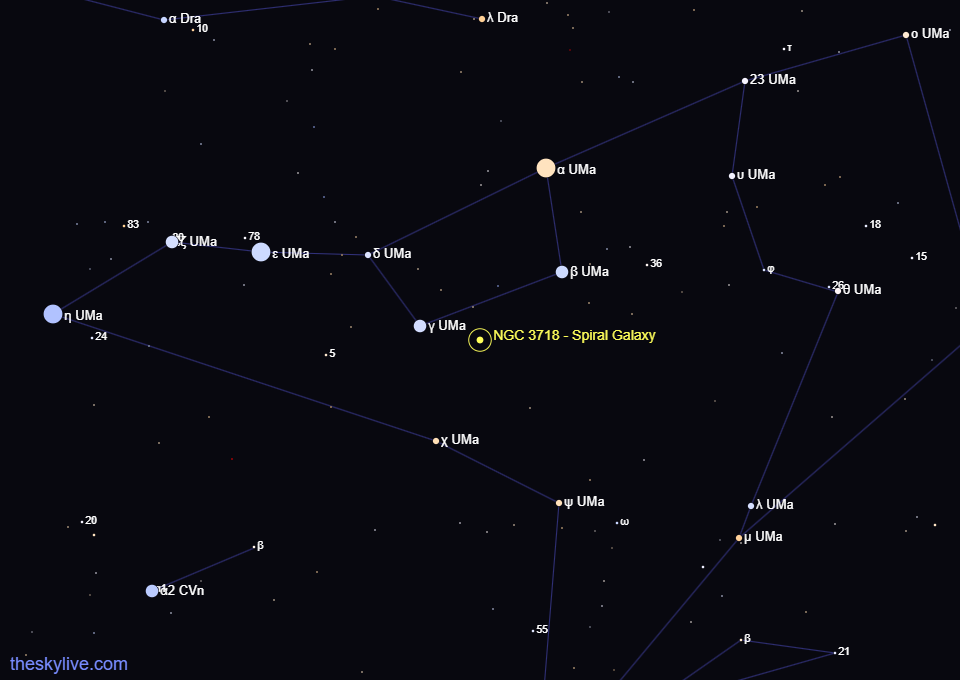
NGC 3718 is a Spiral Galaxy in the Ursa Major constellation. NGC 3718 is situated north of the celestial equator and, as such, it is more easily visible from the northern hemisphere.
Given its visual magnitude, NGC 3718 is visible with the help of a telescope having an aperture of 6 inches (150mm) or more.
Platesolve
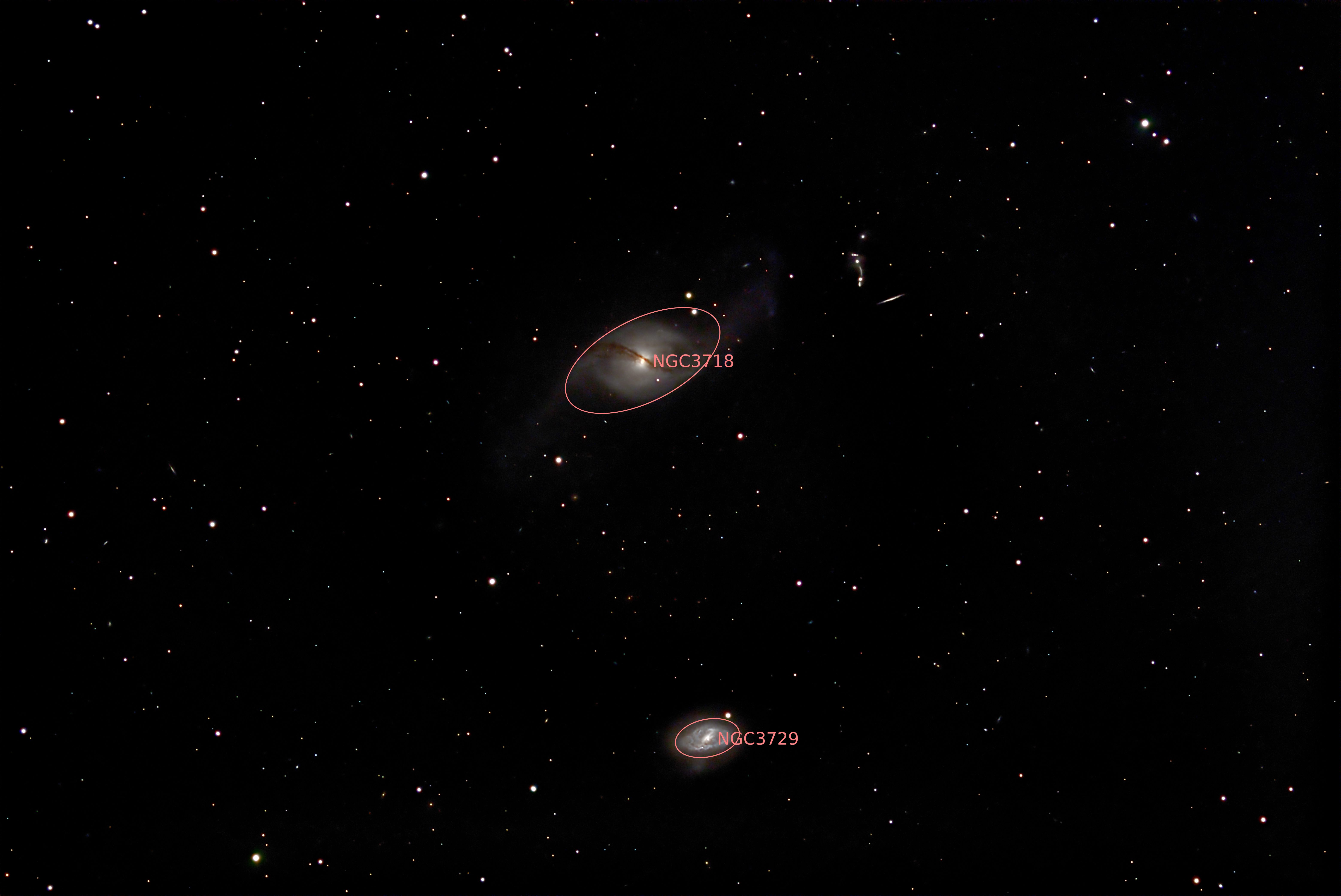
NGC 3718 and NGC 3729 Galaxies

Imaging Details
Click to Return to Home Page