NGC 3613 & NGC 3619
Also Known as: UGC 6323, PGC 34583 (NGC 3613), UGC 6330, PGC 34641 (NGC 3619)
Object Type: Elliptical Galaxy (NGC 3613), Unbarred Lenticular Galaxy (NGC 3619)
Constellation: Ursa Major
Distance from Earth: 98 million light years (NGC 3613), 87 million light years (NGC 3619)
Apparent Magnitude: 11.6 (NGC 3613), 12.6 (NGC 3619)
Coordinates: RA 11H 18M 36.130 Sec DEC 57 deg 59 min 59.73 sec (NGC 3613), RA 11H 19M 21.621 Sec DEC 57 deg 45 min 27.66 sec (NGC 3619)
Actual Size: 38,000 light years (NGC 3613), 98,450 light years (NGC 3619)
Apparent Dimensions: 1.347 arcminutes x 0.997 arcminutes (NGC3613), 3.89 arcminutes x 3.08 arcminutes (NGC 3619)
Discovered by: NGC 3613 was discovered by the astronomer William Herschel on 8 April 1793.
NGC 3619 was discovered by the astronomer William Herschel on March 18, 1790.
Description:
NGC 3613 is an elliptical galaxy in the constellation Ursa Major. It is the center of a cluster of galaxies, and has an estimated globular cluster population of over 2,000.
NGC 3619 is an unbarred lenticular galaxy located in the constellation Ursa Major. It is part of a rich galaxy cluster. It also has a relatively large amount of gas.
Click Below Image(s) for Full Size:
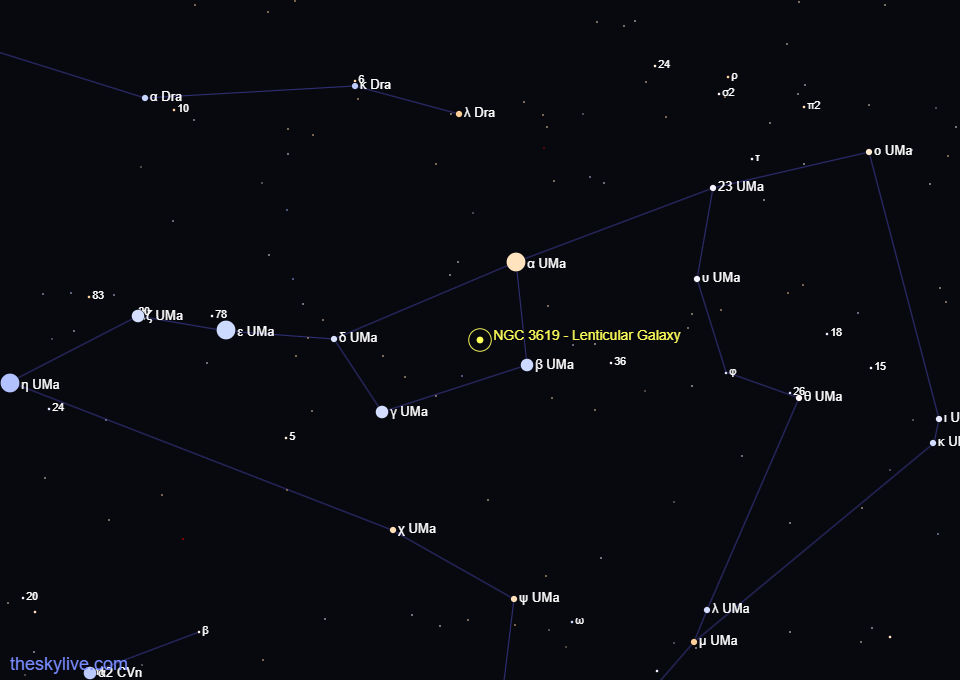
NGC 3613 is a Elliptical Galaxy in the Ursa Major constellation. NGC 3613 is situated north of the celestial equator and, as such, it is more easily visible from the northern hemisphere.
Given its B of 11.6, NGC 3613 is visible with the help of a telescope having an aperture of 8 inches (200mm) or more.
NGC 3619 is a Lenticular Galaxy in the Ursa Major constellation. NGC 3619 is situated north of the celestial equator and, as such, it is more easily visible from the northern hemisphere.
Given its magnitude NGC 3619 is visible with the help of a telescope having an aperture of 10 inches (250mm) or more.
Platesolve
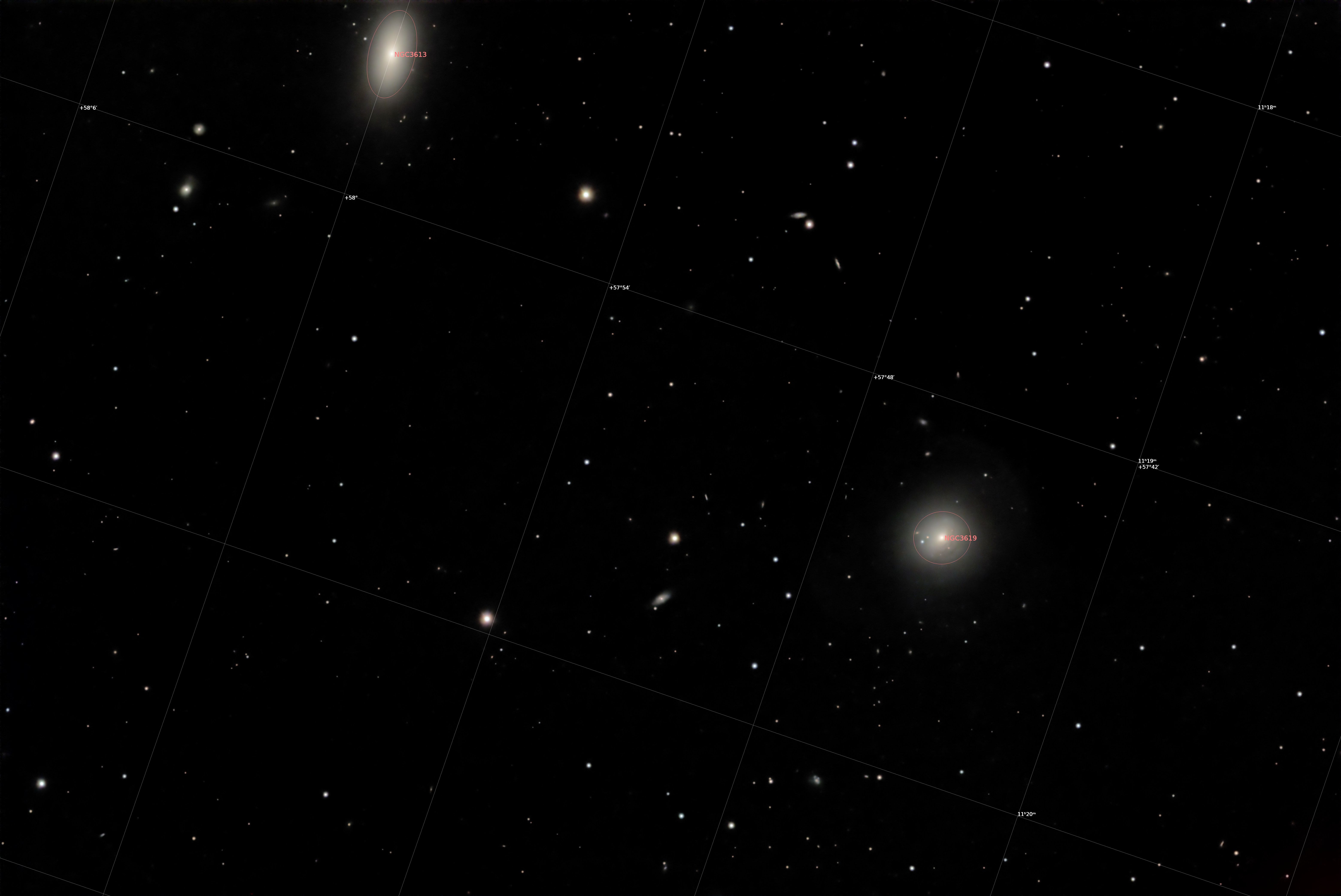
NGC 3613 & NGC 3619 Galaxies
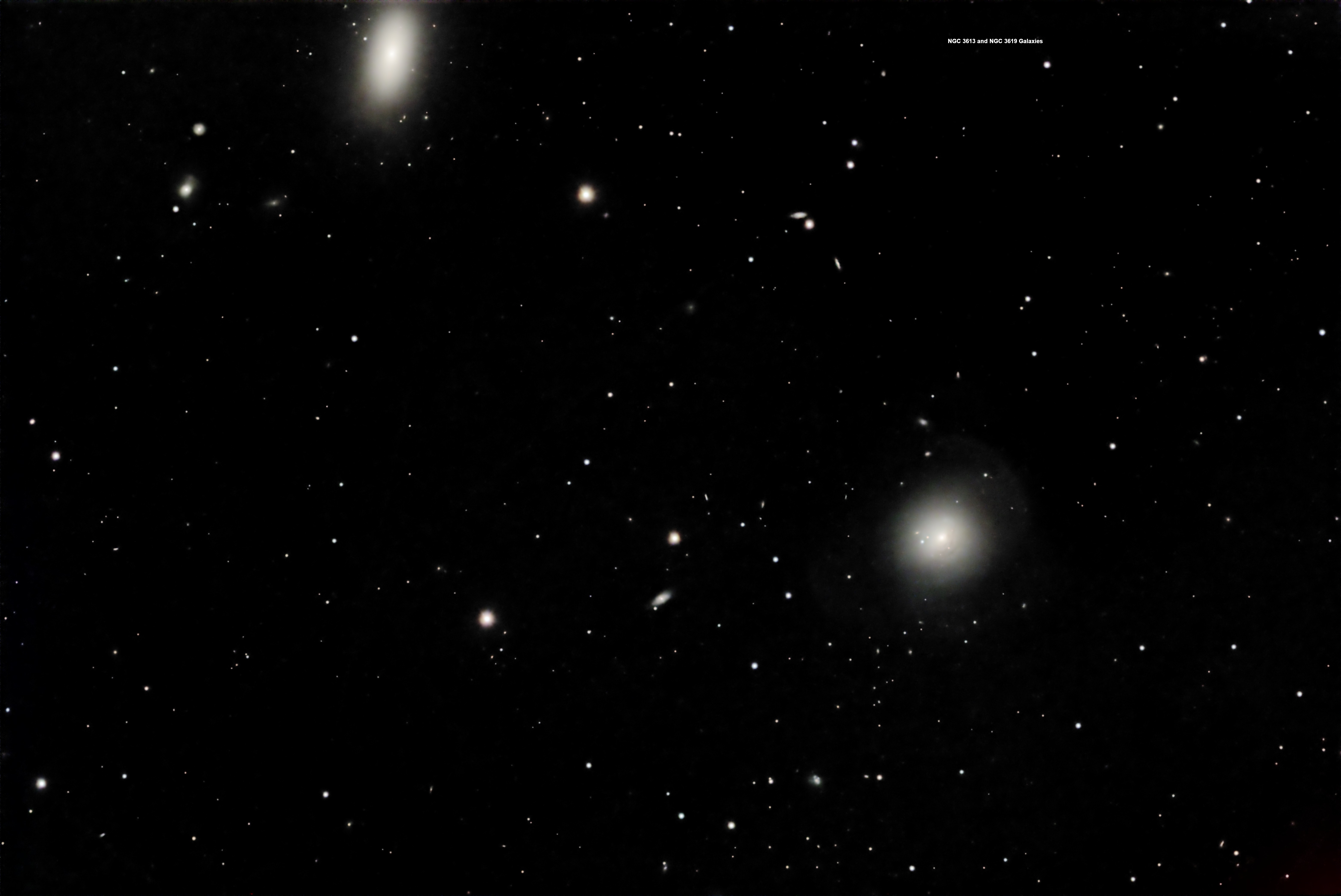
Imaging Details
Click to Return to Home Page