NGC 3501 & NGC 3507
Also Known as: UGC 6116 (NGC 3501)
Object Type: Spiral Galaxies
Constellation: Leo
Distance from Earth: 77 million light years (NGC 3501)... 46 million light years (NGC 3507)
Apparent Magnitude: 13.8 (NGC 3501) .... 10.9 (NGC 3507)
Coordinates: RA 11H 02M 47.307S DEC 17deg 59min 22.31sec (NGC 3501) .. RA 11H 03M 25.56S DEC 18deg 08min 07.6sec (NGC 3507)
Actual Size:
Apparent Dimensions: 4.0 arc-minutes x 0.44 arc-minutes (NGC 3501) ... 2.92 arc-minutes x 2.51 arc-minutes (NGC 3507)
Discovered by: NGC 3501 was discovered by Edouard Stephan in 1881. NGC 3507 was discovered by William Herschel on March 14, 1784.
Description: NGC 3501 is a nice relatively small, clean sided edge on spiral galaxy, only point of note is a central region obviously brighter with small nucleus,
this region didn't 'bulge' as is common but actually gave the galaxy a slim waisted appearance. Two faint stars stand guard at the northern tip.
NGC 3507 looks like a galaxy with two centers but the right one is just a star in our galaxy that happened to be in the light path.
While similar arms may not be visible in NGC 3501, this galaxy is also a spiral — although it is somewhat different from its companion NGC 3507.
NGC 3507 has bars cutting through its center, NGC 3501 does not.
Instead, its loosely wound spiral arms all originate from its center.
The bright gas and stars that make up these arms can be seen here glowing brightly, mottled by the dark dust lanes that trace across the galaxy.
NGC 3507 main spiral appears as a over-extended backwards letter 'S'. A foreground star lies over the galaxy and is brighter than the nucleus to its right. Outer arms form a diffuse halo.
Both NGC 3501 and NGC 3507 are members of the NGC 3607 Group of galaxies, which is a member of the Leo II Groups, a series of galaxies and galaxy clusters strung out from the right edge of the Virgo Supercluster.
Click Below Image(s) for Full Size:
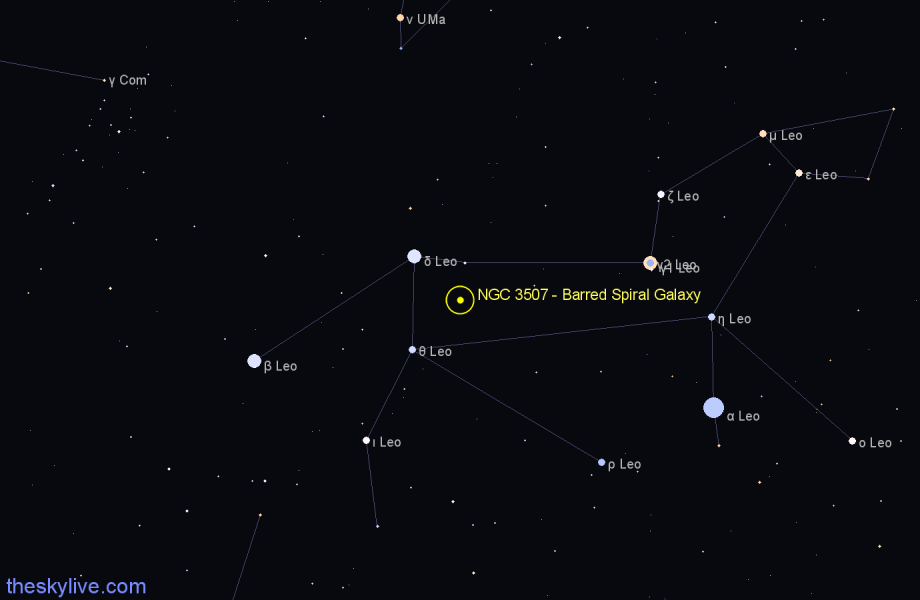
NGC 3501 and NGC 3507 are situated close to the celestial equator and, as such, it is at least partly visible from both hemispheres in certain times of the year.
Platesolve
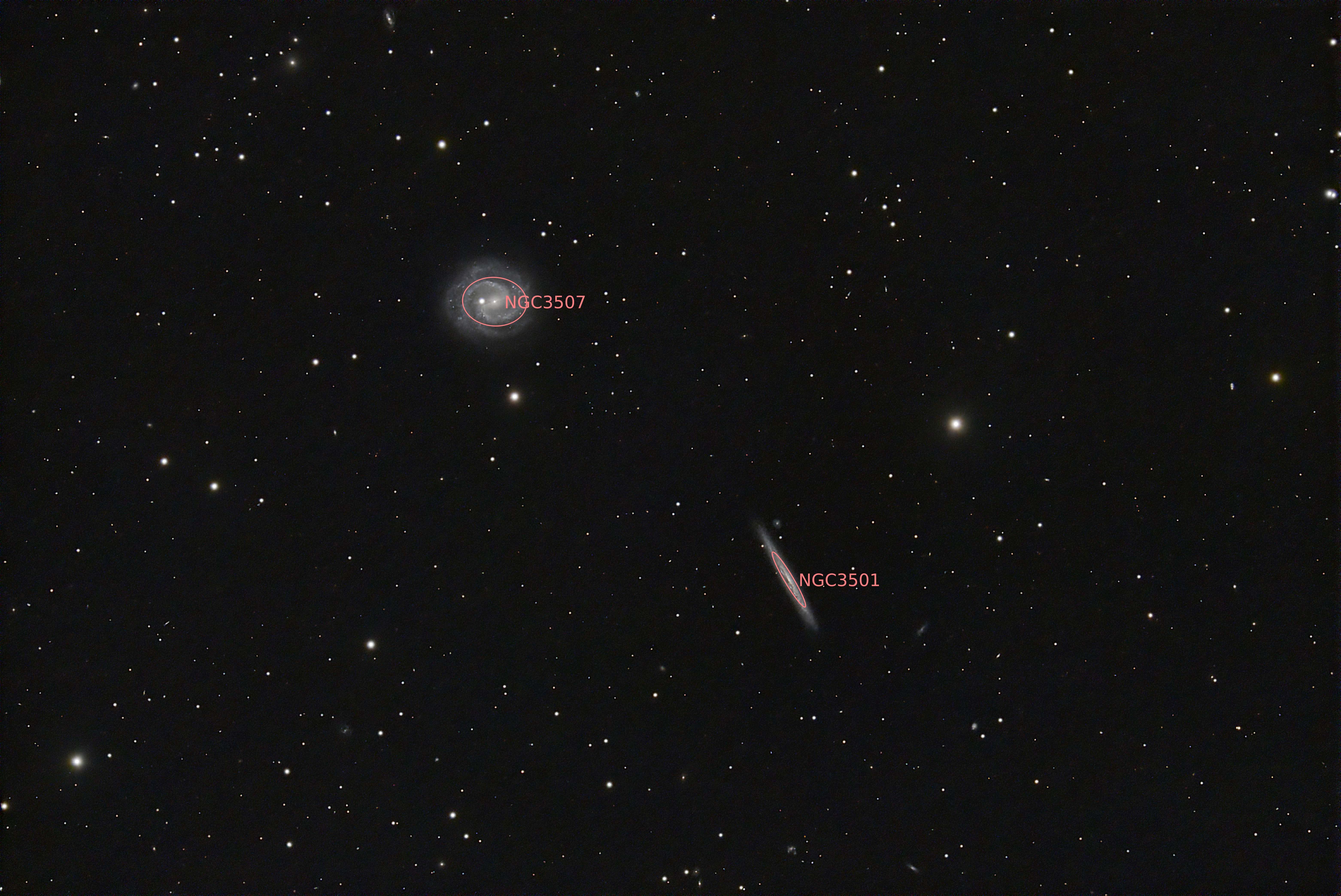
NGC 3501 and NGC 3507 Spiral Galaxies

Imaging Details
Click to Return to Home Page