NGC 3147
Also Known as: PGC 30019, UGC 5532
Object Type: Spiral Galaxy
Constellation: Draco
Distance from Earth: 130 million light years
Apparent Magnitude: 10.6
Coordinates: RA 10H 16M 53.9504 Sec DEC 73 deg 24 min 02.695 sec
Actual Size: 176,000 light years
Apparent Dimensions: 3.9 arcminutes x 3.5 arcminutes
Discovered by: NGC 3147 was discovered by William Herschel on April 3, 1785
Description:
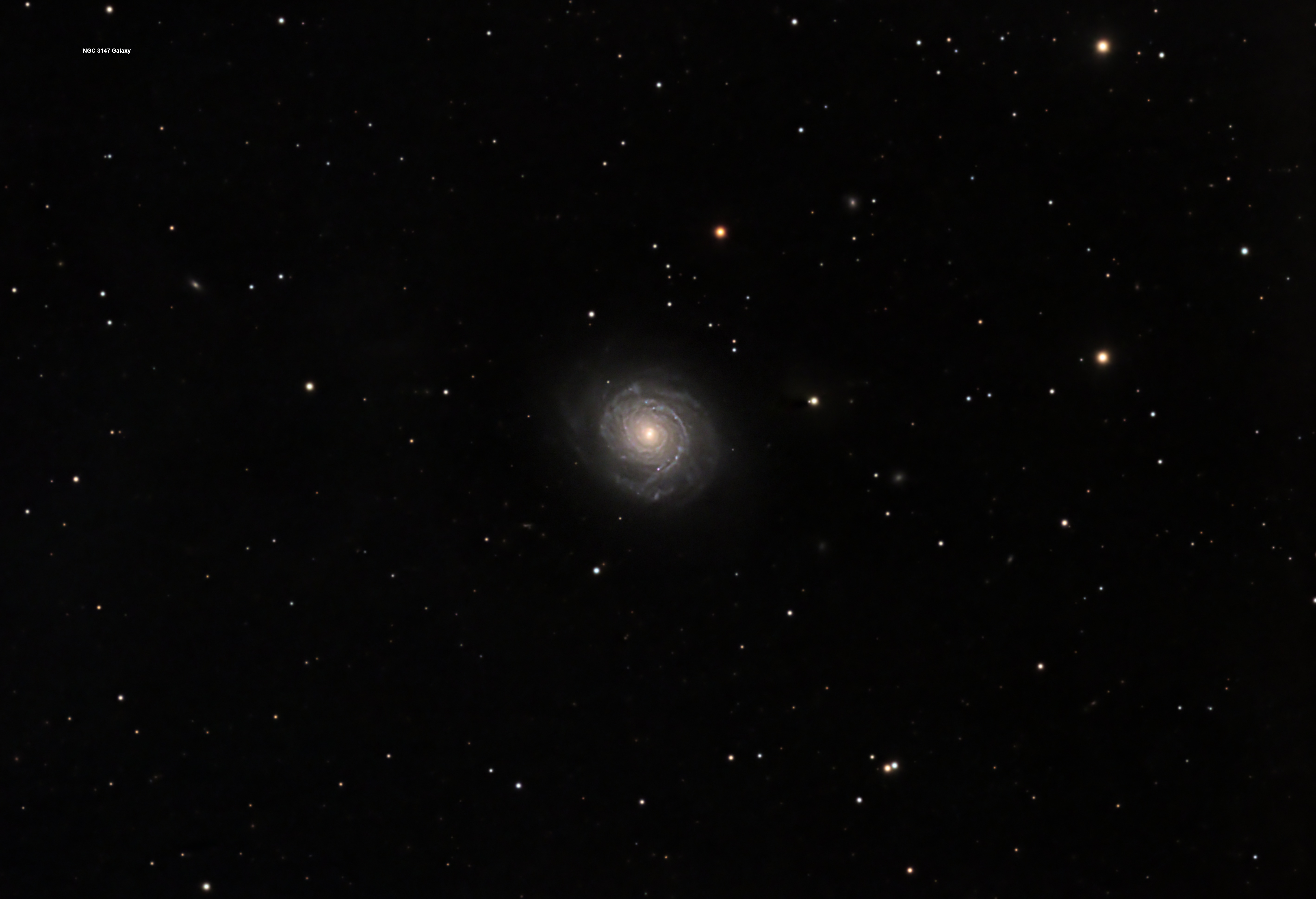
The galaxy has a small and bright nucleus and tightly wound multiple spiral arms. The overall appearance of the galaxy resembles that of NGC 488, however the nuclear bulge is smaller.
The arms consist of spiral segments that branch after approximately one quarter of a revolution. HII regions can be detected in the arms.
NGC 3147 has been characterised as a Seyfert II galaxy. It is considered the best candidate to be a true type II Seyfert galaxy,
galaxies which feature optical/UV spectrum lacking broad emission lines due to the lack of the broad line region rather than its obscuration,
since the nucleus is simultaneously seen unobscured in the X-rays.
The graceful, winding arms of the majestic spiral galaxy NGC 3147 appear like a grand spiral staircase sweeping through space.
They are actually long lanes of young blue stars, pinkish nebulas, and dust in silhouette.
The beauty of the galaxy belies the fact that at its very center is a malnourished black hole surrounded by a thin, compact disk of stars, gas, and dust that have been caught up in a gravitational maelstrom.
The black hole's gravity is so intense that anything that ventures near it gets swept up in the disk.
The disk is so deeply embedded in the black hole's intense gravitational field that the light from the gas disk is modified,
according to Einstein's theories of relativity, giving astronomers a unique peek at the dynamic processes close to a black hole.
Click Below Image(s) for Full Size:
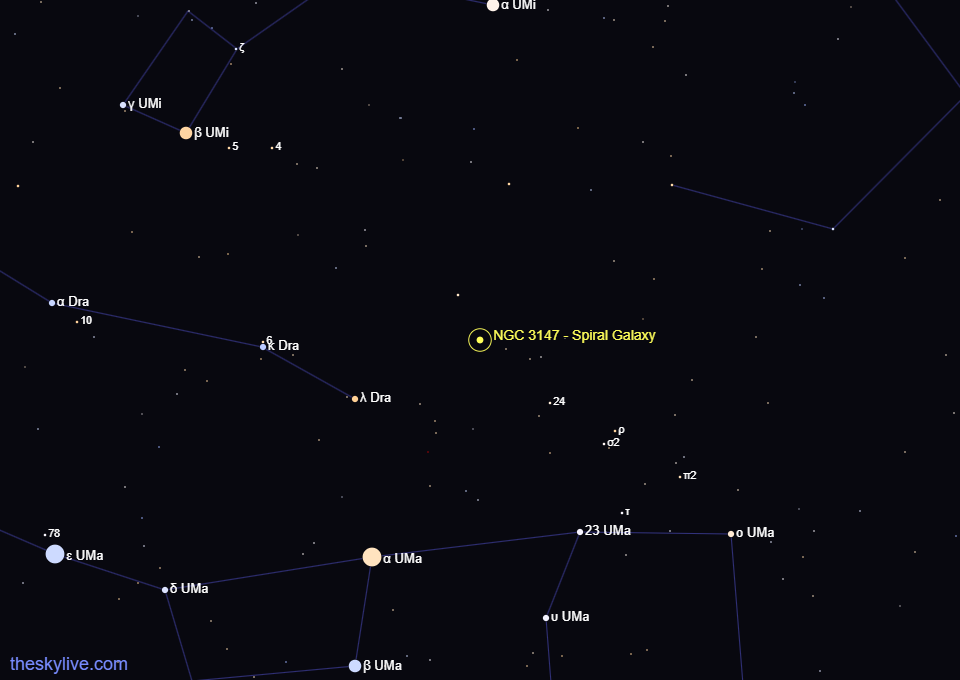
NGC 3147 is a Spiral Galaxy in the Draco constellation. NGC 3147 is situated close to the northern celestial pole and, as such, it is visible for most part of the year from the northern hemisphere.
Given its visual magnitude NGC 3147 is visible with the help of a telescope having an aperture of 6 inches (150mm) or more
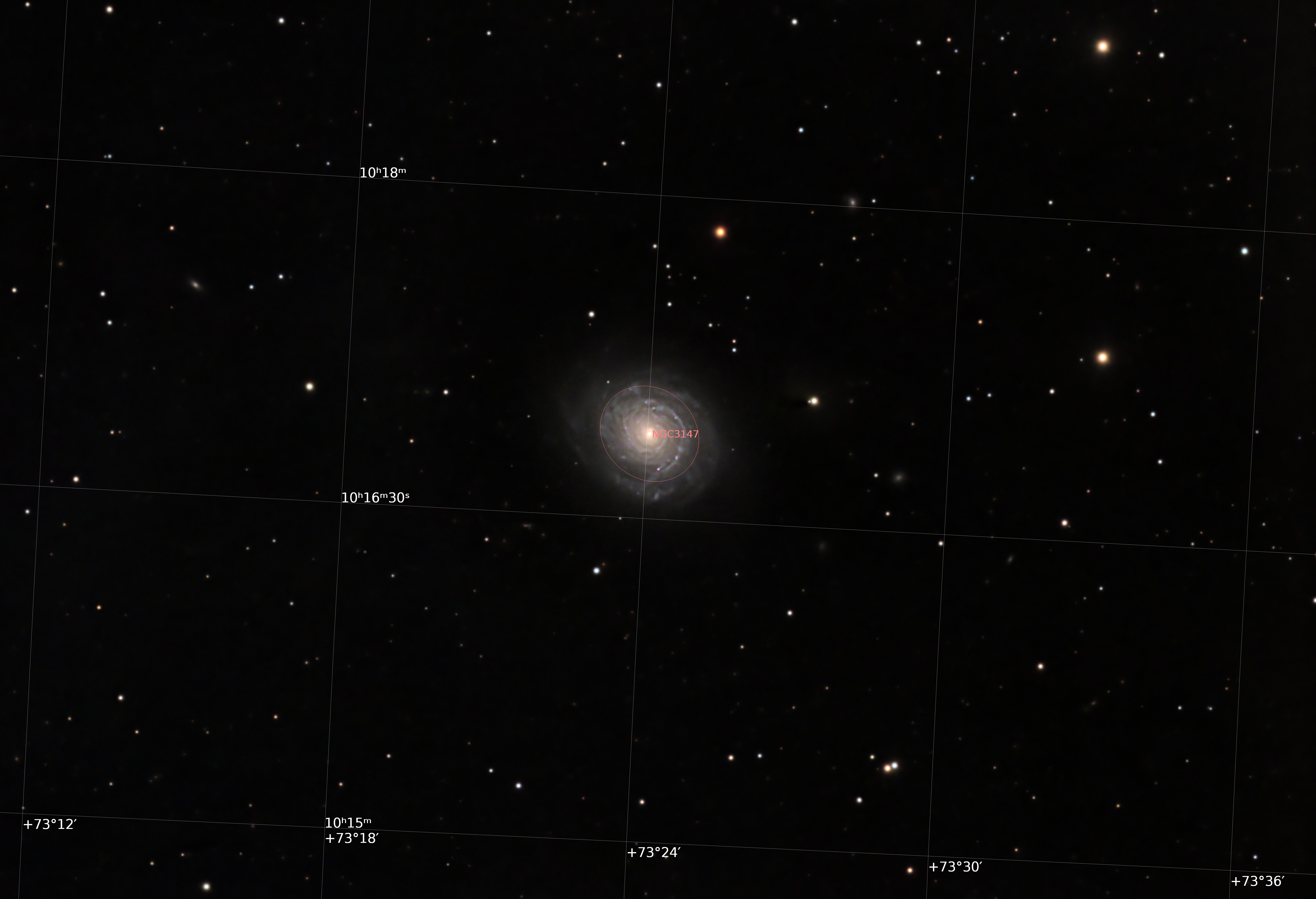
Platesolve
NGC 3147 Galaxy
Imaging Details
Click to Return to Home Page