NGC 2854, NGC 2856, NGC 2857 Galaxies
Also Known as: ARP 285, UGC 4995 (NGC 2854), ARP 285, UGC 4997 (NGC 2856), Arp 1, PGC 26666, UGC 5000 (NGC 2587)
Object Type: Spiral Galaxies
Constellation: Ursa Major
Distance from Earth: 127 million light years (NGC 2854), 121 million light years (NGC 2856), 225 million light years (NGC 2587)
Apparent Magnitude: 13.8 (NGC 2854), 13.2 (NGC 2856), 12.3 (NGC 2857)
Coordinates: RA 09H 24M 02.9S DEC 49 deg 12 min 14 sec (NGC 2854), RA 09H 24M 16.2S DEC 49 deg 14 min 57 sec (NGC 2856), RA 09H 24M 37.698S DEC 49 deg 21 min 25.69 sec (NGC 2857)
Actual Size: 47,280 light years (NGC 2854), 42,900 light years (NGC 2856), 111,264 light years (NGC 2857)
Apparent Dimensions: 1.28 arcminutes x 0.56 arcminutes (NGC 2854), 1.22 arcminutes x 0.58 arcminutes (NGC 2856), 1.7 arcminutes x 1.43 arcminutes (NGC 2857)
Discovered by: NGC 2857 was discovered on January 9, 1856, by R. J. Mitchell.
On 9 March 1788 William Herschel found two nebulae with his 18.7 inch reflecting telescope. He cataloged them as III 713 and III 714 (class III = very faint nebulae).
He noted both as «considerably faint, considerably small, little extended».
Later in 1888 Dreyer cataloged nebula III 713 as NGC 2856 and nebula III 714 as NGC 2854.
The pretty face-on spiral nebula nearby was obviously overseen by Herschel. It remained unnoticed until 9 January 1856 when the Irish astronomer R. J. Mitchell, an assistant to William Parsons, 3rd Earl of Rosse,
discovered it with the giant 72 inch «Leviathan of Birr Castle».
Dreyer cataloged it in 1888 as NGC 2857 and added the description: «very faint, pretty large, 4 stars preceding.»
In 1966 Halton Arp published his «Atlas of Peculiar Galaxies», where he ordered galaxies into groups based on purely morphological criteria.
The galaxy NGC 2857 was the first entry in his catalog in the first group «spiral galaxies, low surface brightness» (group #1-6).
He just remarked: «High contrast print of low surface brightness spiral.» The pair of galaxies NGC 2854 and NGC 2856 received the designation Arp 285,
classified as «double galaxies, infall and attraction» (group #281-286). He remarked: «Narrow tail leads away from northern nucleus.»
Description: NGC 2857 is the first object in Halton Arp's Atlas of Peculiar Galaxies, and one of six Arp objects in the 'Low Surface Brightness Galaxies' section.
The other five low surface brightness galaxies are Arp 2 (UGC 10310), Arp 3, Arp 4, Arp 5 (NGC 3664), and Arp 6 (NGC 2537).
The group are not physically associated, with NGC 2854/56 thought to lie at a distance almost twice as far away.
The galaxies are also included in the galaxy group WBL 221, which contains 7 galaxies including NGC 2857, although as noted this galaxy is twice as far away as the others.
NGC 2857 is also included in the 11 galaxy group LGG 168 (which does not include NGC 2854 or NGC 2856).
The strong UV signals shown in the GALEX observations from all three galaxies suggest that there is a lot of star formation going on in them.
The UV observations also suggest tidal tails being drawn out from NGC 2854, probably from its interaction with NGC 2856.
There is also possibly a string of material, originally thought to be a jet, being drawn out from NGC 2856 that is best seen in the UV as well,
although there are signs of it on both the SDSS and PanSTARRS images as well.
It is not however a jet but a series of star forming complexes. The material to form these would have been accreted from NGC 2854.
Click Below Image(s) for Full Size:
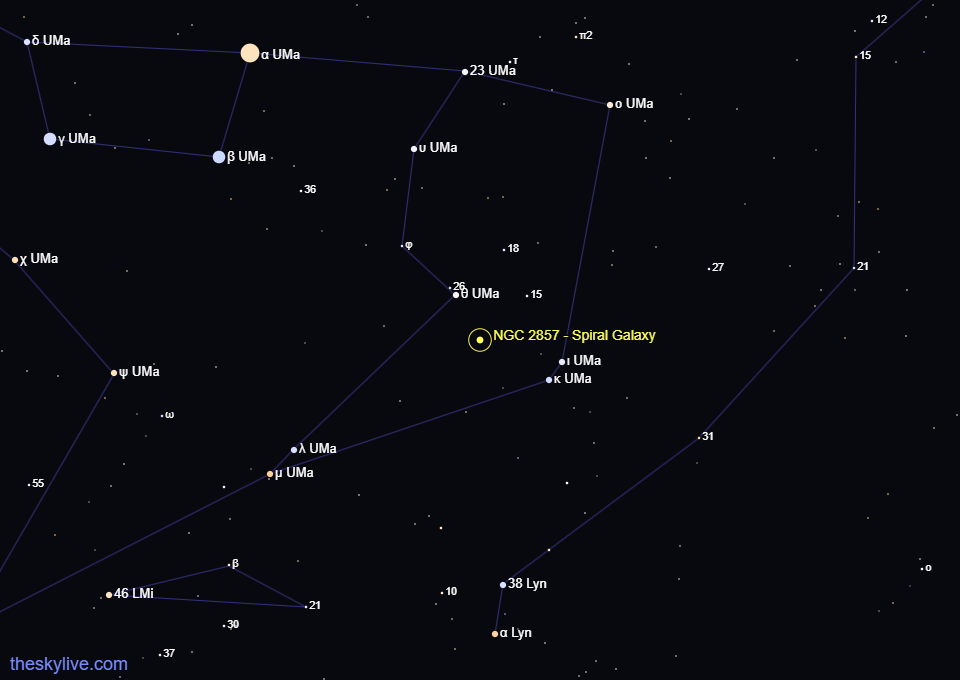
NGC 2854 is a Barred Spiral Galaxy in the Ursa Major constellation. NGC 2854 is situated north of the celestial equator and, as such, it is more easily visible from the northern hemisphere.
Given its NGC 2854 is visible with the help of a telescope having an aperture of 14 inches (350mm) or more.NGC 2857 is a Spiral Galaxy in the Ursa Major constellation.
NGC 2856 is a Barred Spiral Galaxy in the Ursa Major constellation. NGC 2856 is situated north of the celestial equator and, as such, it is more easily visible from the northern hemisphere.
Given its B, NGC 2856 is visible with the help of a telescope having an aperture of 14 inches (350mm) or more.NGC 2857 is situated north of the celestial equator and, as such, it is more easily visible from the northern hemisphere.
Given its visual magnitude NGC 2857 is visible with the help of a telescope having an aperture of 8 inches (200mm) or more.
Platesolve
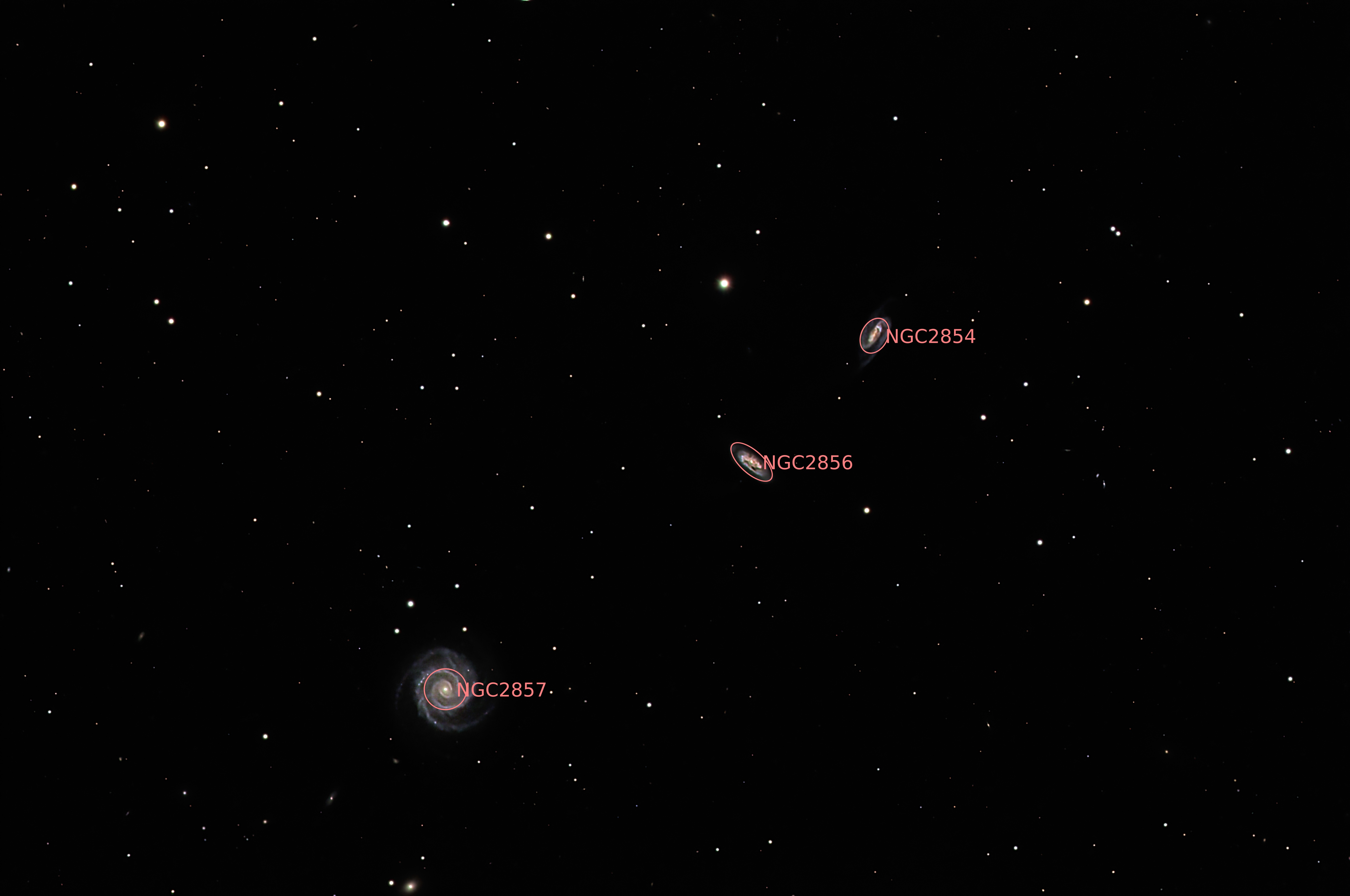
NGC 2854, NGC 2856, NGC 2857 Spiral Galaxies

Imaging Details
Click to Return to Home Page