NGC 2274 & NGC 2275
Also Known as: PGC 19603, UGC 3541 (NGC 2274), UGC 3542 (NGC 2275)
Object Type: Elliptical Galaxy (NGC 2274), Spiral Galaxy (NGC 2275)
Constellation: Gemini
Distance from Earth: 2 billion light years (NGC 2274)
Apparent Magnitude: 13.6 (NGC 2274), 14.5 (NGC 2275)
Coordinates: RA 06H 48m 59S DEC 33deg 32min 12sec (NGC 2274), RA 06H 49m 00s DEC 33deg 34min 08sec (NGC 2275)
Actual Size:
Apparent Dimensions: 1.78 arcminutes (NGC 2274), 2.51 arcminutes x 0.78 arc minutes (NGC 2275)
Discovered by: NGC 2274 and NGC 2275 were discovered by William Herschel on October 26, 1786 with an 18.7-inch f/13 speculum telescope.
He called it "Two. The southern [NGC 2274] is F, S, R, bM. The northern [NGC 2275] F, cS, R, bM."
Description: NGC 2274 is the brighter of the two being an elliptical galaxy. At 12th magnitude this may be a challenge to find. Its companion NGC 2275 is actually much fainter and is an unclassified spiral.
It appears to be undergoing some form of interaction as one of its spirals arms is much more obvious than the other.
The pair is actually part of a small group of galaxies which has been variously catalogued as LGG 139 or WBL 121. The group consists of the four galaxies, NGC 2274, 2275, 2290 and UGC 3537.
NGC 2290 is actually quite a distance from the others at 47’ of arc away. It appears with another group of galaxies which are in fact unrelated.
NGC 2290 was also discovered by William Herschel but in 1793. The separation is due to the fact that the group is relatively close to us at about 4.6 Mpc so the group is spread out on the sky.
Click Below Image(s) for Full Size:
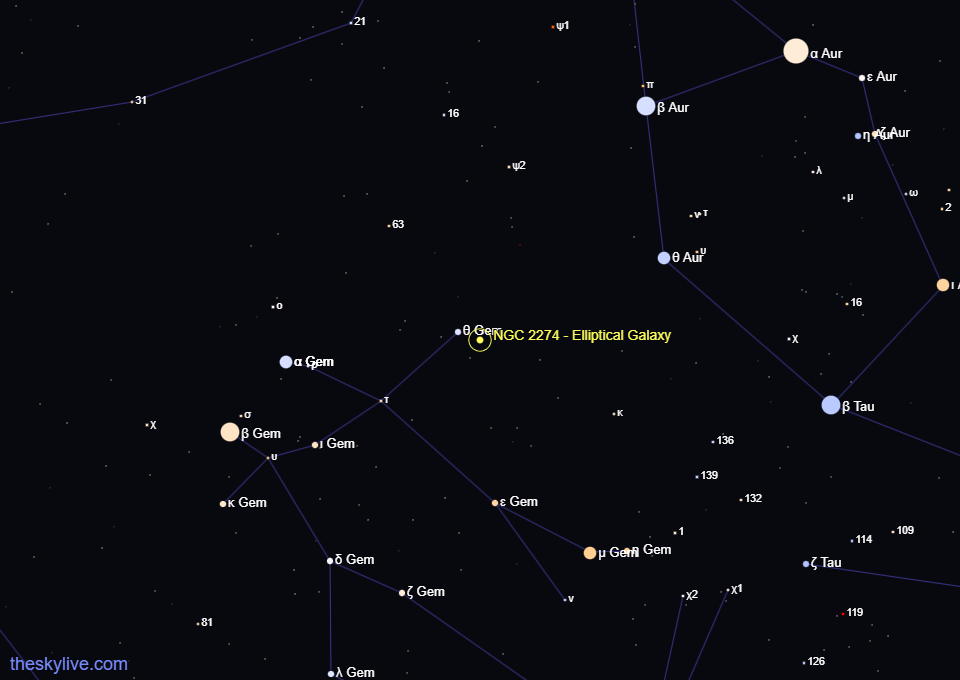
NGC 2274 is a Elliptical Galaxy in the Gemini constellation. NGC 2274 is situated north of the celestial equator and, as such, it is more easily visible from the northern hemisphere.
Given its B magnitude of 13.6, NGC 2274 is visible with the help of a telescope having an aperture of 14 inches (350mm) or more.
NGC 2275 is a Spiral Galaxy in the Gemini constellation. NGC 2275 is situated north of the celestial equator and, as such, it is more easily visible from the northern hemisphere.
Given its B magnitude, NGC 2275 is visible with the help of a telescope having an aperture of 20 inches (500mm) or more.
NGC 2274 and 2275 have been reported with apertures as small as 15cm from very dark sites but I suspect that probably 30cm will be needed from most normal sites, certainly to see NGC 2275.
The other galaxy in the group UGC 3537 appears to be a face on spiral and is quite faint and is going to be a challenge to see unless you have a large telescope
Platesolve
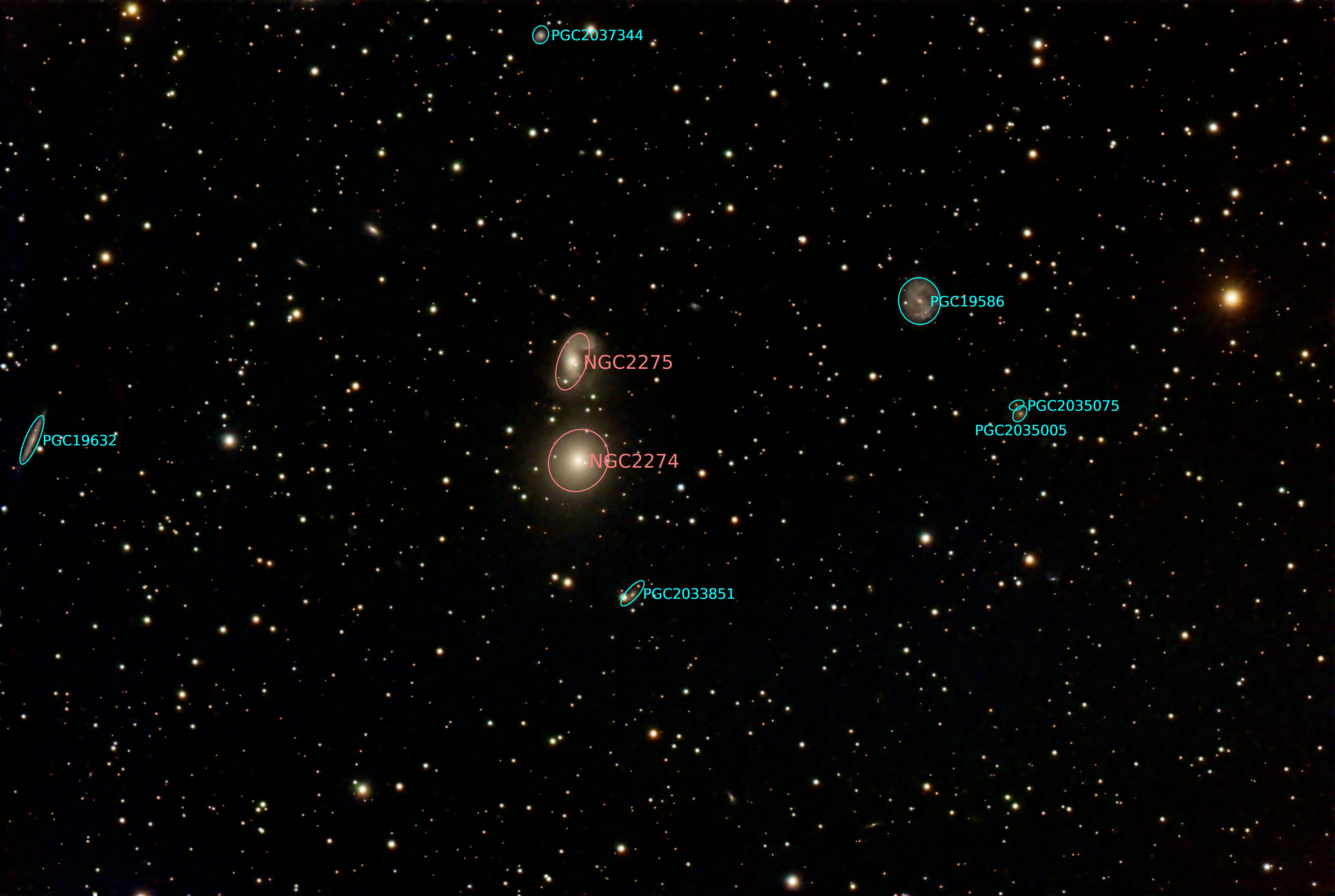
NGC 2274 & NGC 2275 Galaxies

Imaging Details
Click to Return to Home Page