NGC 133 & NGC 146 group
Also Known as: Collinder 3 (NGC 133)
Object Type: Open Clusters
Constellation: Cassiopeia
Distance from Earth: 630 Light years (NGC 133), 9,880 light years (NGC 146)
Apparent Magnitude: 9.4 (NGC 133), 9.1 (NGC 146)
Coordinates: RA 00H 31M 16.9S DEC 63 deg 21 min 09 sec (NGC 133), RA 00H 33M 3.9S DEC 63 deg 18 min 32 sec (NGC 146)
Actual Size: 0.4 light years (NGC 133)
Apparent Dimensions: 2.1 arc-minutes x 2.1 arc-minutes (NGC 133)
Discovered by: NGC 133 was discovered by Heinrich d'Arrest on February 4, 1865. NGC 146 was discovered by John Herschel in 1829 using his father's 18.7 inch reflecting telescope.
Description: NGC 133, along with NGC 146, are a pair of open clusters in Casseopeia, located close to the moderately bright star kappa cassopeae.
NCG 146 is at most 10 million years old
Click Below Image(s) for Full Size:
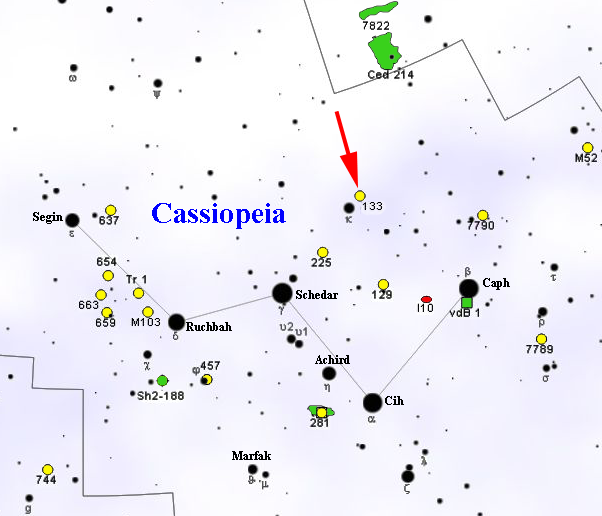
Based on the location of Cassiopeia, NGC 133 can be located in the northern hemisphere of the celestial sky. The celestial hemisphere is equivalent to the hemispheres on Earth.
NGC 133 is north of the Ecliptic.
The Ecliptic is the path the Earth takes as it orbits the Sun. As the Earth is titled, we have Celestial and Ecliptic hemispheres.
The two clusters are not overly impressive in binoculars, but appear better in the telescope.
NGC 146 is fairly easy to locate in the sky, being half a degree away from the bright star Kappa Cassiopeiae.
Its relatively high declination of about 63° means it is not visible for below 27° S.
Platesolve
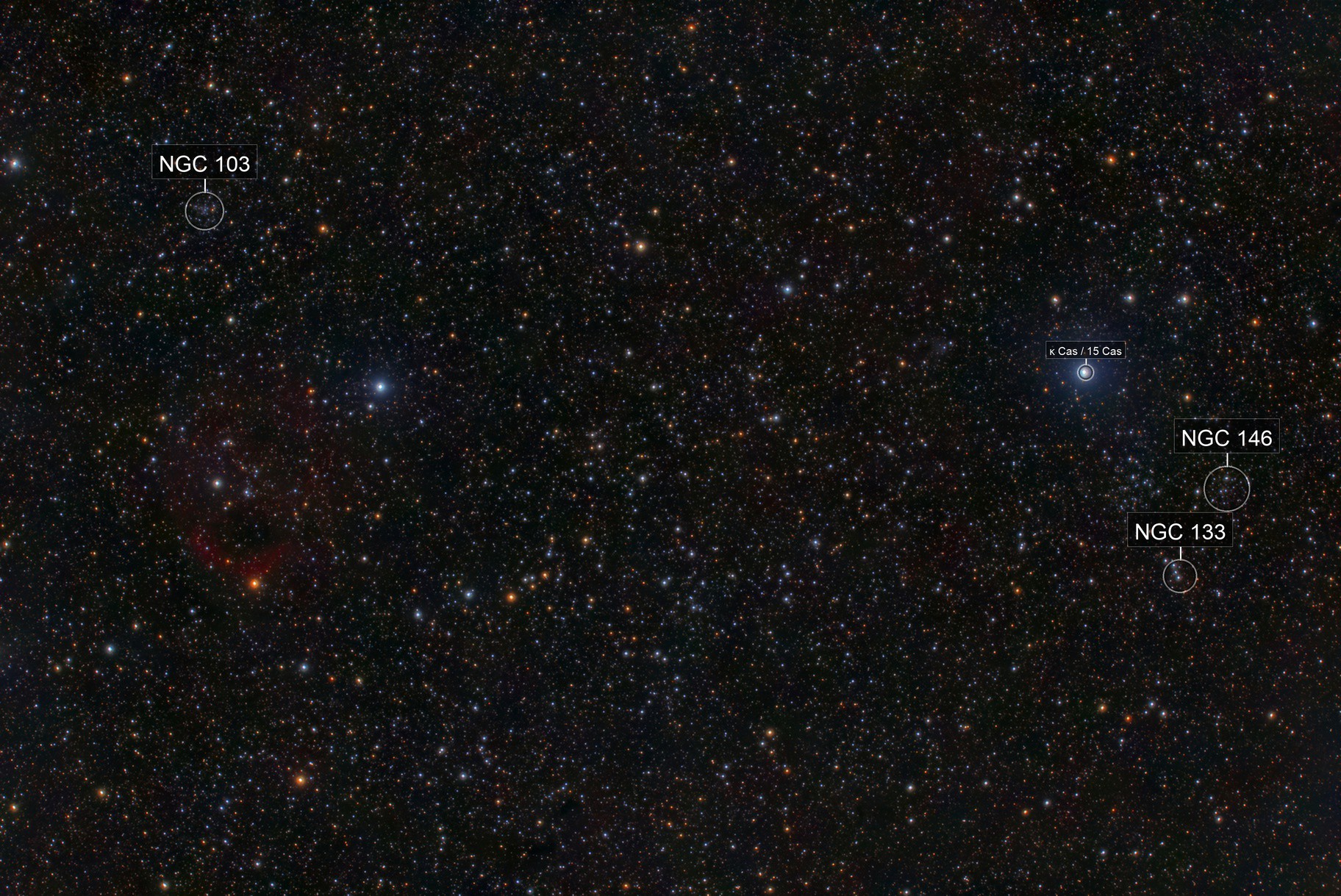
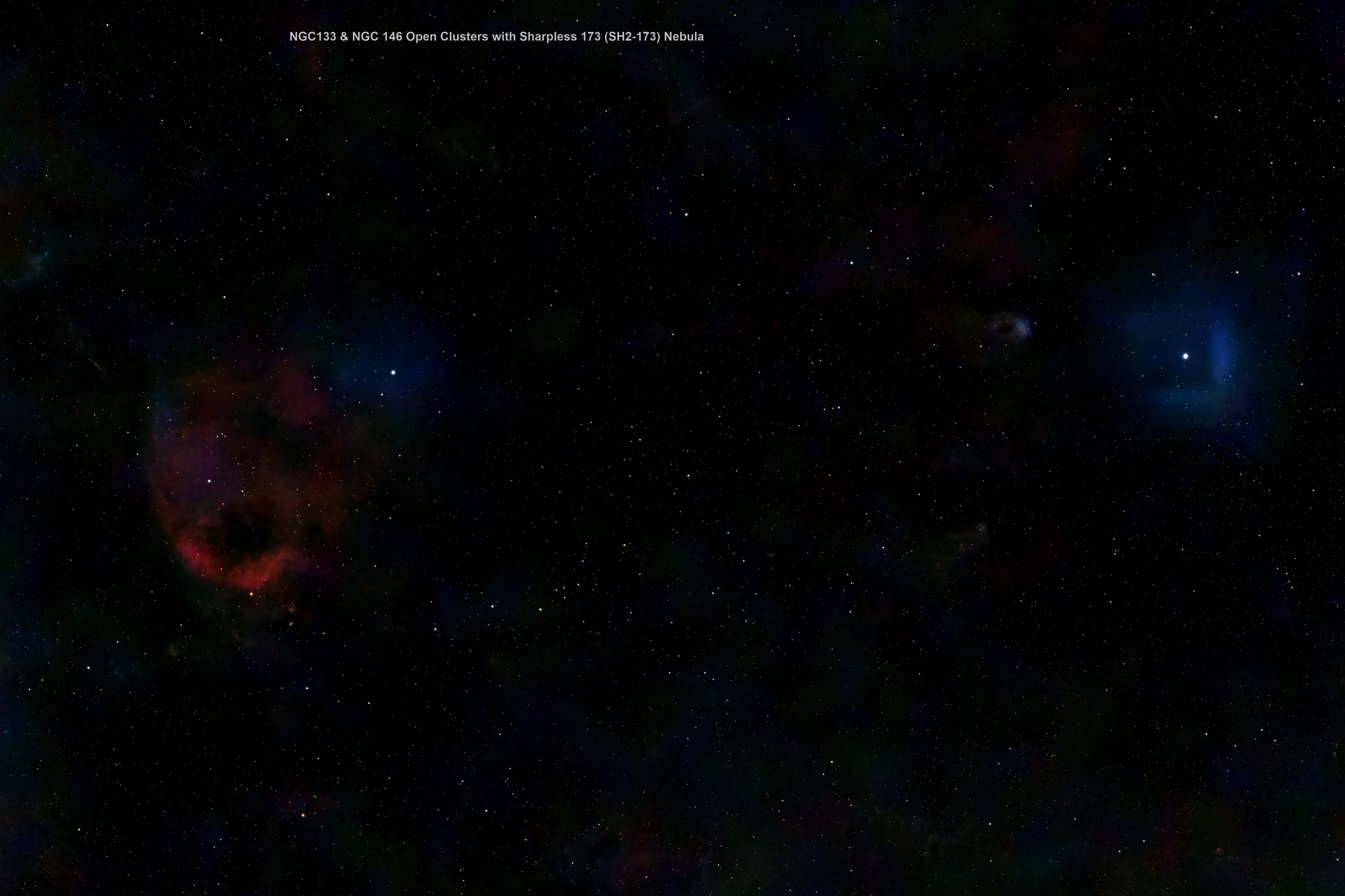
NGC 133 and NGC 146 Open Clusters with Sharpless (Sh2-173) nebula

NGC 133 and NGC 146 Open Clusters with Sharpless (Sh2-173) nebula
Imaging Details
Click to Return to Home Page