NGC 103 and Sharpless 173
Also Known as: Cr 1 (NGC 103), SH2-173 (Sharpless 173)
Object Type: Open Cluster
Constellation: Cassiopeia
Distance from Earth: 4,600 Light years
Apparent Magnitude: 9.8
Coordinates: RA 00H 25M 18S DEC 61 deg 21 min 0 sec
Actual Size: 8.5 light years (NGC 103)
Apparent Dimensions: 6.4 arc-minutes x 6.4 arc-minutes
Discovered by: Caroline Herschel discovered on 27 September 1783 the cluster known today as NGC 189 using her 4.2-inch comet-seeker reflector.
She entered it as number 12 in her discovery log and noted: «About 1° south of the above cluster [NGC 225] a faint nebula surrounded with a great number of both large and small stars».
William Herschel made no observations and John Herschel, not knowning his aunt's discovery log,
independently discovered the cluster on 27 October 1829 and recorded it as h 36 with the remarks: «Cluster, Large; pretty rich; irregular round; 8' diameter; straggling; *s 11...15m.».
Dreyer credited John Herschel with the discovery in the NGC.
Using his 18.7-inch speculum reflector William Herschel discovered on 26 November 1788 the cluster known today as NGC 136.
He then cataloged it as VI 35 and noted: «A small cluster of very faint, exceedingly compressed stars about 1' diam.
The next step to an easily resolvable nebula.» On 16 December of the same year he discovered another open cluster, which he logged as VIII 79 with the remarks: «A coarsely scattered cluster of large stars, mixed with smaller ones, not very rich.»
That cluster received in 1888 by Dreyer its designation NGC 129.
John Herschel discovered on 5 October 1829 the cluster known today as NGC 103. He observed with his 18¼-inch reflector and logged the cluster as h 20. He wrote: «Pretty small, pretty compressed cl; 3' diam; st 11...18m in 2 or 3 principal branches.
If this be VI 35, there must be a mistake in my father's obs or mine of 6m in RA.»
He was wrong, but the first observation of this cluster was made by his father on 26 November 1788 when he noted «clustering, small stars, considerable rich». But he did not assign it a discovery number.
Sh2-173 was discovered by Russian astronomers Grigory Shajn and Vera Gaze in the early 1950s and was initially listed as Simeis 21.
It was later cataloged as Sh2-173 by Stewart Sharpless in his 1959 survey.
Description: NGC 103 is moving away from us at 78.11 km/s.
Sh2-173 is part of the Perseus arm of our Milky Way Galaxy.
Its shape and dark dust clouds bear a resemblance to the mask worn by the Phantom of the Opera in the Broadway musical or the film starring Lon Chaney. Hence it is commonly referred to as the Phantom of the Opera Nebula.
Sh2-173 is about 3 degrees north of Caph (β-Cas, mag 2,27) and was estimated to be about 600,000 to 1,000,000 years old.
The emission nebula contains 7 bright CAS-OB5 stars and is primarily ionized by the only O-star BD+6039. It turns out that Sh2-173 is still expanding at a speed of about 16km/s. Sh2-173 is harboring 46 young star objects.
Click Below Image(s) for Full Size:
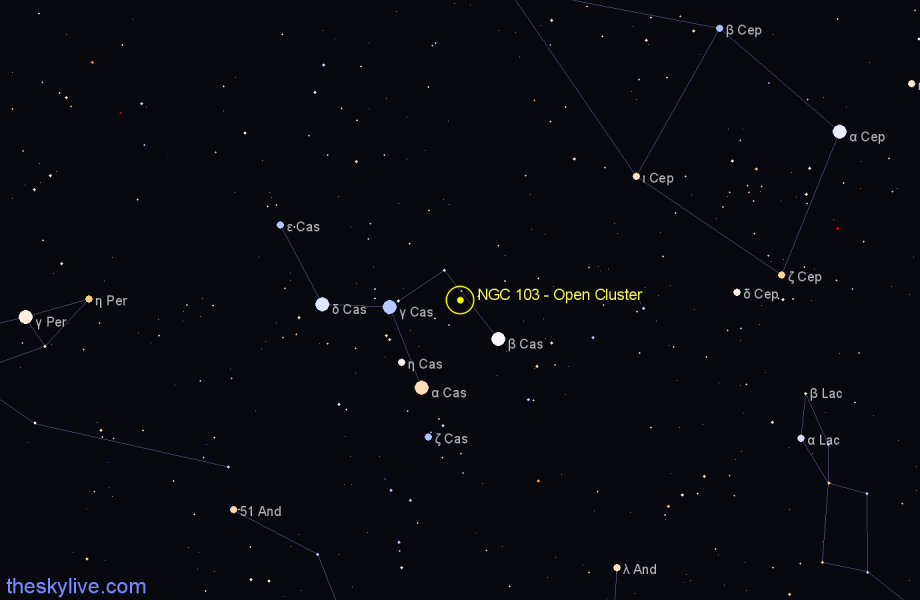
NGC 103 is partially visible with an 8 inch telescope. NGC 103 is situated close to the north celestial pole so it is visible most of the year.
Platesolve
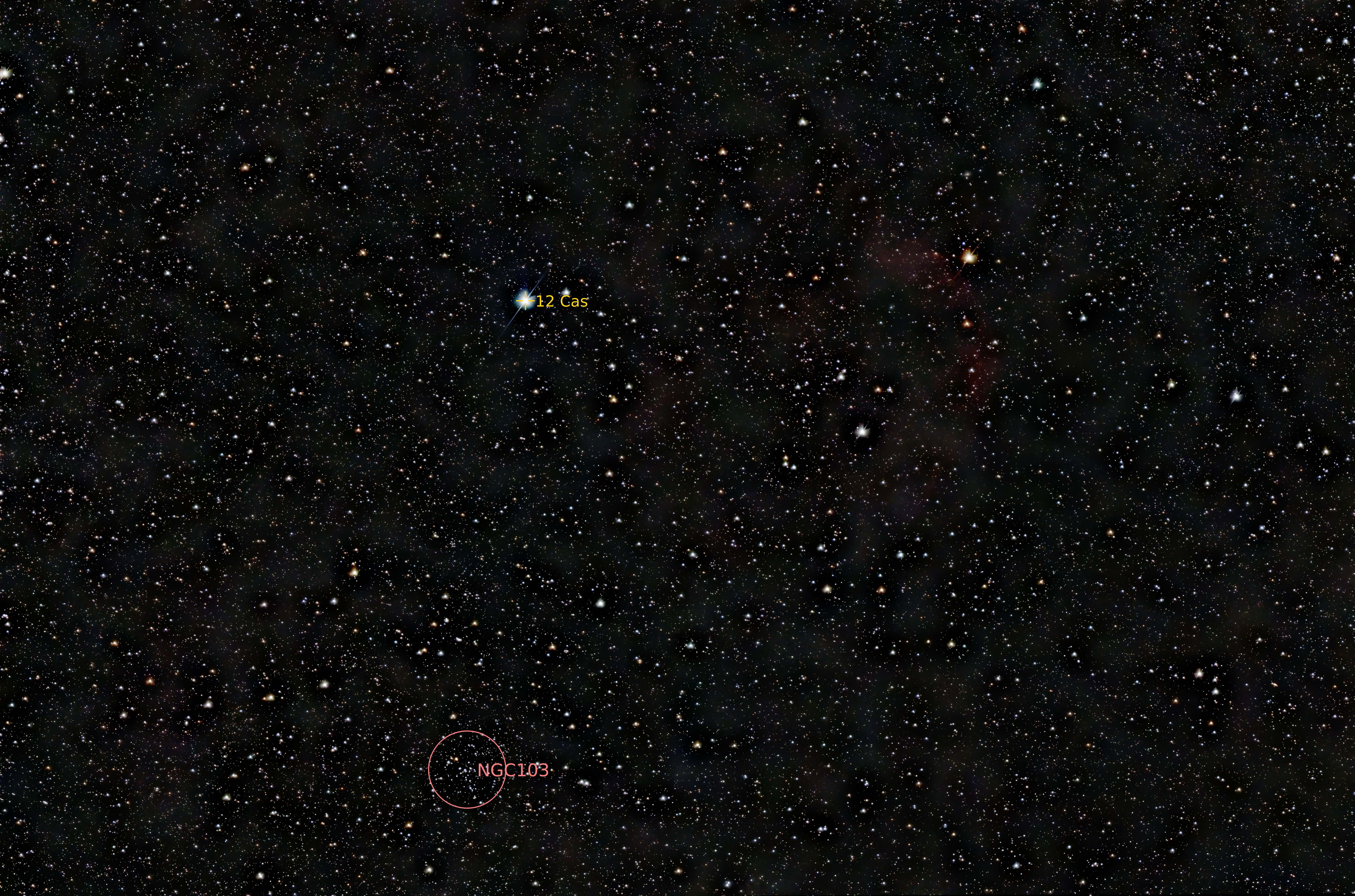
NGC 103 Open Cluster and Sharpless 173 (Sh2-173) Nebula

Imaging Details
Click to Return to Home Page