Orionid Meteor Shower 2019
Constellation: Just to the north of constellation Orion's bright star Betelgeuse
Origin: 1P/Halley
Velocity: 241 miles (66 kilometers) per second
Active Dates: Oct. 2 - Nov. 12, 2025 (Peak night: Oct. 22-23)
Rate: About 5 to 6 meteors per hour
Description:The Orionids meteor shower, often shortened to the Orionids, is one of two meteor showers associated with Halley's Comet.
The Orionids are so-called because the point they appear to come from, called the radiant, lies in the constellation Orion, but they can be seen over a large area of the sky.
The Orionids are an annual meteor shower which last approximately one week in late October.
In some years, meteors may occur at rates of 50–70 per hour.
Orionid outbursts occurred in 585, 930, 1436, 1439, 1465, and 1623.
The Orionids occur at the ascending node of Halley's comet. The ascending node reached its closest distance to Earth around 800 BCE.
Currently Earth approaches Halley's orbit at a distance of 0.154 AU (23.0 million km; 14.3 million mi; 60 LD) during the Orionids.
The next outburst might be in 2070 as a result of particles trapped in a 2:13 MMR with Jupiter.
The Orionids meteor shower is produced by Halley's Comet, which was named after the astronomer Edmund Halley and last passed through the inner Solar System in 1986 on its 75–76 year orbit.
When the comet passes through the Solar System, the Sun sublimates some of the ice, allowing rock particles to break away from the comet.
These particles continue on the comet's trajectory and appear as meteors ("falling stars") when they pass through Earth's upper atmosphere.
The meteor shower radiant is located in Orion about 10 degrees northeast of Betelgeuse.
The Orionids normally peak around October 21–22 and are fast meteors that make atmospheric entry at about 66 km/s (150,000 mph).
Click Below Image(s) for Full Size:
Orionid Meteor Shower Radiant
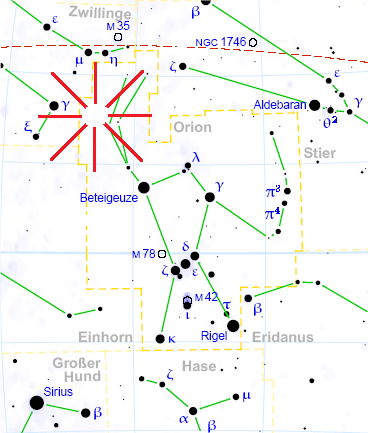
Orionid Meteor Shower

Imaging Details
Click to Return to Home Page