Lyrid Meteor Shower 2020
Constellation: Lyra
Origin: C/1861 G1 Thatcher
Velocity: 29 miles (47 kilometers) per second
Active Dates: April 17 to April 26, 2025 (Peak night: April 21-22)
Rate: About 5 to 6 meteors per hour
Description: The April Lyrids are a meteor shower lasting from about April 15 to April 29 each year.
The radiant of the meteor shower is located near the constellations Lyra and Hercules, near the bright star Vega.
The peak of the shower is typically around April 22–23 each year.
The source of the meteor shower are particles of dust shed by the long-period Comet C/1861 G1 Thatcher.
The April Lyrids are the strongest annual shower of meteors from debris of a long-period comet, mainly because as far as other intermediate long-period comets go (200–10,000 years),
this one has a relatively short orbital period of about 415 years.
The Lyrids have been observed and reported since 687 BC; no other modern shower has been recorded as far back in time.
Counts typically range from 5 to 20 meteors per hour, averaging around 10. As a result of light pollution, observers in rural areas will see more than observers in a city.
Nights without the Moon in the sky will reveal the most meteors.
April Lyrid meteors are usually around magnitude +2. However, some meteors can be brighter, known as "Lyrid fireballs", cast shadows for a split second and leave behind smokey debris trails that last minutes.
Occasionally, the shower intensifies when the planets steer the one-revolution dust trail of the comet into Earth's path, an event that happens about once every 60 years.
This results in an April Lyrid meteor outburst. The one-revolution dust trail is dust that has completed one orbit: the stream of dust released in the return of the comet prior to the current 1862 return.
Click Below Image(s) for Full Size:
Lyrid Meteor Shower Radiant
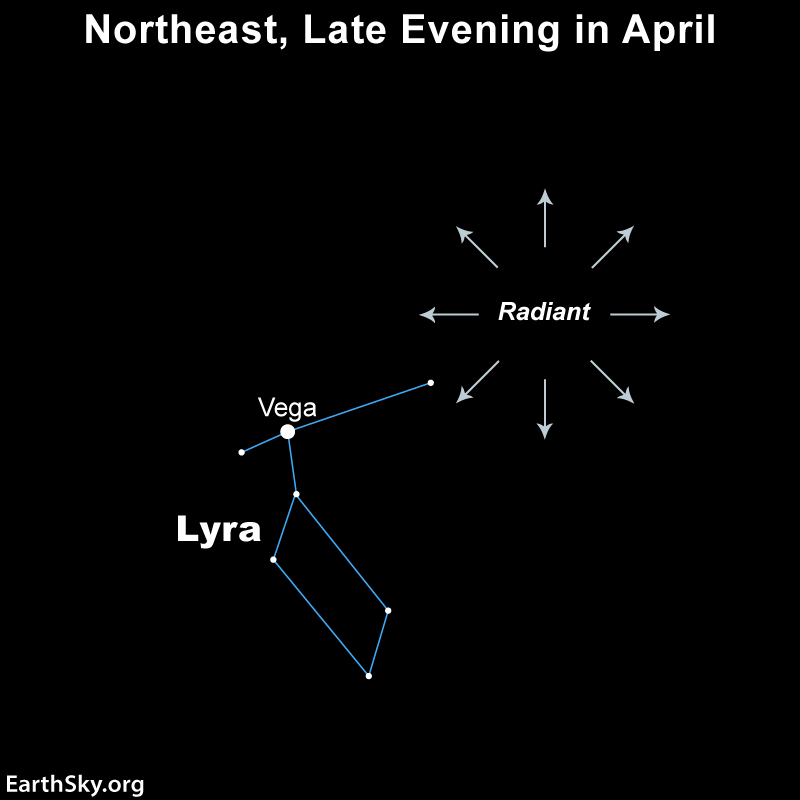
Lyrid Meteor Shower

Imaging Details
Click to Return to Home Page