Messier 99 (M99)
Common Name: St Catherine's Wheel
Also Known as: NGC 4254, Coma Pinwheel, Virgo Cluster Pinwheel
Object Type: Grand Design Unbarred Spiral Galaxy
Constellation: Coma Berenices
Distance from Earth: 55.7 million Light years
Apparent Magnitude: 10.4
Coordinates: RA 12H 18M 49.6S DEC 14deg 28min 59sec
Actual Size: 85,000 light years in diameter
Apparent Dimensions: 5.4 arc-minutes x 4.7 arc-minutes
Discovered by: The Virgo Cluster Pinwheel was discovered by the French astronomer Pierre Méchain on March 17, 1781, along with the galaxies Messier 98 and Messier 100.
Méchain reported the discovery to his friend Charles Messier, who determined the positions for the three objects and added them to the Messier catalogue on April 13, 1781, just before completing the third and final edition.
Messier noted: Nebula without star, of a very pale light, nevertheless a little clearer than the preceding [Messier 98], situated on the northern wing of Virgo, & near the same star, no. 6, of Comae Berenices.
The nebula is between two stars of seventh & of eighth magnitude.
Méchain saw it on March 15, 1781.
Description: M99 is one of the brighter spiral galaxies in the Virgo Cluster and appears almost face-on.
Messier 99 is a grand design spiral, completely unbarred and with two giant spiral arms. One of the spiral arms is normal and the other appears distorted.
M99 is slightly asymmetric in shape, with the nucleus shifted from the galaxy’s center, likely as a result of interactions with other galaxies in the Virgo Cluster.
M99 rotates clockwise and is classified as an Sc type spiral galaxy. It is receding from us at an unusually high velocity of 2,407 km/s. This is the highest redshift recorded for any Messier object.
Even though the Virgo Cluster Pinwheel has a diameter of 80,000 light years – almost the same size as the Milky Way –with an estimated mass of 50 billion solar masses, it has only 5 percent of our galaxy’s mass.
The M99 galaxy has a normal looking arm and an extended spiral arm that appears less tightly wound.
The galaxy is linked to the nearby VIRGO HI21 by a bridge of neutral hydrogen gas. The gravity from VIRGO HI21, an extended region of neutral hydrogen (HI) and suspected dark galaxy, is believed to have drawn out the gas bridge and distorted M99 in a close encounter.
However, as the existence of the dark galaxy is unclear, M99 may have instead interacted with the lenticular galaxy NGC 4262 about 280 million years ago. As a result of the encounter, the star forming rate in M99 is three times greater than in other galaxies of similar type.
Messier 99 was one of the first spiral galaxies in which a spiral pattern was recognized. The spiral pattern was first observed by William Parsons, 3rd Earl of Rosse, in the spring of 1846.
M99 was the second object Lord Rosse recognized as a spiral, after the Whirlpool Galaxy (M51), which he had discovered about a year before M99.
Click Below Image(s) for Full Size:
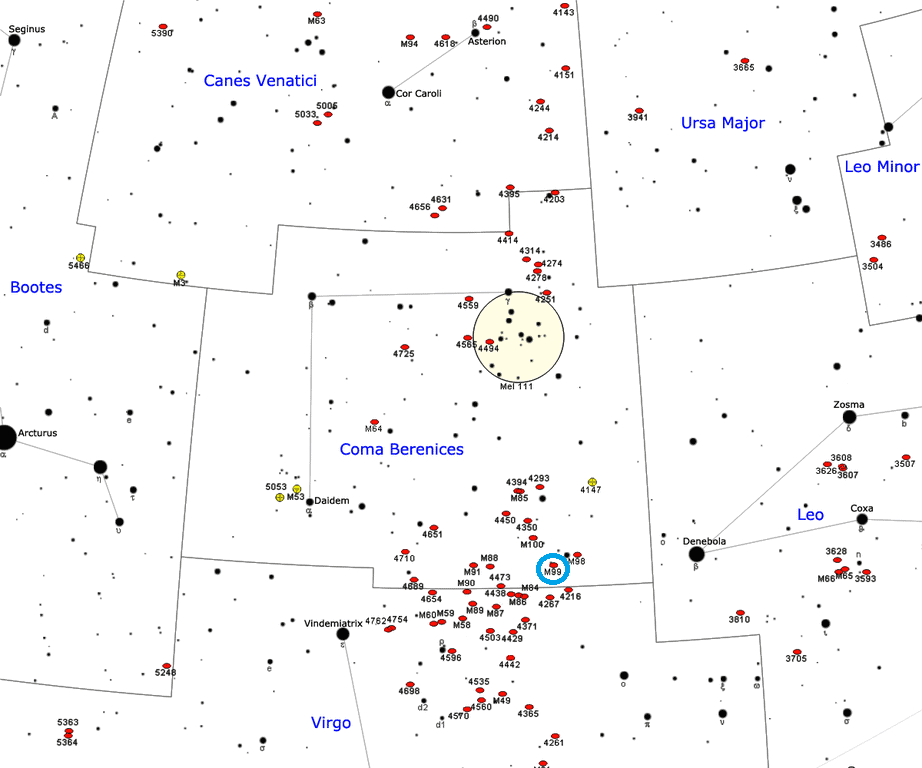
The galaxy can be seen in small telescopes, but only appears as a dim ball of light with a brighter center. 8-inch telescopes reveal a hazy patch of light with a more clearly defined center.
10-inch telescopes begin to hint at the spiral structure under good conditions, and larger instruments reveal the galaxy’s dust bands and other details.
The best time of year to observe M99 and other galaxies in the Virgo Cluster is during the spring.
Platesolve
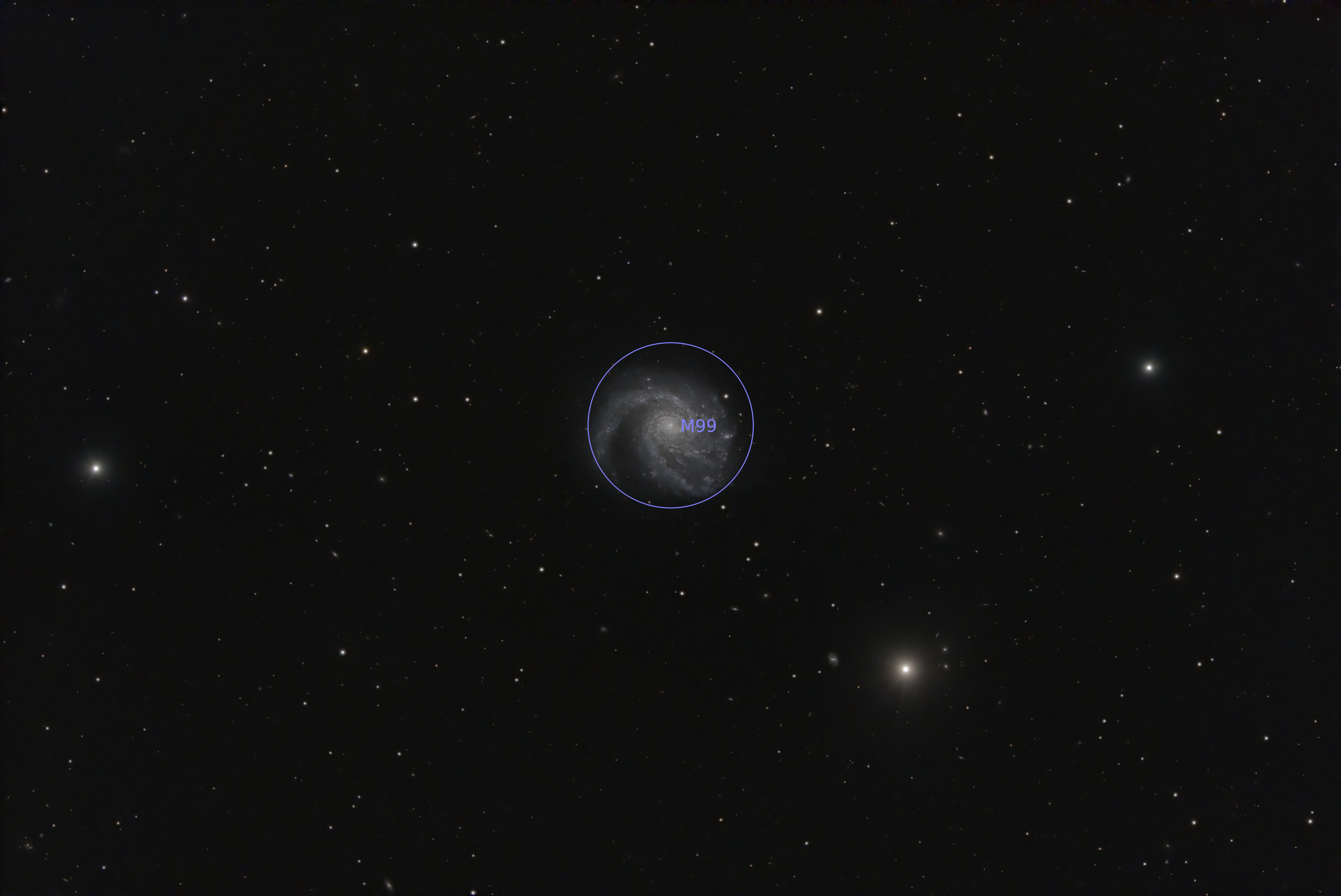
M99 Spiral Galaxy

Imaging Details
Click to Return to Home Page