Messier 95 (M95)
Also Known as: NGC 3351
Object Type: Barred Spiral Galaxy
Constellation: Leo
Distance from Earth: 32.6 million light years
Apparent Magnitude: 11.4
Coordinates: RA 10H 43M 57.7S DEC 11 deg 42 min 14 sec
Actual Size: 46,000 light years in diameter
Apparent Dimensions: 3.1 arc-minutes x 2.9 arc-minutes
Discovered by: M95 was discovered by the French astronomer Pierre Méchain on March 20, 1781, along with the nearby Messier 96.
Méchain reported the discovery to Charles Messier, who added both galaxies to his catalogue on March 24, 1781. He described M95 as a “nebula without a star, in the Lion, above star l (53 Leonis),” adding that “its light is very faint.”
Description: M95 is one of the fainter objects in the Messier catalog.
Messier 95 is a member of the M96 Group, also known as the Leo I Group, a group of gravitationally bound galaxies within the Virgo Supercluster.
The M96 Group also includes the Messier galaxies Messier 96 and Messier 105, and at least 21 fainter members.
M96 is the brightest and largest member of the group, with a linear diameter of 80,000 light years, compared to M105’s 55,000 and M95’s 46,000 light years.
The galaxies in the Leo I Group will eventually merge to form a giant elliptical galaxy.
M95 contains about 40 billion stars and has a well defined structure. It has nearly circular spiral arms.
The galaxy’s central bar is surrounded by tightly wound spiral arms dotted with star forming regions, dust lanes, and clusters of young stars.
The galaxy’s core is where most of the star forming activity is taking place. M95 is moving away at 778 km/s.
M95 contains a ring-like circumnuclear star-forming region at its center. The region has a diameter of 2,000 light years.
The star formation within the ring is arranged in clumps, each about 60 to 85 parsecs in diameter. Each of the clumps contains compact young clusters of stars.
Click Below Image(s) for Full Size:
With an apparent magnitude of 11.4, the galaxy is one of the fainter objects in the Messier catalogue.
In large binoculars, it only shows up as a hazy smudge, but it can easily be seen in small telescopes. 6-inch and 8-inch telescopes reveal a diffuse oval ball of light with a brighter center,
and the galaxy’s bar structure is only visible under exceptionally good conditions.
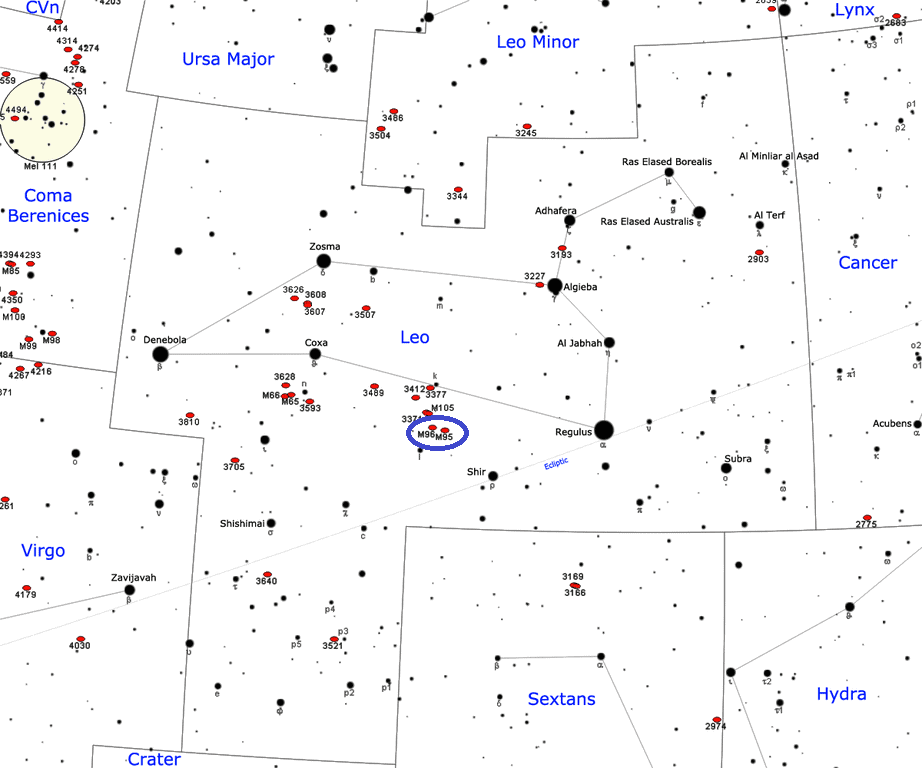
Messier 95, the nearby intermediate spiral galaxy M96, and the elliptical M105 can be found roughly a third of the way from Regulus, the brightest star in Leo, to Denebola,
the third brightest star in the constellation, which lies about 24 degrees east of Regulus.
M105 is the northernmost galaxy in the group and M96, the brightest of the three, is located 50 arc minutes south of M105.
M95 lies 40 arc minutes to the west of M96.
The best time of year to observe M95 and the nearby galaxies is during the spring.
Platesolve
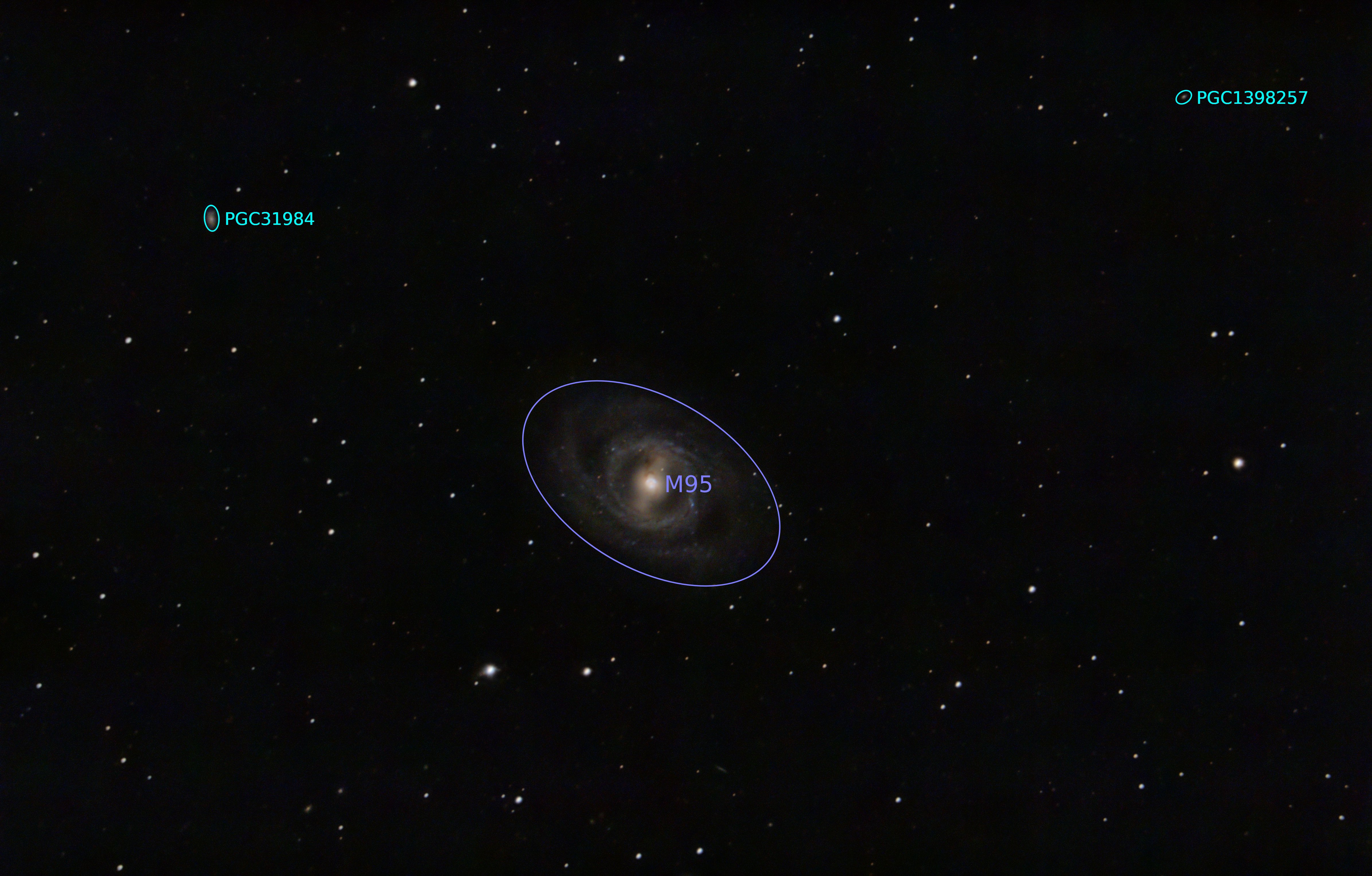
M95 Spiral Galaxy

M95 Spiral Galaxy
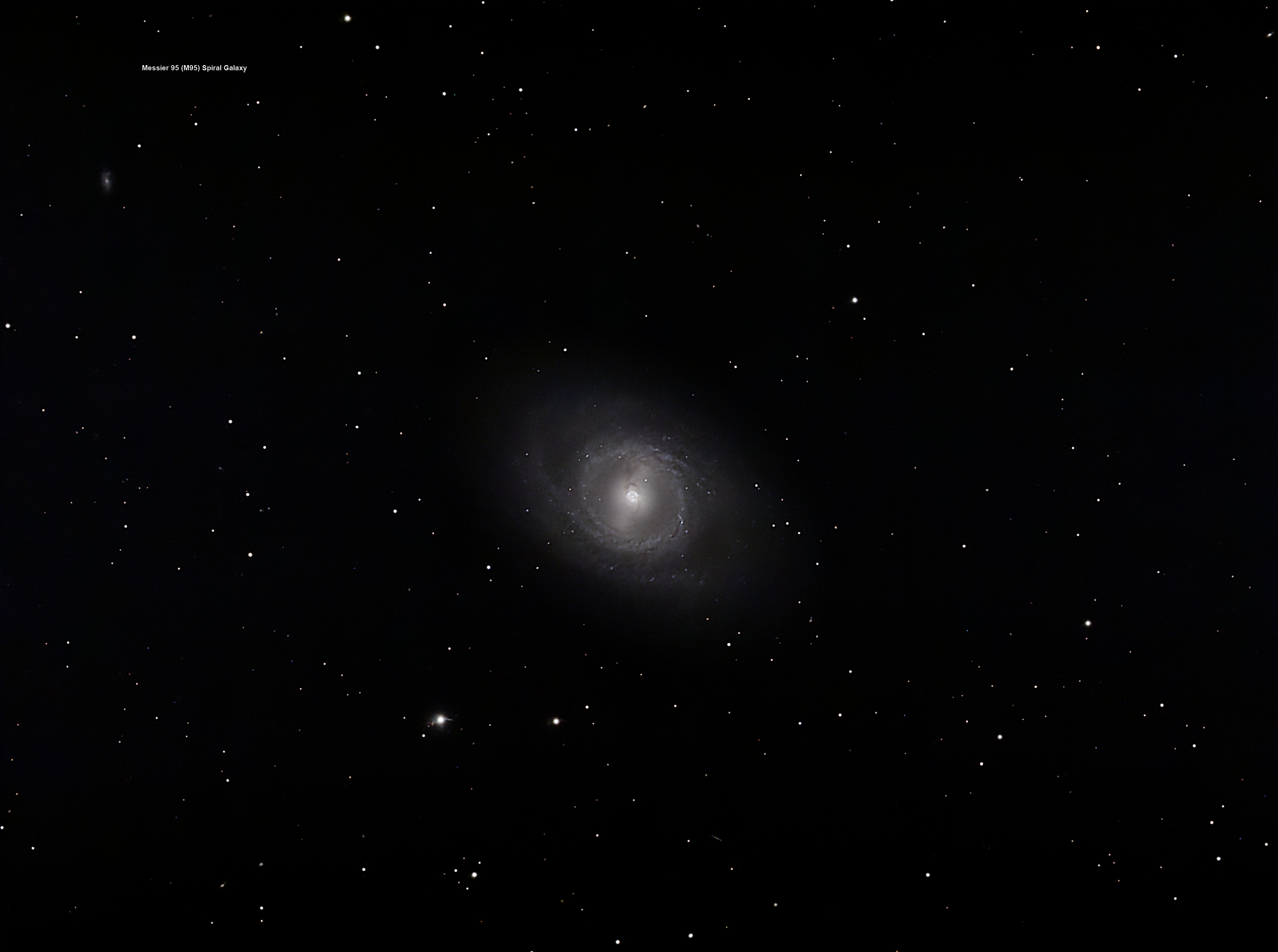
Imaging Details
Click to Return to Home Page