Messier 87 (M87)
Also Known as: NGC 4486, Virgo A
Object Type: Supergiant Elliptical Galaxy
Constellation: Virgo
Distance from Earth: 53.5 million light years
Apparent Magnitude: 8.6
Coordinates: RA 12H 30M 49.4234S DEC 12deg 28.0439min 25sec
Actual Size: 130,000 light years in diameter
Apparent Dimensions: 7.6 arc-minutes x 6.8 arc-minutes
Discovered by: Virgo A was discovered by Charles Messier on March 18, 1781, along with seven other members of the Virgo Cluster – M84, M85, M86, M88, M89, M90 and M91 – and the globular cluster M92, located in the constellation Hercules.
Description: Messier 87 is one of the largest, most massive and most luminous galaxies in the local universe.
Currently, M87 is still dwarfed by IC 1101, a supergiant elliptical galaxy at the center of the Abell 2029 cluster and the brightest galaxy in the group.
IC 1101 is the largest galaxy in the known universe. Also located in the constellation Virgo, it is almost three times the size of M87 and home to about four times as many stars.
However, IC 1101 is more than a billion light years from Earth, or 20 times farther away than M87.
M87 has an estimated mass of almost 2.7 trillion solar masses and an absolute magnitude of about -22. The galaxy is home to at least 1 trillion stars.
The stars form only a fraction of the galaxy’s mass. M87 has an estimated mass to luminosity ratio of 6.3, which means that about one sixth of M87’s mass is in the form of stars.
The total mass of the galaxy may be 200 times that of the Milky Way, even if the galaxies are similar in size.
Giant elliptical galaxies commonly form after a series of mergers of large spiral galaxies like the Milky Way.
Elliptical galaxies outnumber other types in the central region of the Virgo Cluster and, as the cluster members move toward the cluster’s core and merge, M87 will only grow larger.
M87 has a large population of globular clusters, about 15,000 compared with the 150–200 orbiting the Milky Way and a jet of energetic plasma that originates at the core and extends at least 4,900 light-years, traveling at a relativistic speed.
M87 is the second-brightest galaxy within the northern Virgo Cluster, having many satellite galaxies.
Unlike a disk-shaped spiral galaxy, M87 has no distinctive dust lanes.
Instead, it has an almost featureless, ellipsoidal shape typical of most giant elliptical galaxies, diminishing in luminosity with distance from the center.
Forming around one-sixth of its mass, M87's stars have a nearly spherically symmetric distribution.
Their population density decreases with increasing distance from the core.
It has an active supermassive black hole at its core, which forms the primary component of an active galactic nucleus.
Messier 86 and Messier 87 are believed to be moving toward each other and heading for their first encounter. M87 may have interacted with M84 in the past, which would explain M87’s truncated halo.
However, the truncation may also be a result of contraction caused by unseen mass falling into the galaxy from the rest of the cluster.
Another possible cause of the truncation may be early feedback from M87’s active galactic nucleus, which may have affected the halo formation.
Click Below Image(s) for Full Size:
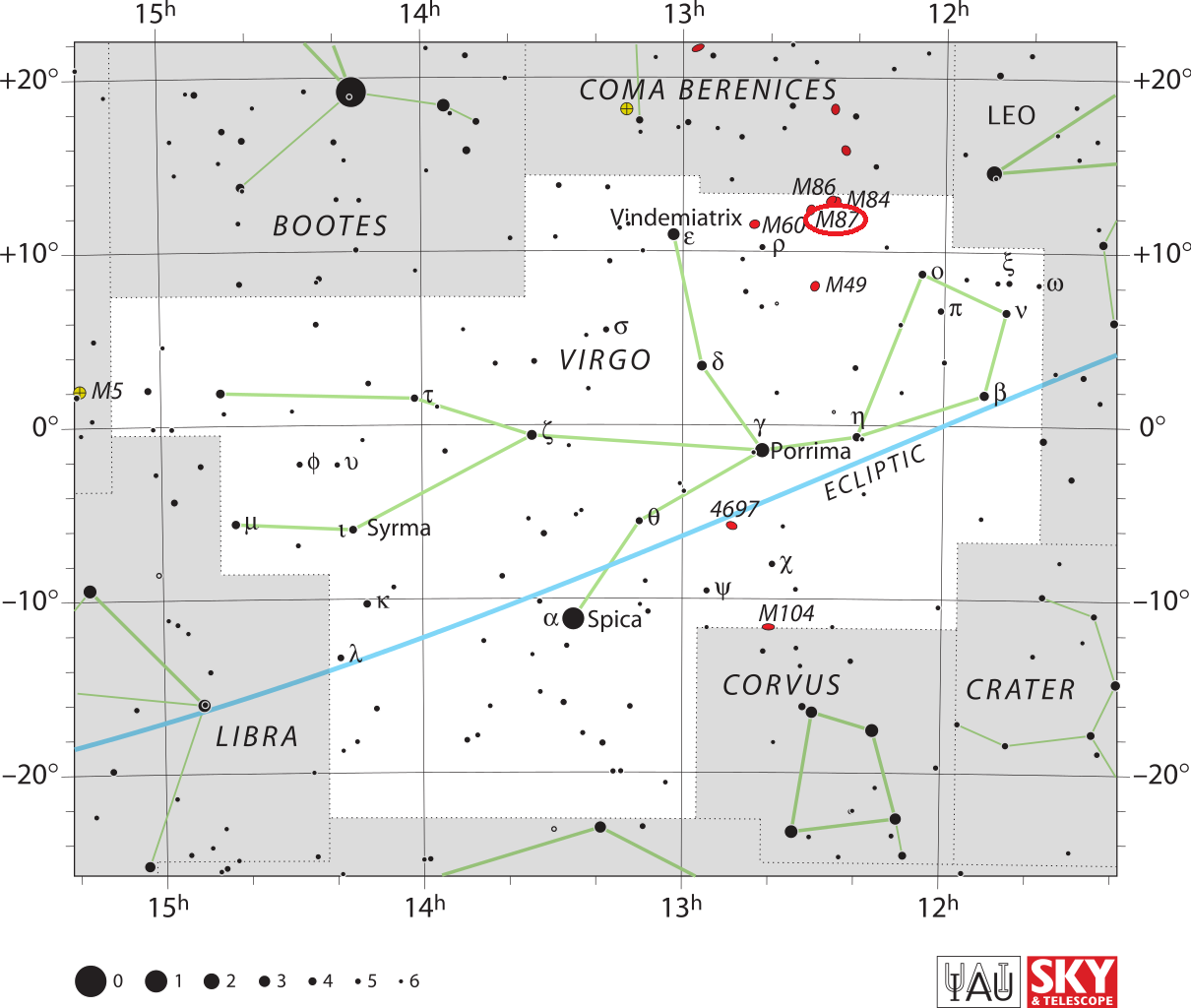
M87 can be observed in small and medium-sized telescopes. These reveal the galaxy’s core, which is about 45 arc seconds in apparent size. The jet emanating from the nucleus of M87 is difficult to see without photographic equipment.
In 10×50 binoculars, M87 appears only as a faint patch of light.
Small telescopes show a fuzzy ball of light, elliptical in shape, with a slightly brighter center.
Being an elliptical galaxy, Virgo A appears mostly featureless even when seen in larger telescopes.
The best time to observe M87 is in May.
Platesolve
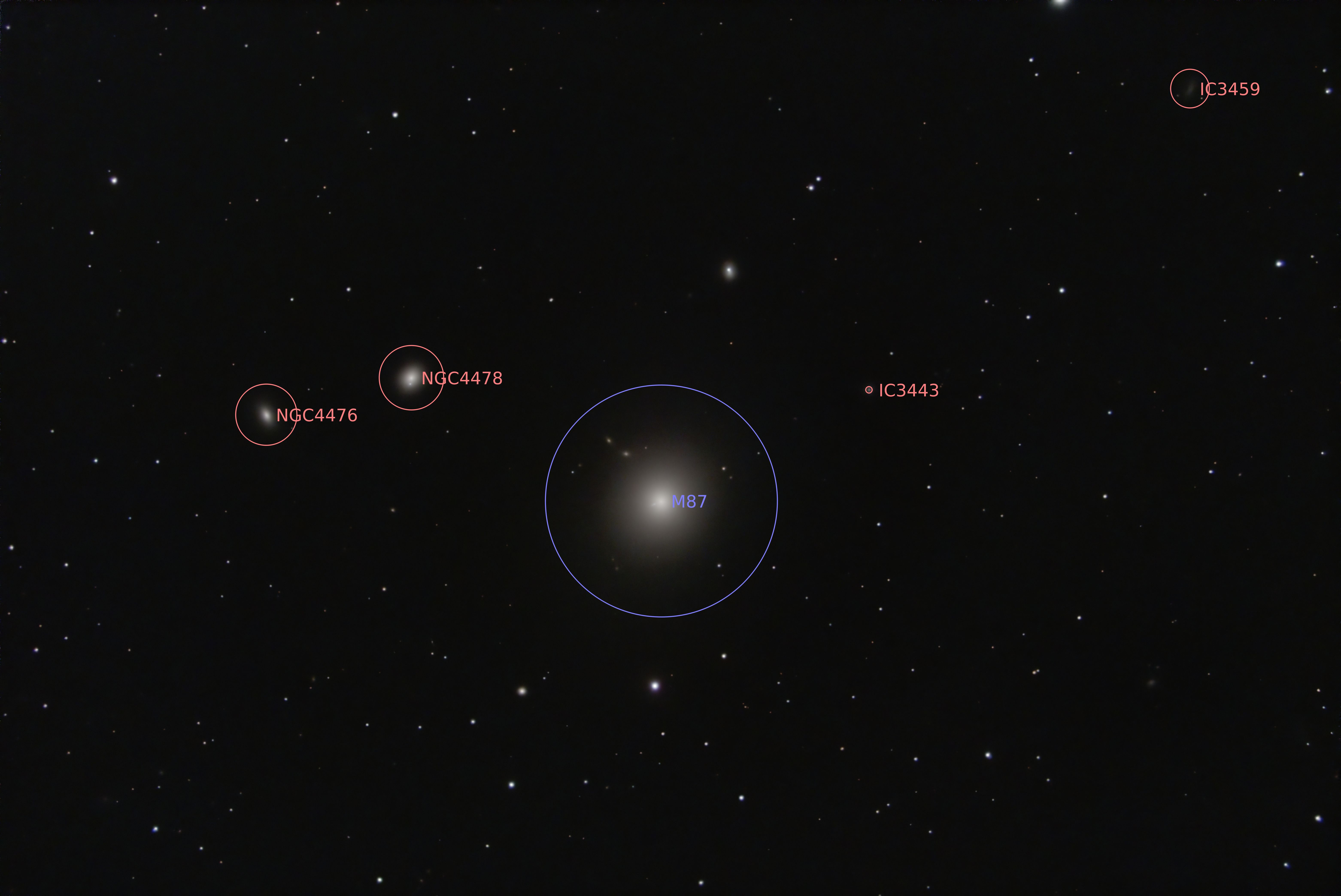
M87 Elliptical Galaxy

Imaging Details
Click to Return to Home Page