Messier 85 (M85)
Also Known as: NGC 4382
Object Type: Elliptical Galaxy
Constellation: Coma Berenices
Distance from Earth: 60 million light years
Apparent Magnitude: 10.0
Coordinates: RA 12H 25M 24.0S DEC 18 deg 11 min 28 sec
Actual Size: 125,000 light years in diameter
Apparent Dimensions: 17.1 arc-minutes x 5.5 arc-minutes
Discovered by: The M85 galaxy was discovered by the French astronomer Pierre Méchain on March 4, 1781.
He reported the discovery to his friend Charles Messier, who determined the position for the object and included it in his catalogue of deep sky objects on March 18, 1781.
On the same night, Messier discovered seven other members of the Virgo Cluster – Messier 84, Messier 86, Messier 87 (Virgo A), Messier 88, Messier 89, Messier 90 and Messier 91 – as well as the globular cluster Messier 92, located in Hercules.
Description: M85 is either a luminous lenticular or elliptical galaxy consisting of 400 billion stars.
It was long believed to be a lenticular galaxy but recent studies indicate in may be elliptical like M84. M85 is interacting with 2 galaxies, the spiral galaxy NGC 4394 and the elliptical MCG 3-32-38.
Messier 85 has a smaller neighbor about 8 arc minutes to the east. The barred spiral galaxy NGC 4394, which is receding from us at the same velocity as M85 – about 700 km/s – has a visual magnitude of 11.2.
The two galaxies are suspected to form a physical pair. M85 itself is moving away from us at about 729 km/s.
M85 has very little neutral hydrogen indicating it underwent a merger with another galaxy 4 to 7 billion years ago.
The stars in the galaxy are mostly old. The central region is home to relatively young stars, under 3 billion years old, some of them arranged in a ring.
These stars are believed to have formed in a late burst of star forming activity.
Click Below Image(s) for Full Size:
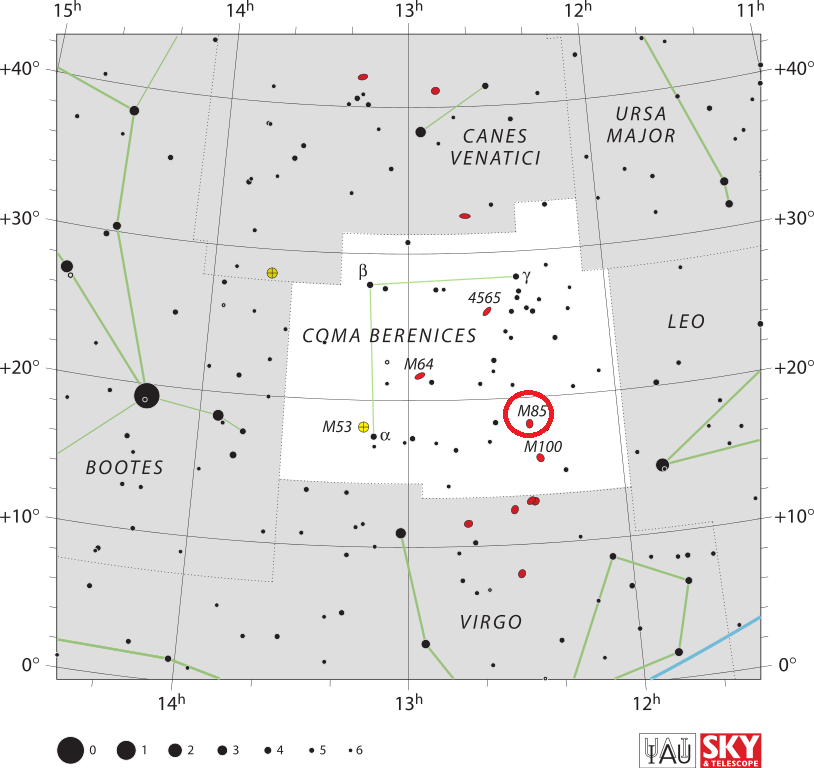
The galaxy is relatively faint and not easy to spot in 10x50 binoculars.
Small telescopes will show only a fuzzy ball with a bright center. Larger (6 or 8 inch) scopes reveal a bright, round patch of light with a significantly brighter core.
The best time to observe M85 is in the spring.
Platesolve
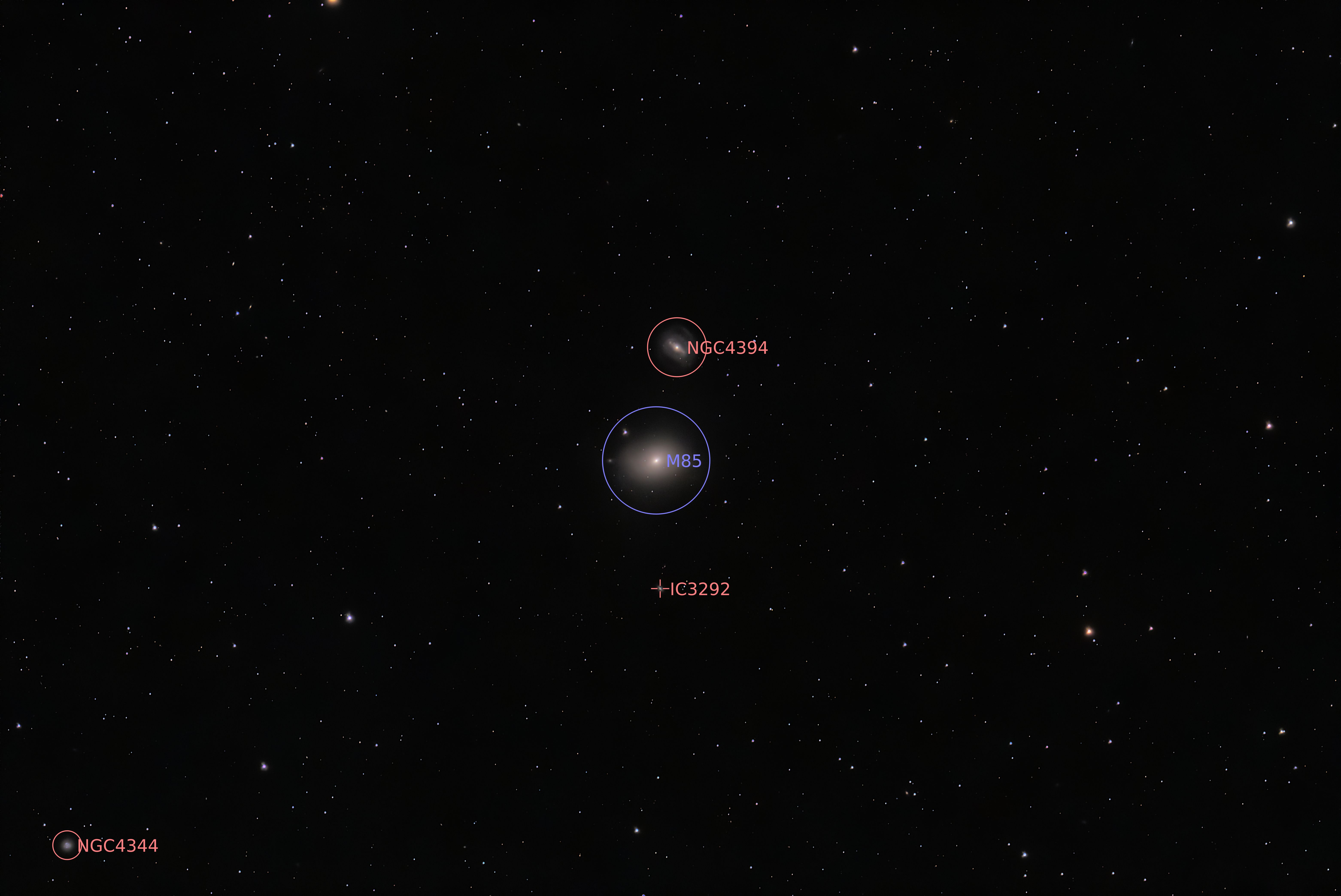
M85 Elliptical Galaxy

Imaging Details
Click to Return to Home Page