Messier 84 (M84) and Messier 86 (M86) Galaxies
M84 Also Known as: NGC 4374
M86 Also Known as: NGC 4406
M84 Object Type: Giant Elliptical or Lenticular Galaxy
M86 Object Type: Elliptical or Lenticular Galaxy
Constellation: Virgo
M84 Distance from Earth: 54.9 million light years
M86 Distance from Earth: 52 million light years
M84 Apparent Magnitude: 9.1
M86 Apparent Magnitude: 9.8
M84 Coordinates: RA 12H 25M 03.7433S DEC 12deg 53min 13.139sec
M86 Coordinates: RA 12H 28M 11.7S DEC 12deg 56min 46sec
M84 Actual Size:: 110,000 light years in diameter... M86 Actual Size:: 130,000 light years in diameter.
M84 Apparent Dimensions:: 6.5 arc-minutes x 5.6 arc-minutes ... M86 Apparent Dimensions:: 8.9 arc-minutes x 5.8 arc-minutes
Discovered by: Messier 84 is one of Charles Messier’s original discoveries. Messier discovered the object on March 18, 1781 and subsequently added it to his catalogue. On the same day, he also discovered and catalogued the globular cluster Messier 92, located in the constellation Hercules, and seven other galaxies in the Virgo Cluster: Messier 85, Messier 88 and Messier 91 in Coma Berenices, and Messier 86, Virgo A (M87), Messier 89 and Messier 90 in Virgo.
Description: Messier 84 is either an elliptical galaxy of type E1 or a lenticular galaxy of type S0 seen face-on.
It is situated in the inner core of the Virgo Cluster, a region populated with galaxies, including Messier 49, Messier 60, Messier 86, Messier 87, the edge-on spirals NGC 4388 and NGC 4402, the elliptical galaxy NGC 4387, the barred spirals NGC 4413 and NGC 4425, and the interacting galaxies NGC 4438 and NGC 4435.
M84 is part of Markarian’s Chain, a stretch of galaxies that appear in a curved line when seen from Earth.
Some of the galaxies are superimposed, but others appear to move coherently.
The galaxies that are part of Markarian’s Chain include M84, M86, NGC 4477, NGC 4473, NGC 4461, NGC 4458, NGC 4438 and NGC 4435.
The visible galaxy is surrounded by a massive dark matter halo.
It also has a few young stars and star clusters, indicating star formation at a very low rate. The number of globular clusters is 1,775±150, which is much lower than expected for an elliptical galaxy.
In small telescopes, the M84 and M86 galaxies appear as small, oval-shaped patches of light with brighter centres. They are best seen in medium-sized and large telescopes.
In 8-inch telescopes, several other galaxies can be seen in the vicinity, including NGC 4435, NGC 4388, NGC 4402 and NGC 4438.
The best time of year to observe M84 and M86 and other galaxies in the Virgo Cluster is during the spring.
Click Below Image(s) for Full Size:
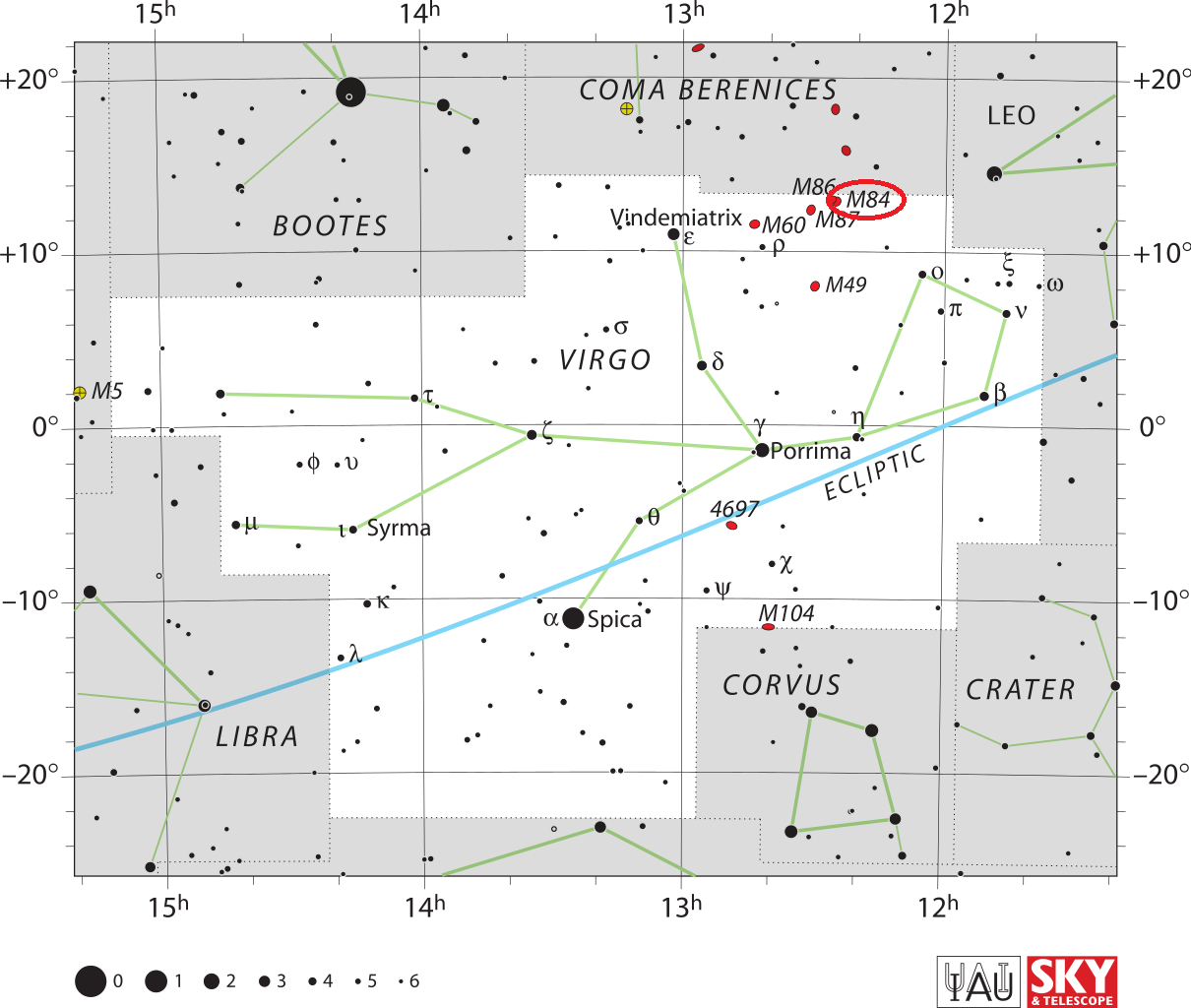
Messier 86 (M86) is an elliptical or lenticular galaxy located in the Virgo Cluster, in the southern constellation Virgo.
Messier 86 is located in the center of the Virgo Cluster and is one of its brightest members. It forms a striking group with M84.
Messier 86 is experiencing ram pressure stripping and losing gas as a result of moving through the Virgo Cluster at such a high velocity.
M86 is linked with the neighboring disrupted spiral galaxy NGC 4438 by filaments of ionized gas.
Messier 86 is linked by several filaments of ionized gas to the severely disrupted spiral galaxy NGC 4438, indicating that M86 may have stripped some gas and interstellar dust from the spiral.
It is also suffering ram-pressure stripping as it moves at high speed through Virgo's intracluster medium, losing its interstellar medium and leaving behind a very long trail of X ray-emitting hot gas.
Messier 86 is approaching the Milky Way at 244 km/s, the highest blue shift of all Messier objects and is unusual for a member of the Virgo Cluster because the entire cluster is receding from us at an average velocity of 1,000 km/s.
It seems to be moving toward us because it is really moving towards the center of the Virgo Cluster from the opposite side, which explains the blueshift.
Because of its enormous mass, the cluster’s core has a strong gravitational field, one that can accelerate any galaxy’s velocity to that observed in M86.
Messier 86 has a rich array of globular clusters, with a total number of around 3,800.
Its halo also has a number of stellar streams interpreted as remnants of dwarf galaxies that have been disrupted and absorbed by this galaxy.
The galaxy can be seen in 10×50 binoculars under good conditions, but only appears as a faint patch of light.
Small and medium-sized telescopes show an oval-shaped patch with a brighter center, while larger instruments provide a better view of the galaxy’s halo.
The best time to view M86 is in the spring.
Platesolve
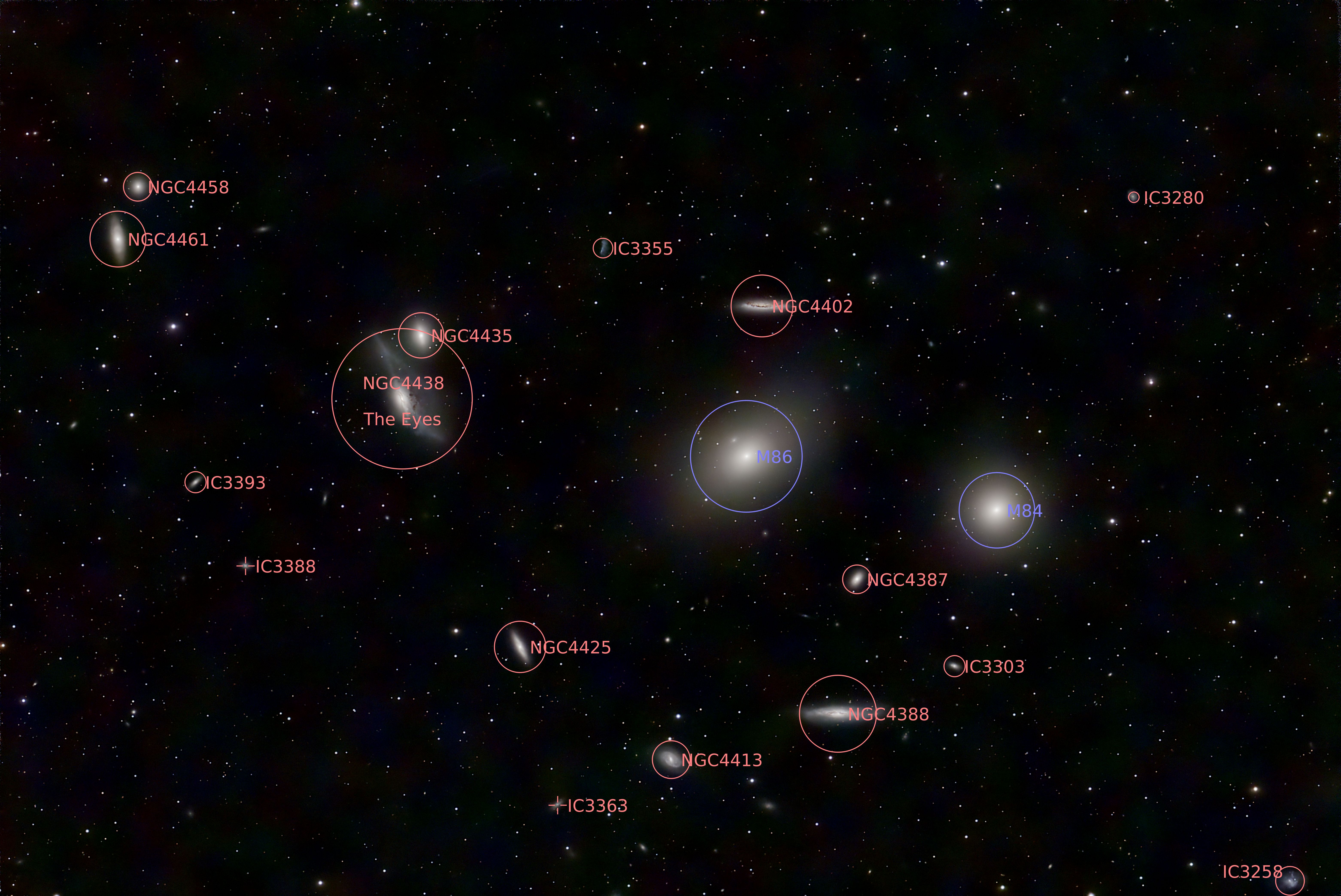
M84 & M86 Galaxies Group - Part of Markarian'c Chain

Imaging Details
M84 & M86 Galaxies
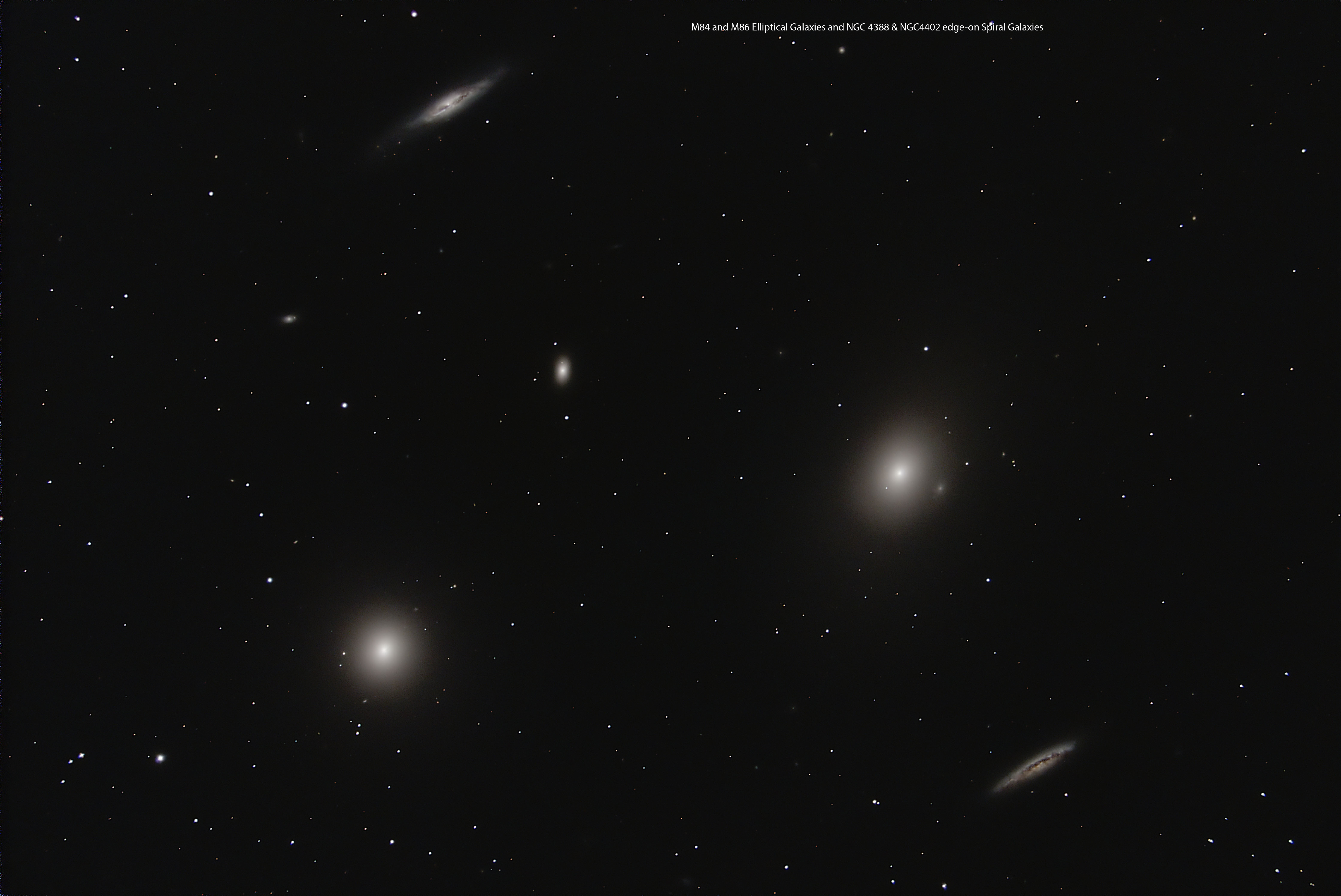
Imaging Details
M84 & M86 Galaxies
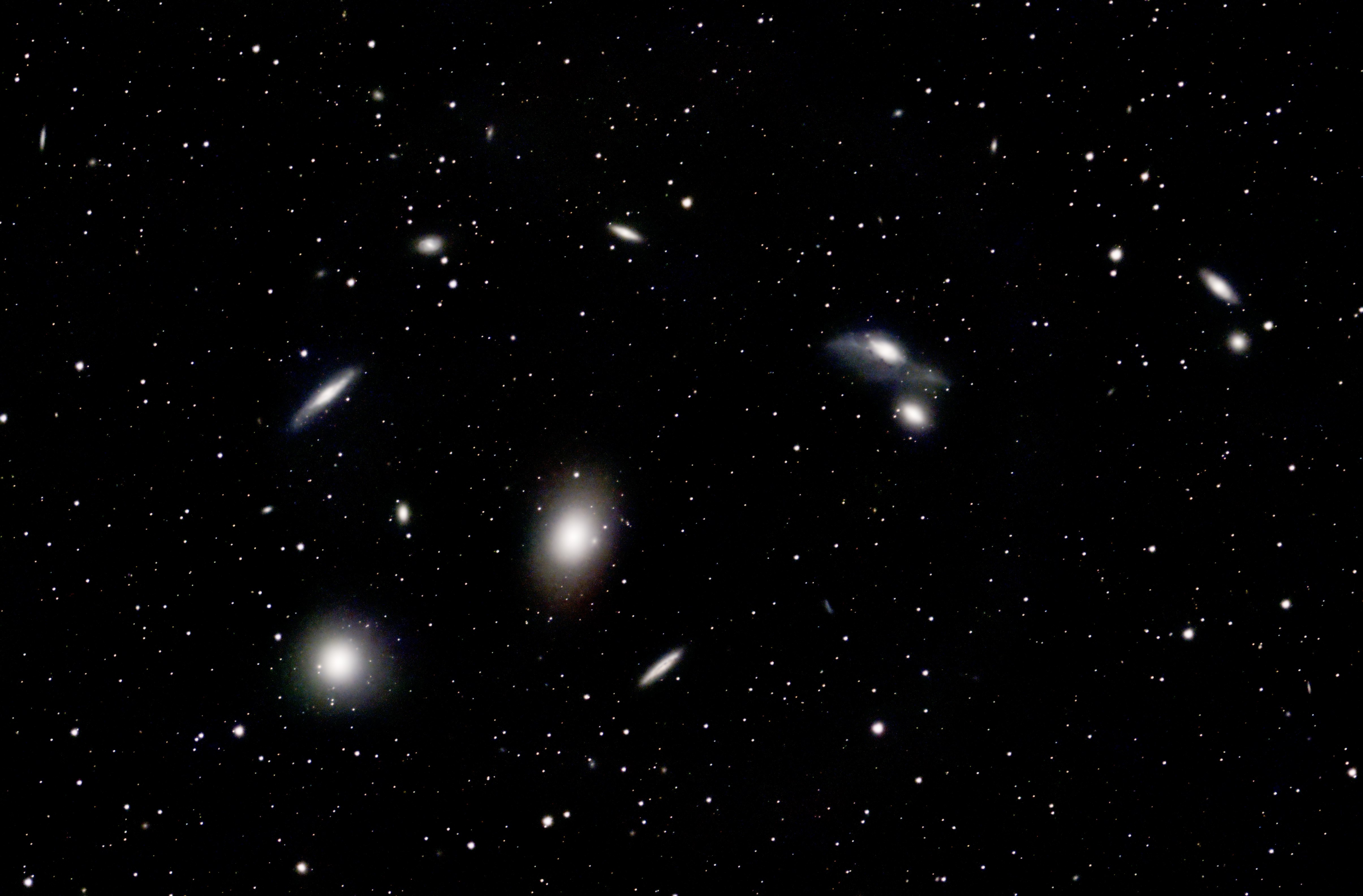
Imaging Details
Click to Return to Home Page