Messier 78 (M78), NGC 2067, NGC 2071
Also Known as: NGC 2068 (M78).
Object Type: Reflection Nebula
Constellation: Orion
Distance from Earth: 1,600 light years (M78) ... 1,300 light years (NGC 2071)
Apparent Magnitude: 8.3 (M78)
Coordinates: RA 05H 46.7M 0S DEC 00 deg 03 min 0 sec (M78)
Actual Size: 10 light years in diameter (M78)... 4 light years (NGC 2071)
M78 Apparent Dimensions: 8.0 arc-minutes x 6.0 arc-minutes
NGC 2067 Apparent Dimensions: 8.0 arc-minutes x 3.0 arc-minutes
NGC 2071 Apparent Dimensions: 7.0 arc-minutes x 5.0 arc-minutes
Discovered by: Messier 78 was discovered by Charles Messier’s colleague Pierre Méchain in early 1780. Messier added the nebula to his catalogue of deep sky objects on December 17 of that year.
NGC 2067 was discovered by Wilhelm Tempel in 1876.
NGC 2071 was discovered by William Herschel in 1781.
Description: : M78 is the brightest reflection nebula in the sky.
It is part of a group of nebulae that also includes Messier 78, NGC 2064, and NGC 2067.
Messier 78 is a reflection nebula, which means that it contains very little ionized gas and merely reflects the light of the nearby stars. Two early B-type 10th magnitude stars in M78, HD 38563A and HD 38563B, are responsible for illuminating the nebula’s dust clouds.
It is located in an area with other nebulae belonging to the Orion Molecular Cloud Complex (NGC 2064, NGC 2067, and NGC 2071). M78 is the brightest reflection nebula in this group.
The Orion Complex itself is hundreds of light years across, spreading from the stars of Orion’s Belt all the way to Orion’s Sword.
It is one of the brightest and most active star forming regions visible in the sky and contains several famous nebulae, including the Orion Nebula (M42), De Mairan’s Nebula (M43),
the bright emission nebula IC 434, which contains the dark Horsehead Nebula, the emission nebula known as Barnard’s Loop, the Flame Nebula, and the large H II region known as the Angelfish Nebula or Lambda Orionis Ring, centered on Meissa (Lambda Orionis).
At least 192 stars have formed within the molecular cloud associated with the nebula. Two magnitude 10 stars in M78 are responsible for illuminating the nebula’s dust clouds.
NGC 2071 is both a star cluster and a nebula.
Click Below Image(s) for Full Size:

M78 group of nebulae are fairly easy to find.
It can easily be seen in large binoculars and small telescopes which show a hazy, comet-like patch of light.
M78 is also visible in 10×50 binoculars as a dim patch, but it requires clear, dark skies to be seen.
4-inch telescopes will sometimes reveal the haze around M78 and also show the nearby reflection nebula NGC 2071 under good conditions.
8-inch telescopes begin to show the details of M78. A 9th magnitude open cluster, NGC 2112, can be seen about 1.75 degrees east of the nebula.
The cluster lies in the background and is some 2,800 distant.
NGC 2067 and NGC 2071 should be in the same eyepiece field, just a few arcminutes away from M78. Though not likely to be seen through binoculars, these companion nebulae are detectable in 3 to 4-inch telescopes as a faint glow northeast of M78.
The best time to observe M78 is the winter months (December-February).
Platesolve
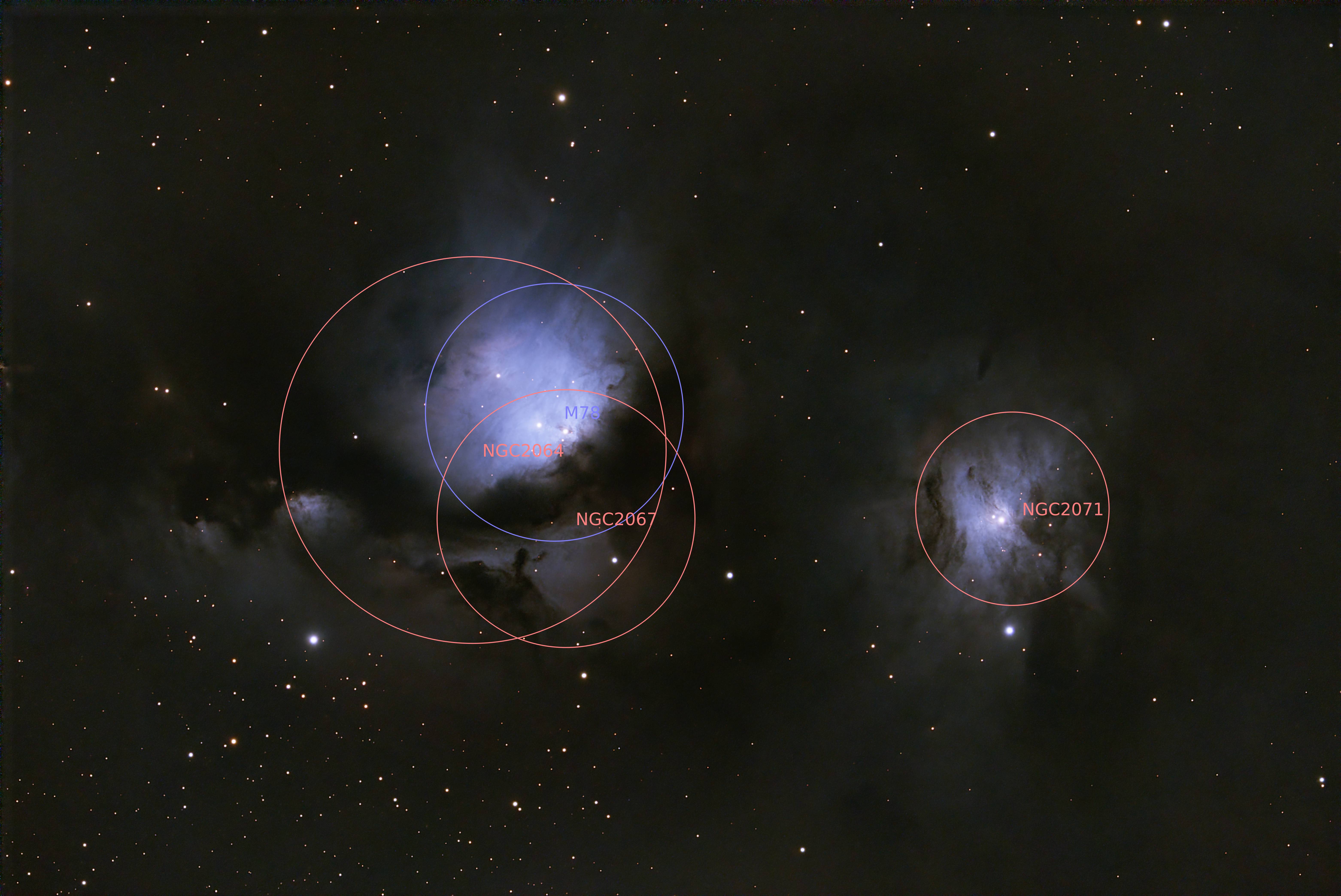
M78, NGC 2067, and NGC 2071 Reflection Nebulae

Imaging Details
Click to Return to Home Page