Messier 73 (M73)
Also Known as: NGC 6994
Object Type: Open Cluster - Asterism of 4 stars
Constellation: Aquarius
Distance from Earth: 2,500 Light years
Apparent Magnitude: 9.0
Coordinates: RA 20H 58M 54S DEC -12deg 38min 0sec
Actual Size: 20 light years
Apparent Dimensions: 2.8 arc-minutes
Discovered by: Charles Messier discovered M73 on October 4, 1780 and added it to his catalogue as object number 73. He described it as a cluster with some nebulosity.
Much later observations by John Herschel could not find any nebulosity.
Moreover, Herschel noted that the designation of M73 as a cluster was questionable.
Nonetheless, Herschel included M73 in his General Catalogue of clusters, nebulae, and galaxies, and John Dreyer included M73 when he compiled the New General Catalogue.
Description: Messier 73 (M73) is an asterism formed by four physically unrelated stars located in the southern constellation Aquarius.
The stars that form M73 have apparent magnitudes of 10.48, 11.32, 11.90 and 11.94, and occupy an area of 2.8 arc minutes of apparent sky.
M73 was once treated as a potential sparsely populated open cluster, which consists of stars that are physically associated in space as well as on the sky.
Even though there has been a lot of debate about the nature of M73 since Messier’s discovery, recent studies indicate that M73 is not an open cluster, but merely an asterism,
and that the four stars lie at different distances from Earth and are moving in different directions.
However, as recently as 2000, a photometry study suggested that M73 was a cluster remnant, about 9 arc minutes wide, with an estimated age of 2 to 3 billion years.
It was only two years later that a high-resolution spectroscopic study of the spectra of the six brightest stars near the center of M73 revealed that the four stars were not in fact physically related.
The controversy was resolved in 2002, when M. Odenkirchen and C. Soubiran published an analysis of the high resolution spectra of the six brightest stars within 6 ′ of the center point.
They demonstrated that the distances from the Earth to the six stars were very different from each other, and the stars were moving in different directions.
Therefore, they concluded that the stars were only an asterism.
Click Below Image(s) for Full Size:
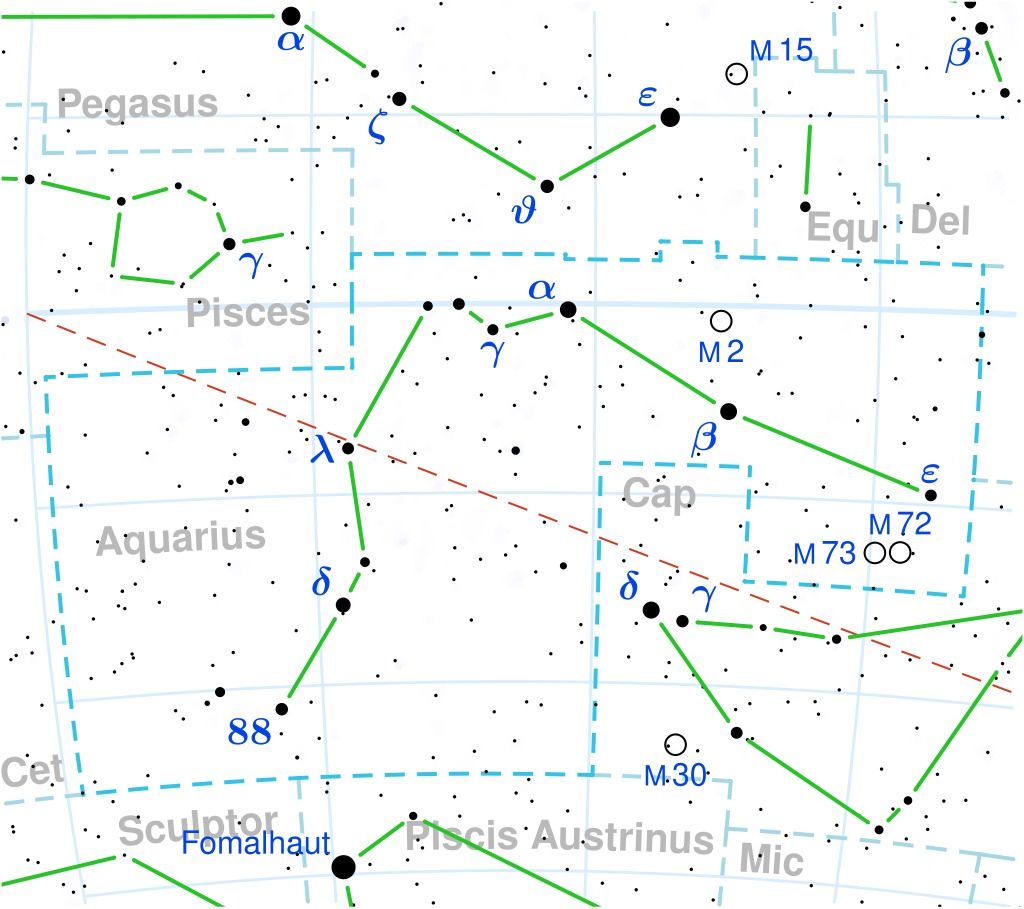
Although M73 was determined to be only a chance alignment of stars, further analysis of asterisms is still important for the identification of sparsely populated open clusters.
A full study of very many such clusters would demonstrate how, how often, and to what degree open clusters are ripped apart by the gravitational forces in the Milky Way and reveal more of the sources of these forces.
The stars of M73 are quite faint and not easy to observe in 10×50 binoculars. Larger binoculars will reveal a dim point of light, while a 4-inch telescope will show the Y shape clearly.
The best time of year to observe M73 is during the summer.
Platesolve
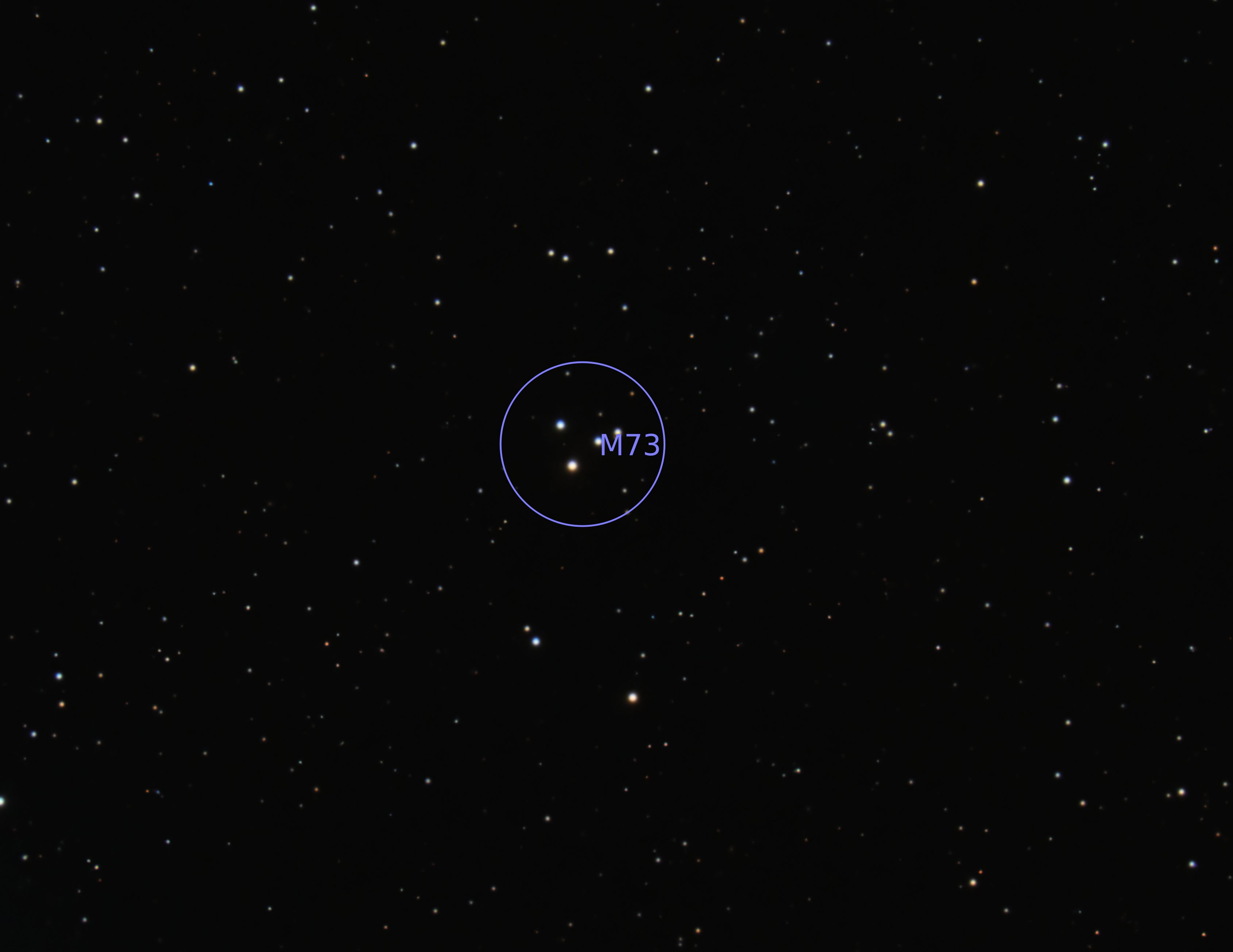
M73 Open Cluster

Imaging Details
Click to Return to Home Page