Messier 72 (M72)
Also Known as: NGC 6981
Object Type: Globular Cluster
Constellation: Aquarius
Distance from Earth: 54,570 light years
Apparent Magnitude: 9.3
Coordinates: RA 20H 53M 27.7S DEC -12deg 32min 14.3sec
Actual Size: 106 light years in diameter
Apparent Dimensions: 6.6 arc-minutes
Discovered by:Messier 72 was discovered by Charles Messier’s colleague Pierre Méchain on August 29, 1780.
Messier found the object on October 4 together with Messier 73, which lies about 1.5 degrees to the east. He added them both to his catalogue, describing M72 as a faint nebula.
Both Mechain & Messier opted for the then-dominant of the competing terms for such objects, considering it a faint nebula rather than a cluster.
With a larger instrument, astronomer John Herschel called it a bright "cluster of stars of a round figure".
Astronomer Harlow Shapley noted a similarity to Messier 4.
Description:
M72 is one of the smallest, faintest and most remote clusters listed in Messier’s catalogue, roughly twice as far away from us as the galactic center, but it is also one of the most intrinsically luminous Messier clusters.
M72 is approaching us at 255 km/s.
Messier 72 has an estimated mass of about 168,000 solar masses and is believed to be about 9.5 billion years old.
This rich collection of scattered stars, known as Messier 72, looks like a city seen from an airplane window at night, as small glints of light from suburban homes dot the outskirts of the bright city center.
Messier 72 is actually a globular cluster, an ancient spherical collection of old stars packed much closer together at its center, like buildings in the heart of a city compared to less urban areas.
As well as huge numbers of stars in the cluster itself the picture also captures the images of many much more distant galaxies seen between and around the cluster stars.
Click Below Image(s) for Full Size:
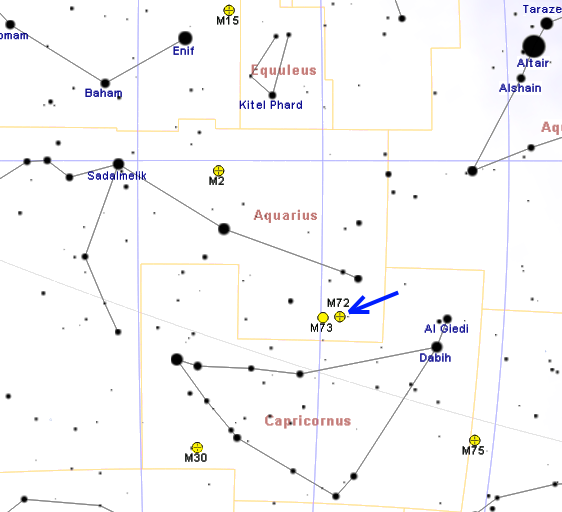
In small telescopes, M72 appears as a faint nebula and it takes a medium-sized instrument to resolve the stars in the surrounding field.
Larger telescopes will reveal a cluster with an apparent diameter of 2.5 arc minutes.
The full angular diameter of M72 is 6.6 arc minutes, corresponding to a spatial extension of 106 light years.
12-inch telescopes will resolve the cluster’s core region, which occupies 1.25 arc minutes of apparent sky.
The best time of year to observe M72 is during the summer.
Platesolve
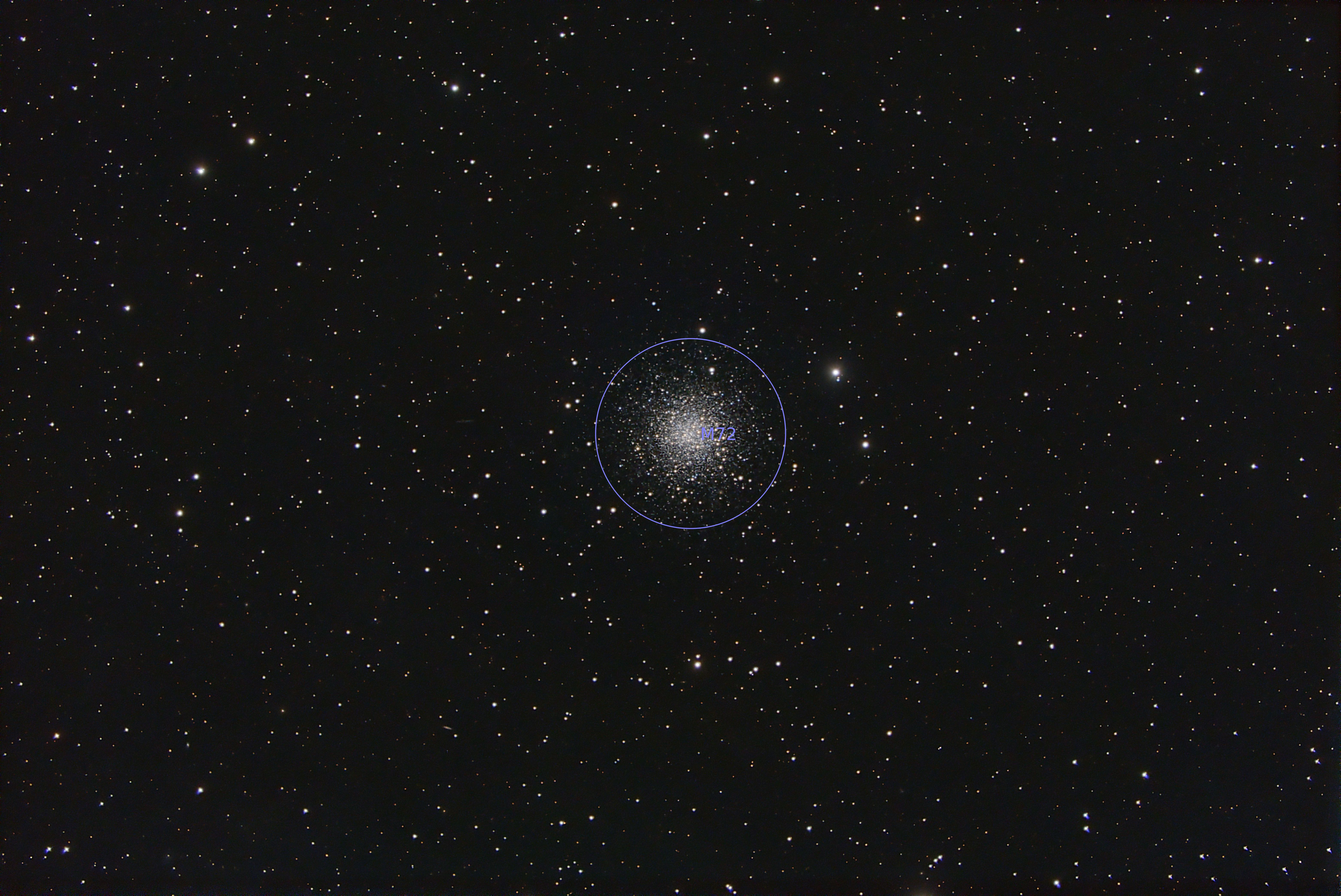
M72 Globular Cluster

Imaging Details
Click to Return to Home Page