Messier 71 (M71)
Also Known as: NGC 6838
Object Type: Globular Cluster
Constellation: Sagitta
Distance from Earth: 13,000 light years
Apparent Magnitude: 6.1
Coordinates: RA 19H 53M 46.49S DEC 18 deg 46 min 45.1 sec
Actual Size: 27 light years in diameter
Apparent Dimensions: 7.2 arc-minutes
Discovered by: Messier 71 was discovered by the Swiss astronomer Jean-Philippe Loys de Chéseaux in 1746.
German astronomer Johann Gottfried Koehler discovered the cluster independently between 1772 and 1779.
He described the object as a “very pale nebula in the Arrow [Sagitta] at 1deg 50′ [Aqr] [301d 50′] and 39d northern latitude.”
Charles Messier’s friend and colleague Pierre Méchain discovered the cluster on June 28, 1780.
Messier added it to his catalogue as a nebula without stars based on his own observations on October 4, 1780.
Description: M71 is one of the smallest globular clusters known consisting of just 20,000 stars.
Stars in globular clusters are generally very old and very metal-poor. For this reason, astronomers debated whether M71 was a globular or an open cluster for centuries.
Until the 1970s, M71 was believed to be a densely populated open cluster, much like Messier 11 (Wild Duck Cluster), and classified as such.
In 1943, James Cuffey of Kirkwood Observatory in Bloomington, Indiana, found that it was more like a loosely populated globular cluster, one like Messier 68.
However, further studies in 1959 once again pegged M71 as an open cluster.
Today, M71 is classified as a very loosely concentrated globular cluster, with a density classification of X or XI.
Messier 71 is about 13,200 times more luminous than the Sun and has about 17 percent of the Sun’s heavy elements (or metals), which is quite a lot for a globular cluster.
The diameter of M71 may extend to about 90 light years, but the stars that are further away from the center and more diffuse are not confirmed members of the cluster.
It is estimated to be 9 to 10 billion years old and contains an unusually high percentage of metals. M71 has a mass of about 17,000 solar masses.
Click Below Image(s) for Full Size:
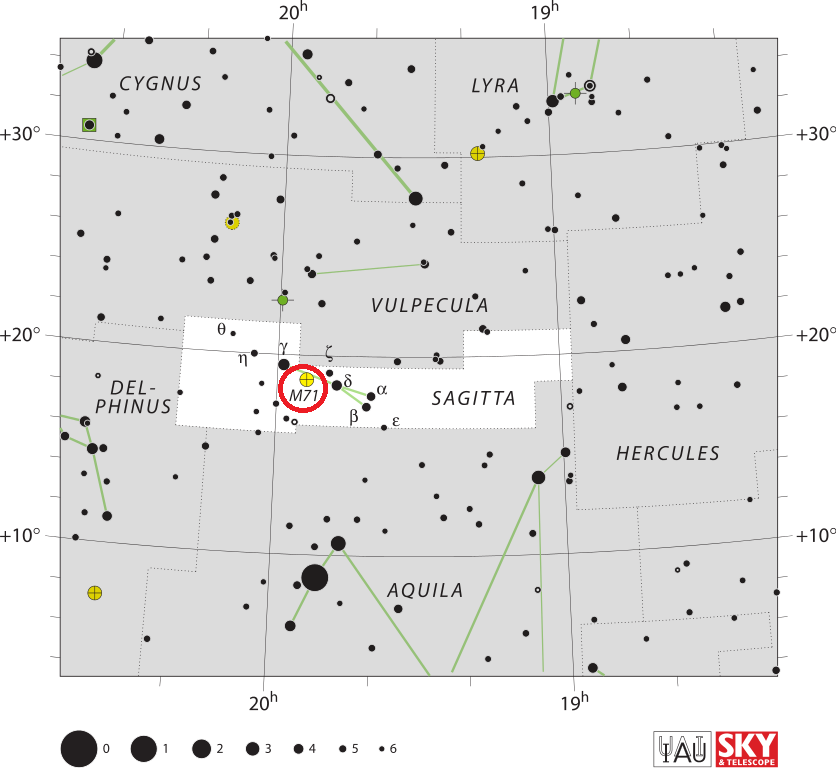
M71 is located in the summer triangle (Deneb, Altair, Vega).
It appears as a hazy patch in binoculars. At least a medium sized telescope is necessary to resolve the cluster into stars.
The best time to observe M71 is the summer (June-August).
Platesolve
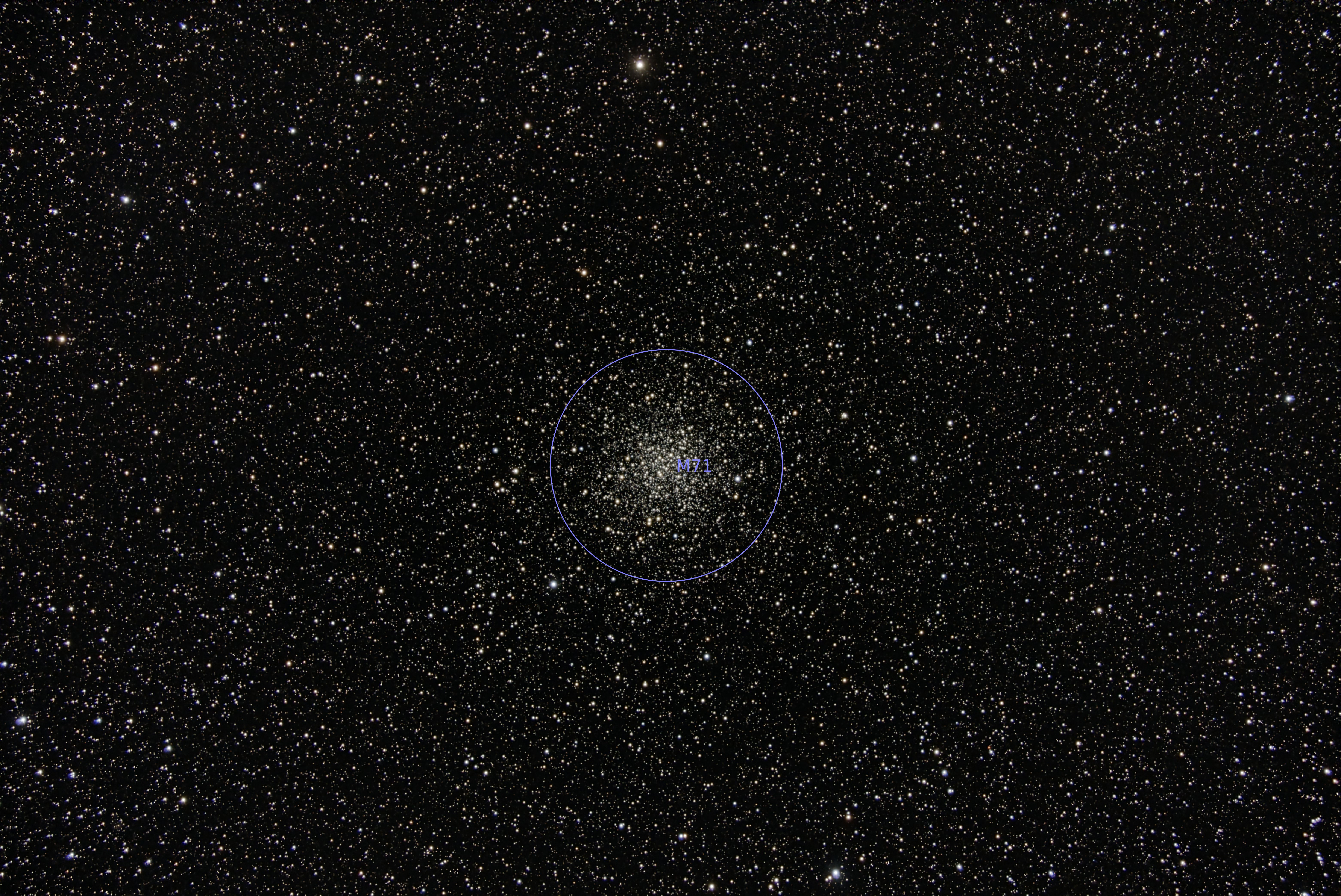
M71 Globular Cluster

Imaging Details
Click to Return to Home Page