Messier 67 (M67)
Common Name: King Cobra Cluster
Also Known as: NGC 2682, Collinder 204
Object Type: Open Cluster
Constellation: Cancer
Distance from Earth: 2,610 light years
Apparent Magnitude: 6.1
Coordinates: RA 08H 51.4M 0S DEC 11 deg 49 min 0 sec
Actual Size: 20,000 light years in diameter
Apparent Dimensions: 30 arc-minutes
Discovered by: M67 was discovered by Johann Gottfried Koehler in 1779. He described it as a ‘rather conspicuous nebula in elongated figure’.
Charles Messier independently discovered the cluster and added it to his catalogue on April 6, 1780. He was able to resolve it into individual stars and described it as a “cluster of small stars with nebulosity, below the southern claw of Cancer.
The position determined from the star Alpha [Cancri].”
Description: Messier 67 is one of the oldest known open clusters and the single oldest open cluster listed by Messier in his catalogue.
The estimated age of M67 is in the range from 3.2 to 5 billion years.
Messier 67 contains more than 500 stars and is often studied for the insight it provides into stellar evolution.
With the exception of about 30 blue stragglers, the stars in M67 are all roughly the same age and lie at the same distance. The origins of the blue stragglers have not been explained yet.
Not counting the blue stragglers, the cluster does not have any main sequence stars bluer than spectral class F.
Messier 67 has undergone mass segregation, which means that its heavier stars have moved toward the cluster’s center and less massive ones have migrated toward the outer region over time.
As a result, the cluster’s stars are much more gravitationally bound than those in younger open clusters.
The few open clusters that are known to be older are not as close to Earth as M67.
These include NGC 188 in the constellation Cepheus, with an estimated age of 5 billion years, NGC 6791 in Lyra, which is believed to be about 7 to 8 billion years old, and Berkeley 17 in Auriga, with age estimates ranging from 10 to 13 billion years.
The average age of the stars in the cluster is around 4 billion years, which means that they are roughly the same age as the Sun and have similar elemental abundancies.
Open clusters are typically younger and the stars tend to disperse over time, usually before they reach this age.
For example, the Beehive Cluster (M44), another Messier cluster in the Cancer constellation, is only 600 million years old. The stars of M67, however, are expected to stay together for another 5 billion years before dissociating.
In spite of being one of the most studied objects of its kind, the basic properties of M67 – mass, age, number of stars of different types – vary considerably from one source to the next.
The cluster’s mass, while uncertain, is estimated to be between 1,080 and 1,400 times that of the Sun and the distance is believed to be in the range between 800 and 900 parsecs.
The cluster contains more than 100 Sun-like stars and a great many red giants. The high number of stars similar to the Sun had led scientists to consider M67 as the Sun’s possible parent cluster, but simulations have indicated that this was very unlikely.
Click Below Image(s) for Full Size:
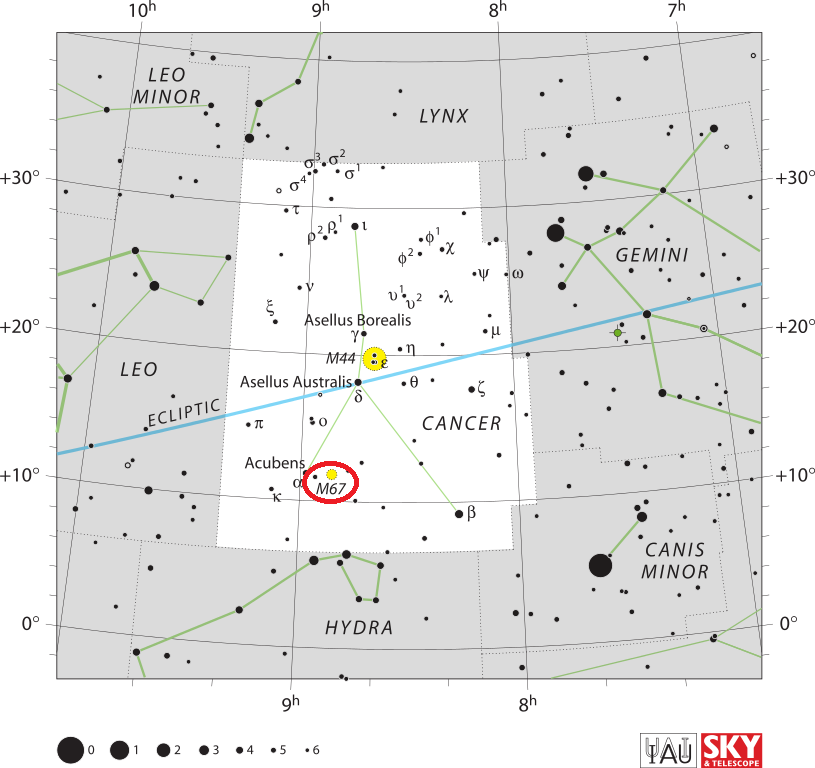
With an apparent diameter of 30 arc minutes, M67 appears roughly the same size as the full Moon.
Small 10×50 binoculars show the cluster as an elongated patch of light, while small telescopes reveal its brightest stars. 6-inch and 8-inch instruments resolve dozens of stars, while 12-inch telescopes reveal about 100 individual stars in the cluster.
The best time of year to observe M67 from northern latitudes is during the late winter and early spring.
Platesolve
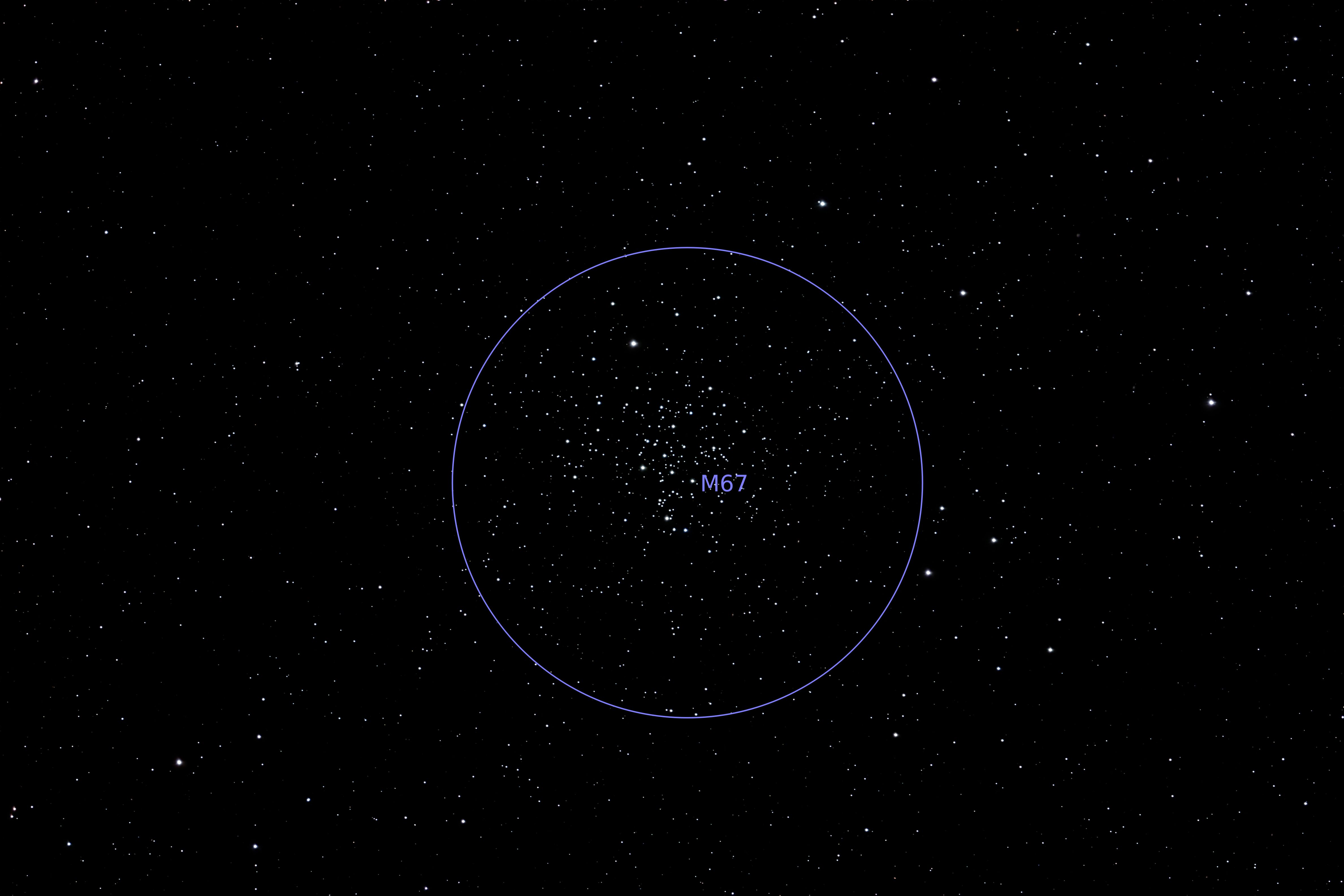
M67 Open Cluster

Imaging Details
Click to Return to Home Page