Messier 64 (M64)
Common Name: Black-Eye Galaxy
Also Known as: : NGC 4826, Sleeping Beauty Galaxy, Evil Eye Galaxy
Object Type: Spiral Galaxy
Constellation: : Coma Berenices
Distance from Earth: 24 million light years
Apparent Magnitude: 9.36
Coordinates: RA 12H 56M 43.7S DEC 21 deg 40 min 58 sec
Actual Size: 70,000 light years in diameter
Apparent Dimensions: 10.71 arc-minutes x 5.128 arc-minutes
Discovered by: M64 was discovered by Edward Pigott on March 23, 1779.
Johann Elert Bode independently discovered M64 12 days later.
Description: Messier 64 is known for the spectacular large dark band of dust in front of its bright central region, which has earned the galaxy the nicknames the Black Eye or Evil Eye.
The dust band has also helped astronomers estimate which side of M64 is nearer to us.
Messier 64 is a member of the Canes Venatici I Group, also known as the M94 Group or the Canes Venatici Cloud, a small, loose group of galaxies within the Virgo Supercluster, located in the constellations Coma Berenices and Canes Venatici.
Messier 64 has two counter-rotating disks roughly equal in mass, possibly as a result of a merger with a smaller satellite galaxy in a retrograde orbit or of ongoing accretion of gas clouds from the interstellar neighborhood.
The dark dust lane that blocks the light of the galaxy’s central region may in fact be material from the smaller galaxy that hasn’t settled into the larger galaxy’s orbital plane yet.
The inner disk of M64, roughly 3,000 light years in radius, rubs along the outer disk, which spans about 40,000 light years and rotates in the opposite direction at about 300 km/s.
The rubbing of the two counter-rotating disks results in an intense burst of star forming activity in the region where the disks’ gases collide and are compressed.
While the interstellar gas in the galaxy’s outer regions rotates in the opposite direction from the gas and stars in the inner disk, all the stars in M64 are rotating in the same direction.
The group was named after the bright spiral galaxy Messier 94, also known as the Cat’s Eye Galaxy or Croc’s Eye Galaxy, located in Canes Venatici constellation.
The Black Eye Galaxy is home to about 100 billion stars.
It is receding from us at 408 km/s.
Click Below Image(s) for Full Size:
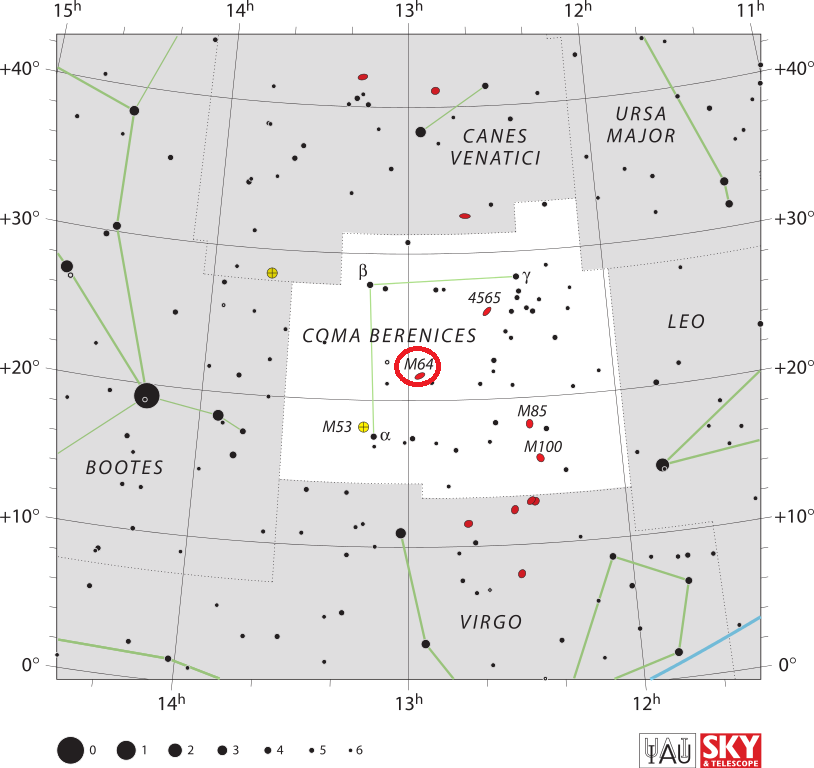
Binoculars reveal only a faint, irregular patch of light, but 4-inch telescopes easily show the galaxy’s large, bright nucleus and if observing conditions are particularly good, its large dark dust lane.
The dust lane is even easier to see in 6-inch telescopes, while 8-inch instruments also reveal the galaxy’s outer regions, which appear as a large halo of wispy nebulosity.
The best time of year to observe M64 from northern latitudes is during the spring.
Platesolve
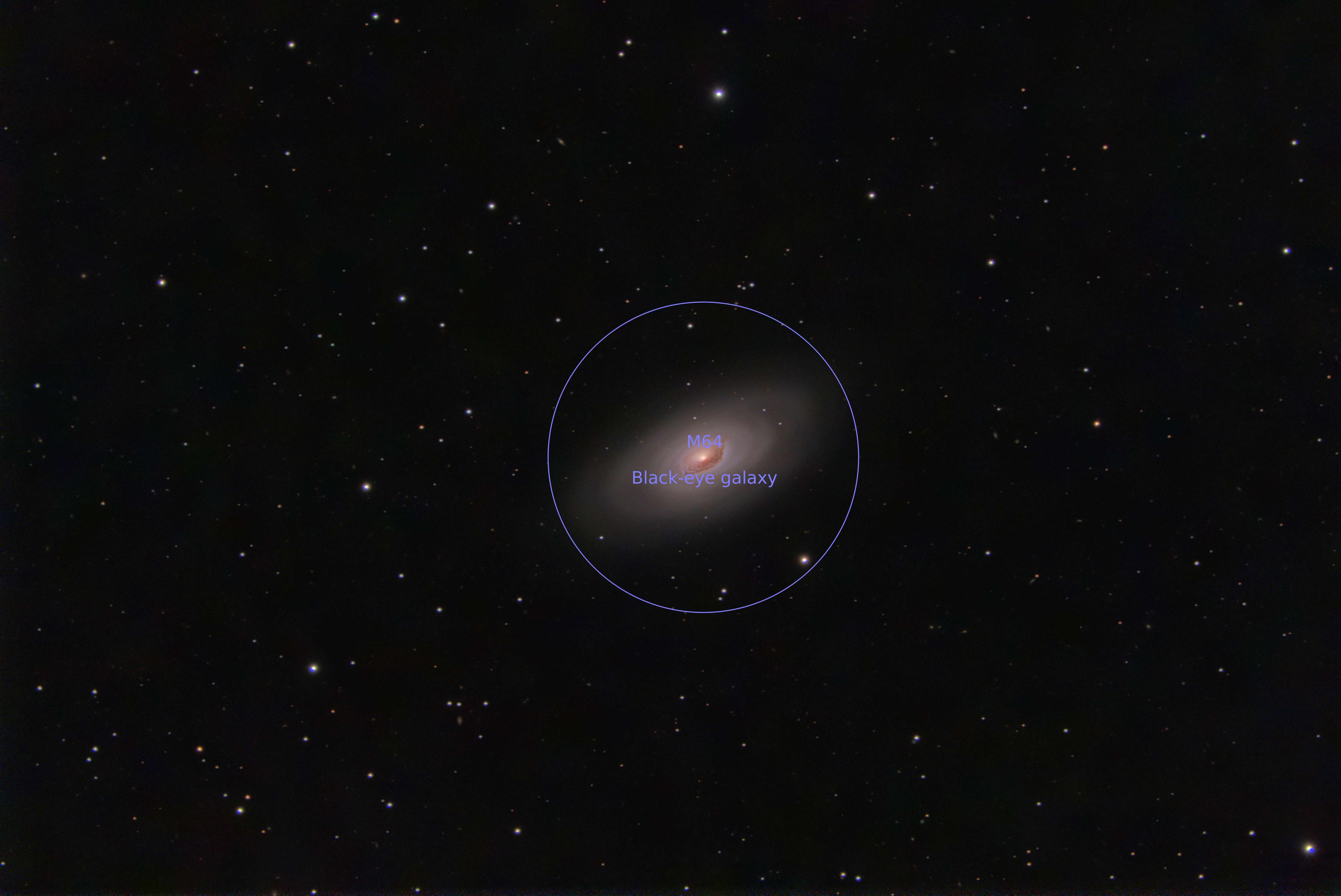
M64 Spiral Galaxy

Imaging Details
Click to Return to Home Page