Messier 52 (M52) & NGC 7635
Also Known as: NGC 7654 (M52), Collinder 455 (M52), Sharpless 162 (Sh2-162) (NGC 7635), Caldwell 11 (NGC 7635)
Object Type: Open Cluster (M52), Emission Nebula (NGC 7635)
Constellation: Cassiopeia
Distance from Earth: 4,600 light years (M52), 7,100 light years (NGC 7635)
Apparent Magnitude: 6.9 (M52), 10.0 (NGC 7635)
Coordinates: RA 23H 24M 48S DEC 61 deg 35 min 36 sec (M52), RA 22H 20M 48.3S DEC 61 deg 12 min 06 sec (NGC 7635)
Actual Size: 22 light years in diameter (M52), 7 light years in diameter (NGC 7635)
Apparent Dimensions: 13 arc-minutes (M52) , 15 arc-minutes x 8 arc-minutes (NGC 7635)
Discovered by: M52 was discovered by Charles Messier on September 7, 1774. He noted the cluster of very small stars mingled with nebulosity.
NGC 7635 was discovered in November 1787 by William Herschel.
Description: Messier 52 contains 193 probable members within a region 9 arc minutes in radius. These were discovered by the Swedish astronomer Åke Wallenquist.
Its apparent size is just less than ½ of a full Moon. The cluster has an estimated age of 35 million years.
The distance to M52 has not been established with any degree of certainty because of a high interstellar absorption of the cluster’s light.
Estimates are generally in the range from 3,000 to 7,000 light years.
The cluster has a Trumpler classification of I,2,r, which means that it is detached from the surrounding star field and has strong central concentration (I), it has a moderate range in brightness (2), and is richly populated (r), with 100 or more confirmed members.
The cluster’s density in the central region is about three stars per cubic parsec.
M52 lies near the prominent deep sky object, the Bubble Nebula (NGC 7635).
NGC 7635 is an H II region emission nebula.
The "bubble" is created by the stellar wind from a massive hot, 8.7 magnitude young central star.
The central star is an extremely bright, massive, and short-lived star that has lost most of its outer hydrogen and is now fusing helium into heavier elements.
This emission nebula lies at a much greater distance than M52 (11,000 light years) so the objects are not physically related.
See the M52 selection for more details on M52 and the NGC 7635 selection for more details on NGC 7635.
Click Below Image(s) for Full Size:
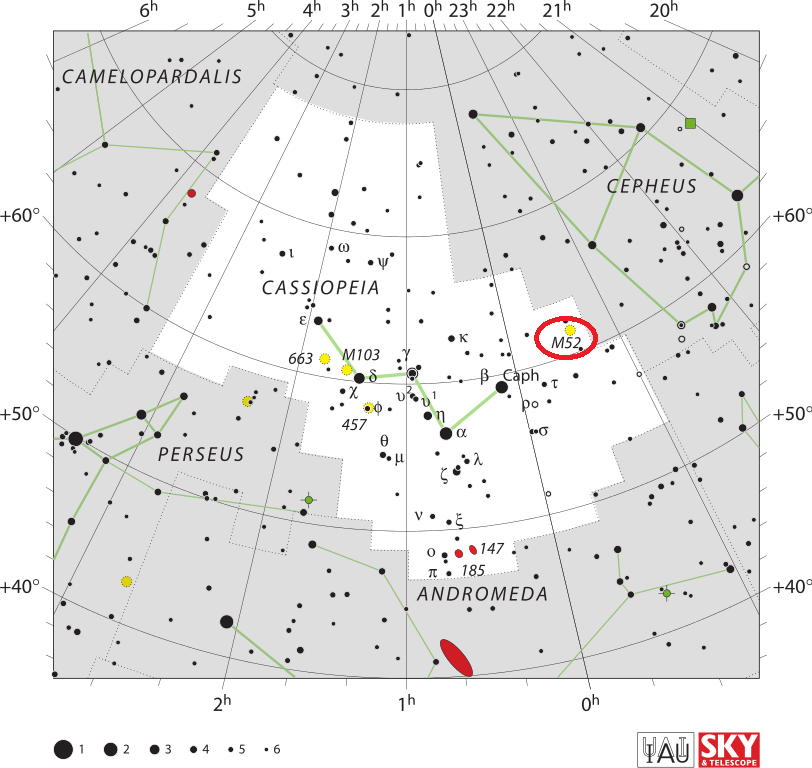
M52 can easily be seen with binoculars.
In 10x50 binoculars it appears as a hazy, nebulous patch. A 4 inch scope reveals a dense compressed star cluster with a shape resembling a ‘V’.
More stars are visible in larger scopes. The cluster occupies an area just less than half of the size of the full Moon.
With an 8-or-10-inch (200 or 250 mm) telescope, the NGC 7635 nebula is visible as an extremely faint and large shell around the star.
M52 & NGC 7635 are best viewed late fall through winter.
Platesolve
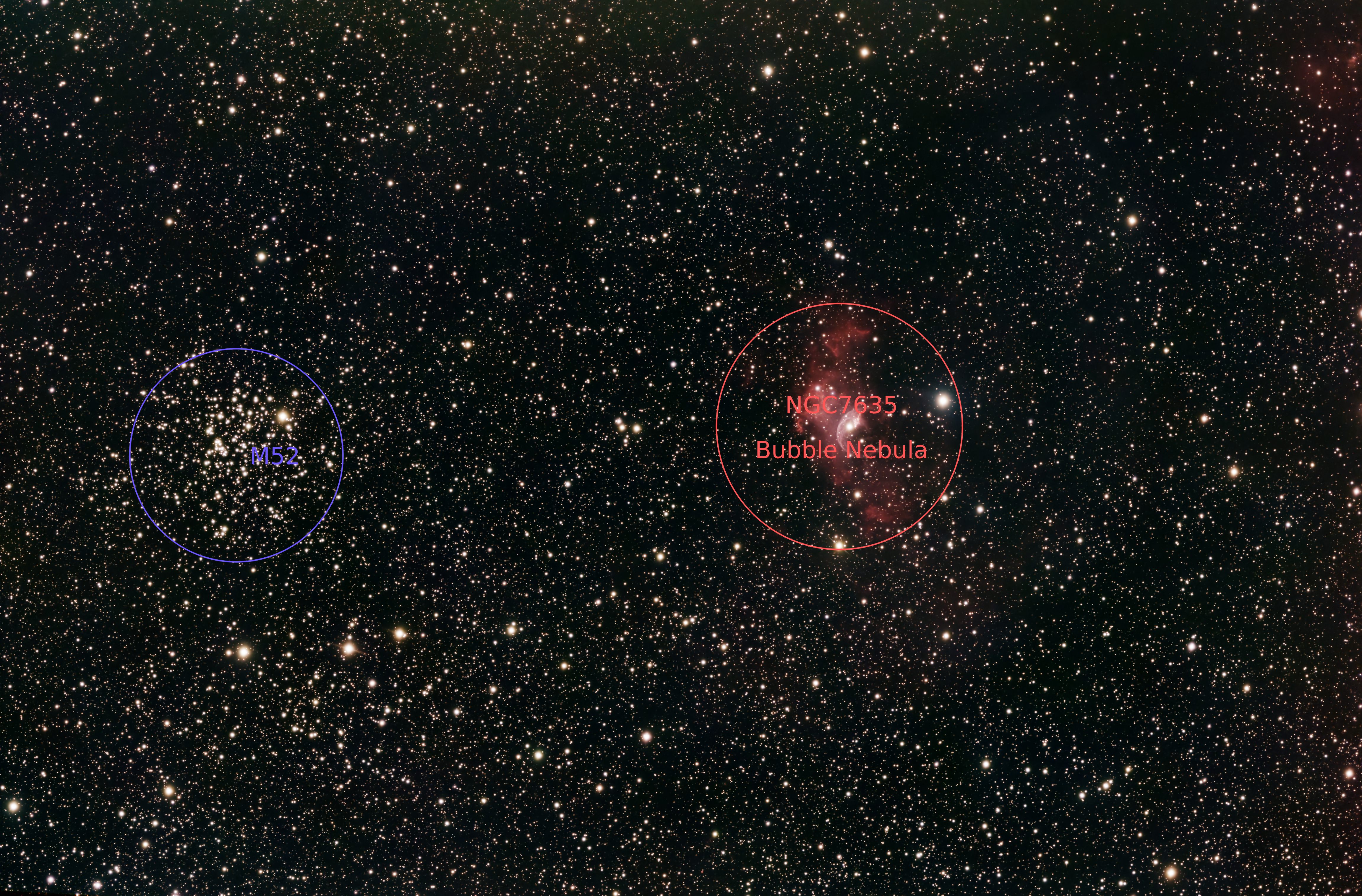
M52 Open Cluster and NGC 6735 Bubble Nebula

M52 Open Cluster and NGC 6735 Bubble Nebula
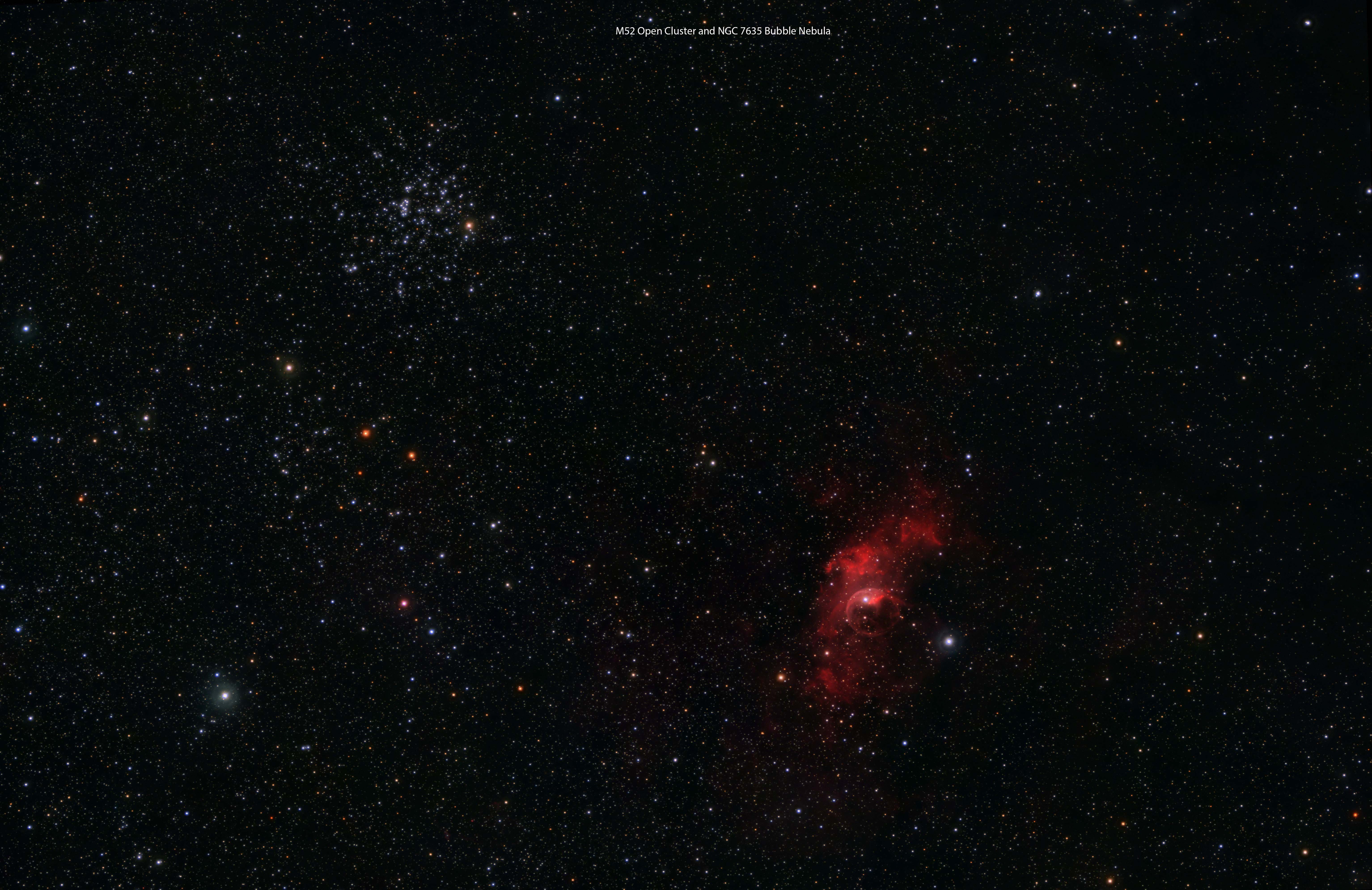 Imaging Details
Click to Return to Home Page