Messier 51 (M51)
Common Name: Whirlpool Galaxy
Also Known as: NGC 5194, Rosse’s Galaxy, Question Mark Galaxy, Arp 85
Object Type: Grand Design Spiral Galaxy
Constellation: Canes Venatici
Distance from Earth: 23 million light years
Apparent Magnitude: 8.4
Coordinates: RA 13H 29M 52.7S DEC 47 deg 11 min 43 sec
Actual Size: 76,900 light years in diameter
Apparent Dimensions: 11.2 arc-minutes x 6.9 arc-minutes
Discovered by: The Whirlpool Galaxy is one of Charles Messier’s original discoveries. Messier first observed the object on October 13, 1773.
Description: The Whirlpool Galaxy is sometimes referred to as Messier 51a and the smaller NGC 5195 as Messier 51b.
It is a ‘grand-design’ spiral galaxy. It is one of the easiest Messier object to find.
It is quite bright and appears face-on, which makes it a popular target among amateur astronomers and astrophotographers.
M51 is also the brightest example of an interacting spiral galaxy in the sky.
M51 is the brightest member of the M51 group of galaxies that includes the Sunflower Galaxy and the spiral galaxies NGC 5023 and NGC 5229.
Messier 51 is classified as a Seyfert 2 galaxy, an active galaxy with a quasar-like nucleus, a very high surface brightness and a characteristic bright core, one that appears particularly bright at infrared wavelengths.
The Whirlpool Galaxy is interacting with a smaller companion, NGC 5195 (Messier 51b), a dwarf galaxy connected to its larger neighbor by a tidal bridge of dust.
The bridge is visible in images of the pair silhouetted against the central region of the smaller galaxy.
The tidal interaction with NGC 5195, which was not discovered until the advent of radio astronomy, has considerably enhanced the spiral structure of the Whirlpool Galaxy. Astronomers believe that it is also triggering waves of new star formation.
The interaction leads to compression of hydrogen gas which, in turn, leads to formation of stellar nurseries.
The two galaxies will eventually merge, but it will take another few passes for the merger to be complete.
M51 is about 35% the size of our Milky Way.
The Whirlpool Galaxy is also known as the Question Mark Galaxy or Rosse’s Galaxy, after William Parsons, 3rd Earl of Rosse, who was the first to recognize the spiral nature of this “nebula” in 1845.
It wasn’t until the 1920s, when Edwin Hubble proved that “spiral nebulae” were in fact distant galaxies, that Whirlpool and other objects of this type were recognized as independent galaxies and not nebulae inside the Milky Way.
Messier 51 is about 35 percent the size of our own galaxy, the Milky Way, and has an estimated mass of 160 billion solar masses.
Click Below Image(s) for Full Size:
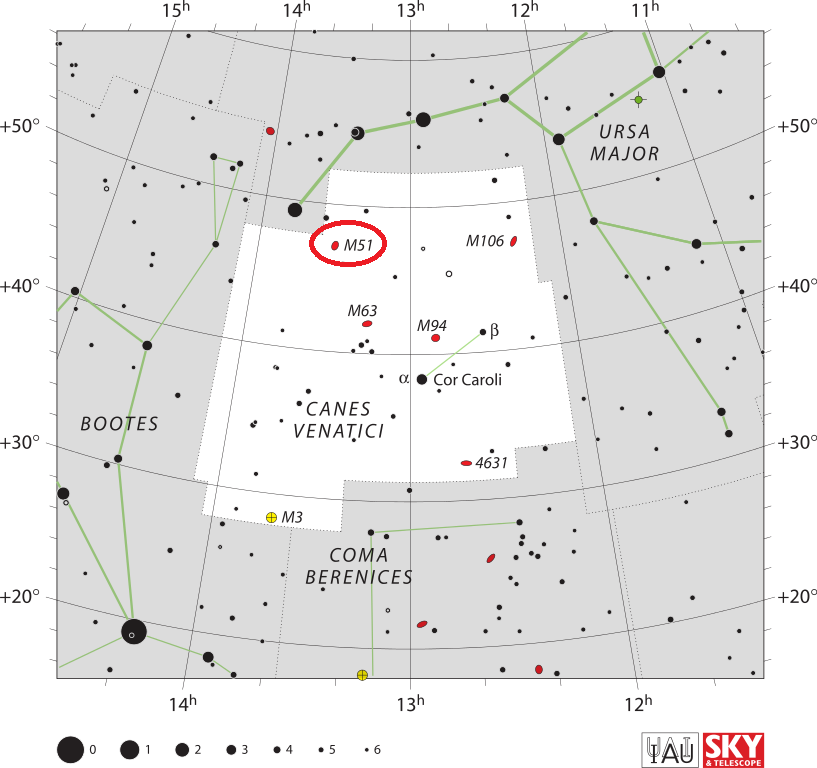
Messier 51 is one of the easiest Messier objects to find, as it lies in the vicinity of the Big Dipper asterism.
The galaxy is positioned only 3.5 degrees southwest of Alkaid, Eta Ursae Majoris, the star that marks the end of the Dipper’s handle, or the tip of the Great Bear‘s tail.
In good conditions M51 appears as a patch of light in 10x50 binoculars.
Small telescopes show a more diffuse patch of light with a bright central region.
An 8 inch scope reveals more of the bright core and the large halo, and a hint at the dark dust lanes and spiral arms.
M51’s smaller companion (NGC 5195) is also visible. 12-inch and larger telescopes reveal a number of spiral bands and vast H II regions, as well as the band of light that connects the Whirlpool Galaxy to its smaller neighbor.
The best time of year to observe M51 is in the months of March, April and May.
Platesolve
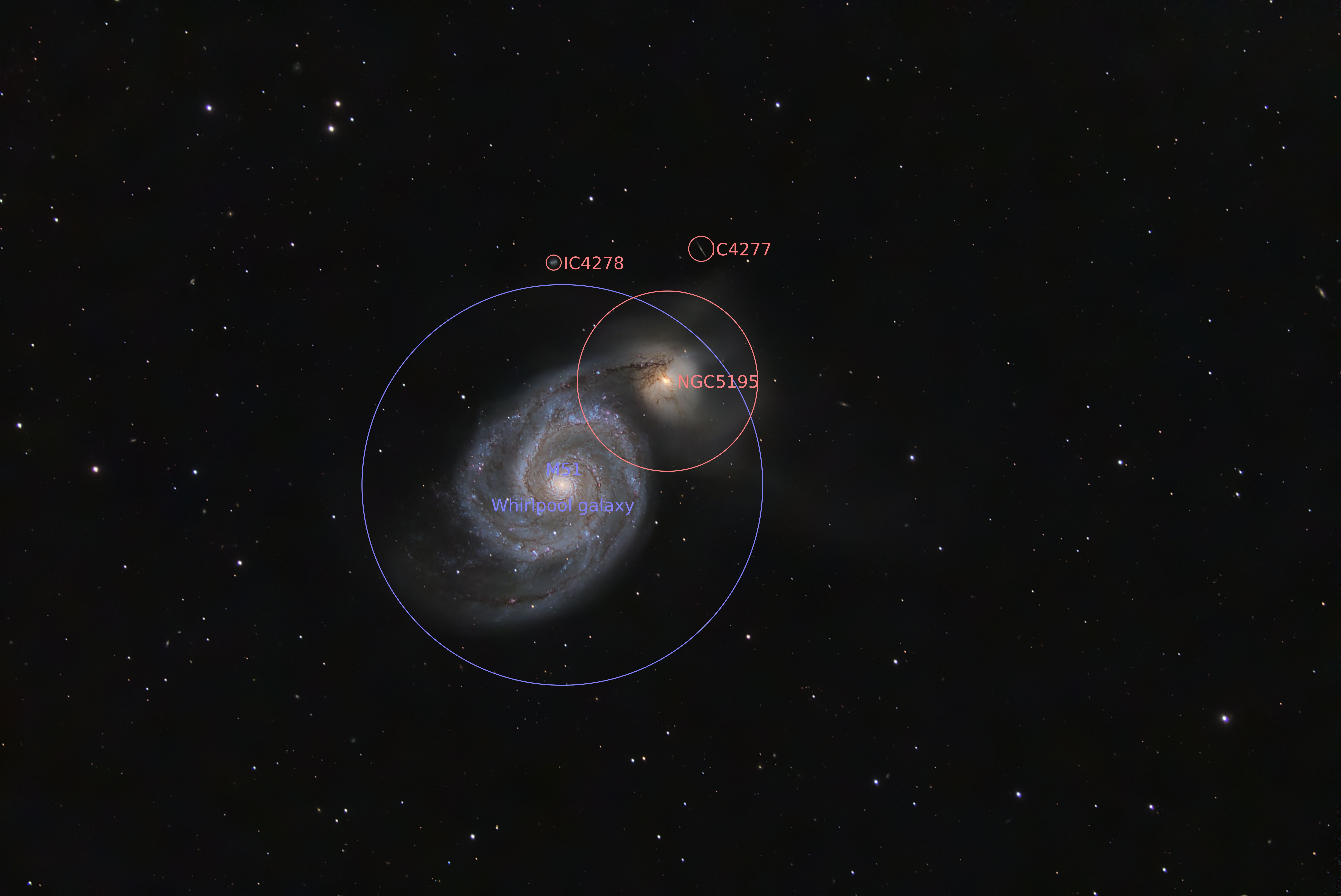
M51 Galaxy

Imaging Details
Click to Return to Home Page