Messier 44 (M44)
Common Name: Beehive Cluster
Also Known as: NGC 2632, Praesepe, the Manger, Melotte 88
Object Type: Open Cluster
Constellation: Cancer
Distance from Earth: 577 light years
Apparent Magnitude: 3.7
Coordinates: RA 08H 40.4M 0S DEC 19 deg 59 min 0 sec
Actual Size: Bright central core 22.8 light years in diameter, tidal radius is about 39 light years
Apparent Dimensions: 95 arc-minutes
Discovered by: Messier 44 is a prominent deep sky object and has been known since ancient times.
Greek and Roman observers saw the cluster as a manger from which 2 donkeys are eating.
Greek poet and philosopher Aratus mentioned Praesepe (the Manger) in his poem Phainomaina or Phainomena (Heavenly Phenomena, or Appearances) in 260 B.C.
Greek astronomer Claudius Ptolemy (AD 90 – 168) also documented the cluster, calling it “the nebulous mass in the breast of Cancer.”
Messier 44 was one of the first deep sky objects that Galileo Galilei studied with his telescope in 1609.
He was able to resolve 40 stars. He wrote, “The nebula called Praesepe contains not one star only but a mass of more than 40 small stars.
We have noted 36 besides the Aselli [Gamma and Delta Cancri].”
Charles Messier added the Beehive Cluster to his catalogue on March 4, 1769, describing it as a “cluster of stars known by the name of the nebula in Cancer.”
Description: M44 is a bright large open cluster.
Praesepe contains at least 1,000 stars and has a mass between 500 and 600 times solar.
About 68 percent of the members are M-class (red) dwarfs, 30 percent are of spectral types F, G and K, and 2 percent of the members are bright, A-class stars.
Five giants have also been identified in the cluster: one with the stellar classification G0 III and four belonging to the spectral class K0 III. Researchers have also found 11 white dwarfs.
The brightest stars in M44 have a visual magnitude of 6 to 6.5 and appear blue-white in color.
Praesepe is one of the brightest Messier objects and has been known since ancient times.
The only objects on Messier’s list that are brighter than M44 are the Pleiades cluster (M45) and the Andromeda Galaxy (M31).
The Pleiades are also the only deep sky object in Messier’s catalogue that is nearer to us than the Beehive Cluster. Winnecke 4 (M40), which is also closer, is a double star and not a deep sky object.
Praesepe has a similar age and proper motion to the Hyades (600 to 700 million years old), the nearest open cluster to the solar system, which lies in the same line of sight as the bright star Aldebaran in Taurus constellation.
The two clusters likely share a similar origin.
It is also one of the closest open Clusters.
Messier 44 has experienced mass segregation, a process often seen in star clusters and other gravitationally bound systems (e.g. galaxy clusters), by which heavier objects move toward the center, while lighter ones move away from the center.
The bright, massive stars of M44 are now concentrated in the central region of the cluster while the fainter, less massive members are found in the halo.
Click Below Image(s) for Full Size:
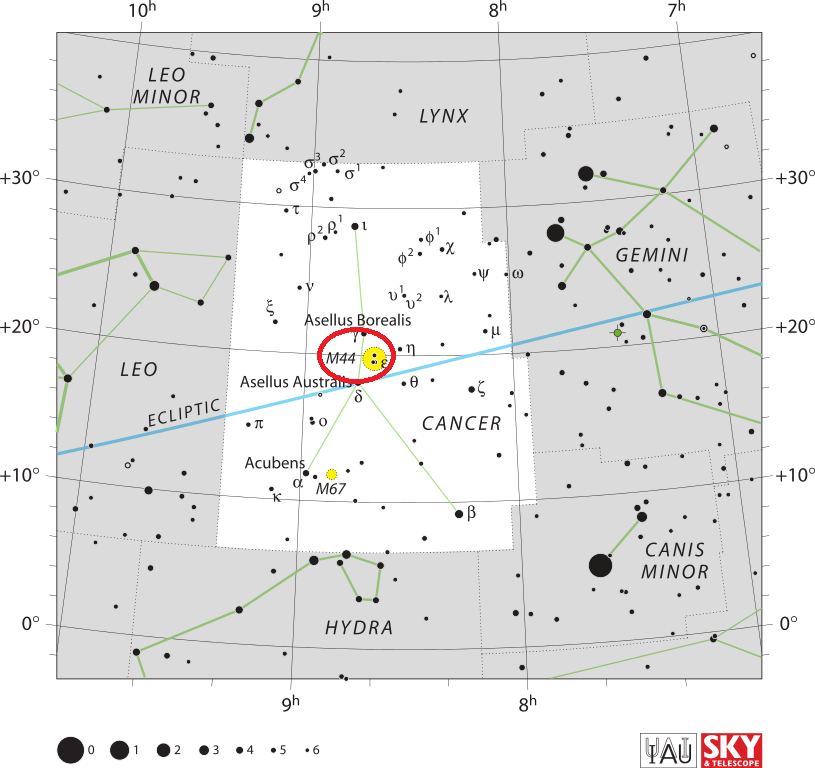
M44 is one of the nearest open clusters to Earth and can easily be seen without binoculars.
It appears as a blurry patch of light to the naked eye. The cluster is best seen in binoculars and small telescopes.
Occupying an area 95 arc minutes across, it fits in the field of view of binoculars and low power telescopes.
Larger telescopes reveal more than 200 stars in the cluster.
The best time of year to observe the Beehive Cluster is from February to May, when Cancer rises high in the sky for northern observers.
Platesolve
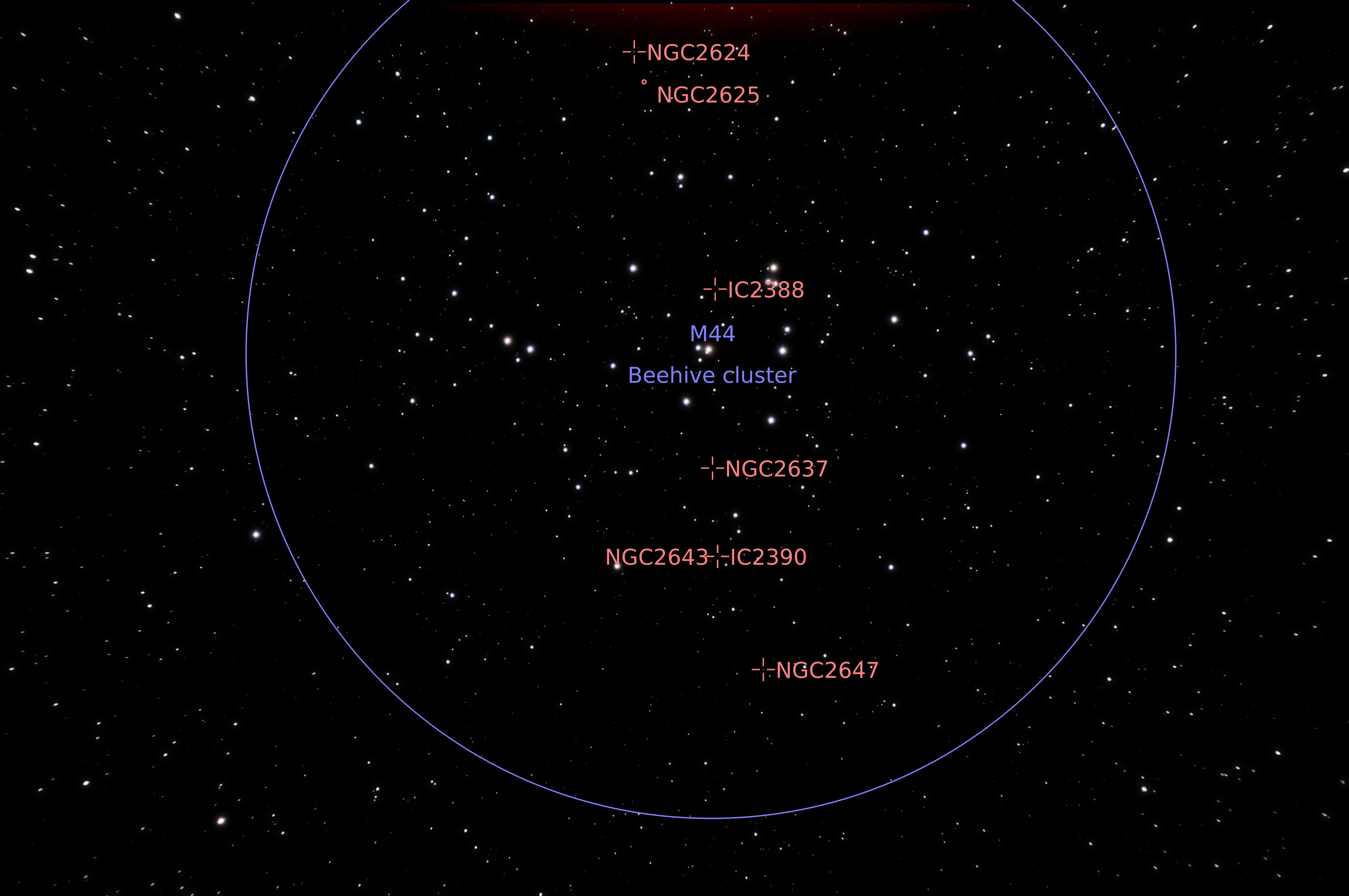
M44 Open Cluster

Imaging Details
Click to Return to Home Page