Messier 41 (M41)
Also Known as: NGC 2287, Collinder 118
Object Type: Open Cluster
Constellation: Canis Major
Distance from Earth: 2,300 light years
Apparent Magnitude: 4.5
Coordinates: RA 06H 46M 0S DEC -20deg 46min 0sec
Actual Size: 25 light years in diameter.
Apparent Dimensions: 38 arc-seconds
Discovered by: Messier 41 was discovered by the Italian astronomer Giovanni Battista Hodierna before 1654 and possibly seen by Greek philosopher and scientist Aristotle around 325 BC.
In his work Meteorologica, Aristotle reported a star with a faint tail located below Sirius.
English astronomer John Flamsteed discovered the open cluster independently on February 16, 1702, as did the French astronomer Guillaume Le Gentil in 1749.
Charles Messier added the cluster to his catalogue on January 16, 1765, describing it as a “cluster of stars below Sirius, near Rho Canis Majoris,” adding that “this cluster appears nebulous in an ordinary telescope of one foot [FL]; it is nothing more than a cluster of small stars.”
Description: Messier 41 occupies an area of 38 arc minutes in apparent diameter, roughly the size of the full Moon.
The cluster has a true diameter of 25 light years. Its estimated age is between 190 and 240 million years. M41 is moving away from us at 23.3 km/s.
The cluster is classified as Trumpler type I,3,r, which means that it is detached from the surrounding star field with strong concentration at the center (I), it consists of both bright and faint stars (3), and it is richly populated (r), with 100 or more stars.
Messier 41 contains about 100 members, including several red giants and a number of white dwarfs. The brightest among the giant stars is a K3-type star with a visual magnitude of 6.3, visible near the center of the cluster.
The orange giant is about 700 times more luminous than the Sun. The hottest star in M41 has the spectral classification A0.
Click Below Image(s) for Full Size:
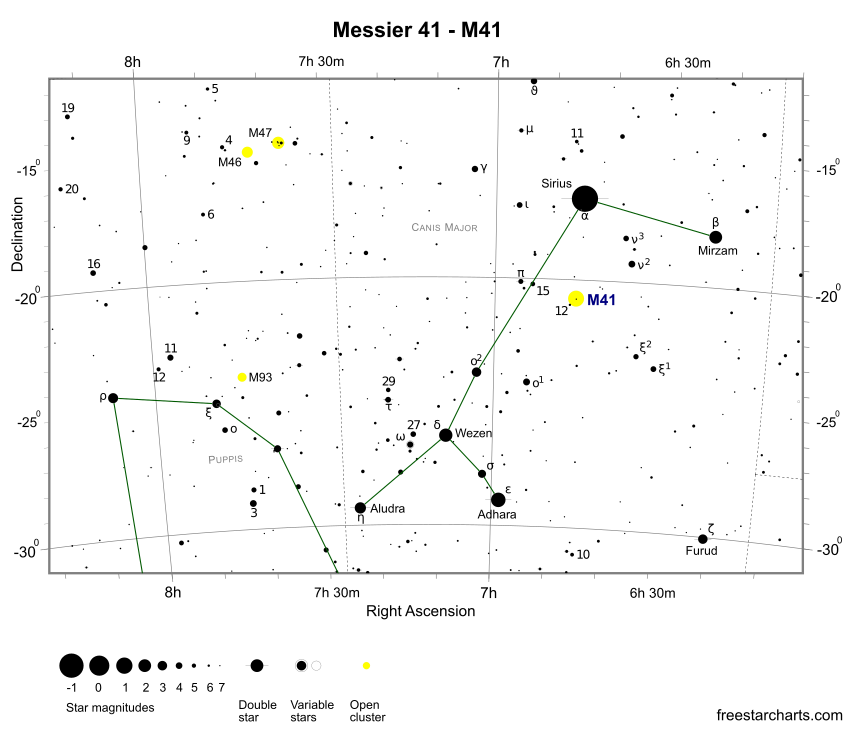
M41 is very easy to find as it lies about 4 degrees south of Sirius, the Dog Star, one of the nearest stars to Earth.
M41 can be seen in the same binocular field with Sirius and Nu-2 Canis Majoris, an evolved orange giant with a visual magnitude of 3.95.
The cluster forms a triangle with the two stars. In clear, dark skies, it is visible to the naked eye.
The cluster is relatively loose and can be resolved in a small telescope. It is best observed at low magnifications.
10×50 binoculars show a large faint patch of light, while larger binoculars resolve some of the stars in the cluster.
Small telescopes (4-inch) resolve about 50 stars, while 6-inch and 8-inch telescopes show many more fainter members.
The best time of year to observe M41 is in the months of December, January and February.
Platesolve
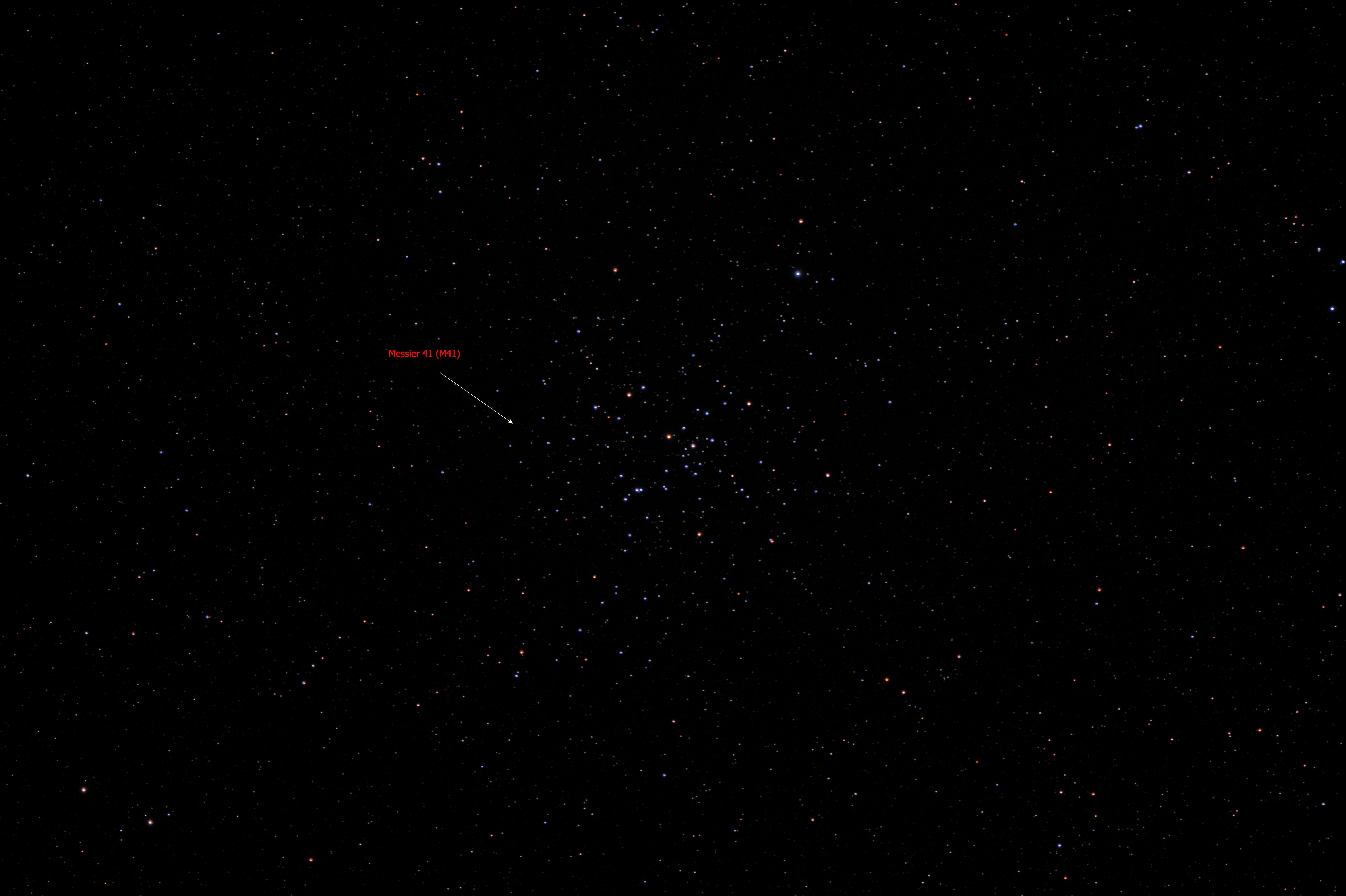
M41 Open Cluster

Imaging Details
Click to Return to Home Page