Messier 40 (M40), NGC 4284, NGC 4290
Common Name: Winnecke 4 (M40)
Also Known as: Winnecke 4 (M40)
Object Type: Double Star (M40) ... Spiral Galaxy (NGC 4284) ... Ring Spiral Galaxy (NGC 4290)
Constellation: Ursa Major
Distance from Earth: 510 light years (M40) ... 225 million light years (NGC 4284) ... 144 million light years (NGC 4290)
Apparent Magnitude: (M40) 9.65 and 10.1
M40 Coordinates: RA 12H 22M 12S DEC 58deg 5min 34sec
NGC 4284 Coordinates: RA 12H 22M 12.8S DEC 58deg 5min 36sec
NGC 4290 Coordinates: RA 12H 20M 48S DEC 58deg 5min 33sec
NGC 4284 Actual Size: 49.5 light years
Apparent Dimensions: 2.5 arc-minutes x 1.2 arc-minutes (NGC 4284) .... 2.25 arc-minutes x 1.5 arc-minutes (NGC 4290)
Discovered by: Winnecke 4 was discovered by Charles Messier on October 24, 1764.
Messier was looking for a nebula reported in the area by the Polish astronomer Johannes Hevelius in the 17th century, but did not find one, so he catalogued the double star instead.
The “nebula” reported by Hevelius may have been the 12th magnitude barred spiral/early type ring galaxy NGC 4290, which may have been visible in large telescopes at the time, but not in those Messier used.
Messier was aware that the object he catalogued was a double star and not a nebula, but included it on his list nonetheless.
If Messier had had a larger telescope, he would have discovered not one, but at least two galaxies in the vacinity of the double star. NGC 4284, another spiral galaxy, can be found right next to NGC 4290, and PGC 39934, a 17th magnitude galaxy, can be seen between NGC 4290 and M40.
Messier 40 was later discovered by the German astronomer Friedrich August Theodor Winnecke in 1863. Winnecke included it in the Winnecke Catalogue of Double Stars as the fourth entry, WNC 4.
Description: Messier 40 (M40) is one of the few Messier objects that are not deep sky objects.
It was not listed in the New General Catalogue (NGC).
Messier 40 is composed of a G0-type star and an F8-type star with apparent magnitudes of 9.65 and 10.10.
The stars are separated by 52.8 arc seconds and form an optical pair, lying along the same line of sight, but not physically connected to each other as they are known to be at different distances from Earth.
The brighter component (G0) is designated as HD 238107 and the fainter (F8), HD 238108. The more distant component lies more than 1,900 light years away.
NGC 4290 is an example of a 'ring' galaxy. Ring galaxies are formed when a low mass galaxy passes through a larger spiral galaxy, usually in a near perpendicular plane triggering a burst of highly energetic and therefore short-lived, star formation in the 'ring'.
This makes them quite transcient and unusual though there are a few fairly bright ones to be seen.
NGC 4290 is an early type ring galaxy classified as SBbc. It has a surface brightness mag. of 14.1 so it is quite bright although it's apparent visual magnitude is only 13.1.
The little spiral nearby goes by the rather uninspiring title of MCG +10-18-032.
Click Below Image(s) for Full Size:
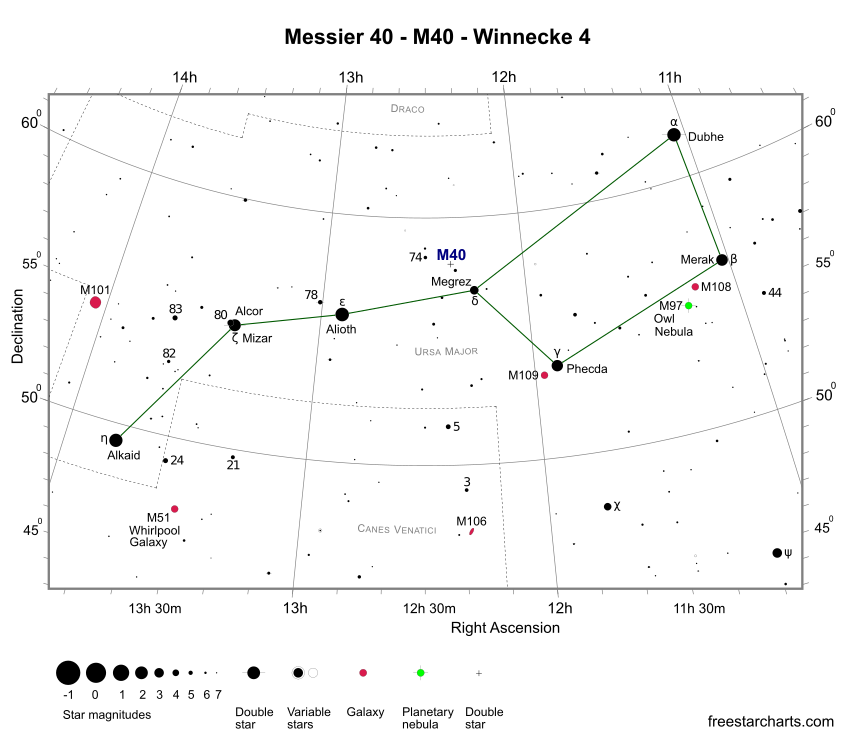
Winnecke 4 can be seen in 10×50 binoculars, but is better viewed in 20×80 binoculars or small telescopes. Small and medium-sized telescopes will show a pair of stars, one orange-yellow and the other white in color. M40 is best seen from the Northern Hemisphere during the months of February, March and April.
Platesolve
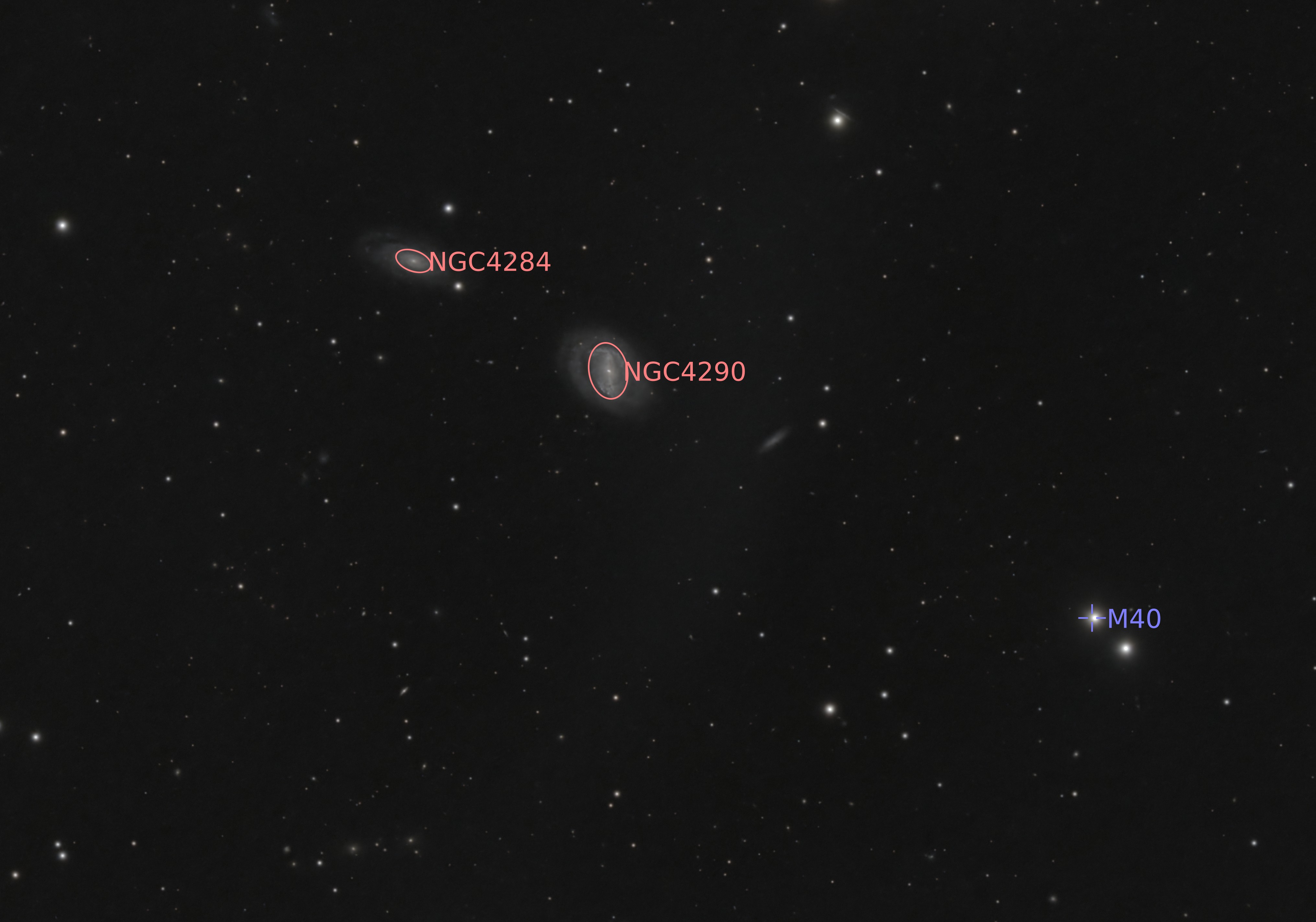
M40 Double Star, NGC 4284 & NGC 4290 Spiral Galaxies
 Imaging Details
Click to Return to Home Page