Messier 36 (M36)
Common Name: Pinwheel Cluster
Also Known as: NGC 1960, Collinder 71
Object Type: Open Cluster
Constellation: Auriga
Distance from Earth: 4,100 light years
Apparent Magnitude: 6.3
Coordinates: RA 05H 36M 12S DEC 34 deg 08 min 04 sec
Actual Size: 14 light years in diameter
Apparent Dimensions: 12 arc-minutes
Discovered by: The cluster was discovered by the Italian astronomer Giovanni Battista Hodierna before 1654.
Guillaume Le Gentil found M36 and M38 independently in 1749. Charles Messier catalogued the cluster on September 2, 1764.
Description: The Pinwheel Cluster contains at least 60 stars and bears a resemblance to the more famous Pleiades cluster (M45) in the constellation Taurus.
The two clusters have almost the same physical size and, like many members of the Pleiades cluster, many members of M36 are also rapid spinners.
M36 is one of the more distant open clusters catalogued by Charles Messier and about 10 times further away than the Pleiades.
With an estimated age of 25 million years, Messier 36 is relatively young and does not have any red giant stars.
The brightest confirmed members are of apparent magnitude 9 and have the stellar classification B2. The brightest star in M36 is about 360 times more luminous than the Sun.
The cluster is classified as Trumpler type I,3,m, which means that it is detached with strong central concentration (I), composed of both bright and faint stars (3), and medium rich, with 50 to 100 members.
It is one of 3 bright star clusters in Auriga along with M37 and M38 however it is the smallest and least dense of the 3.
Click Below Image(s) for Full Size:
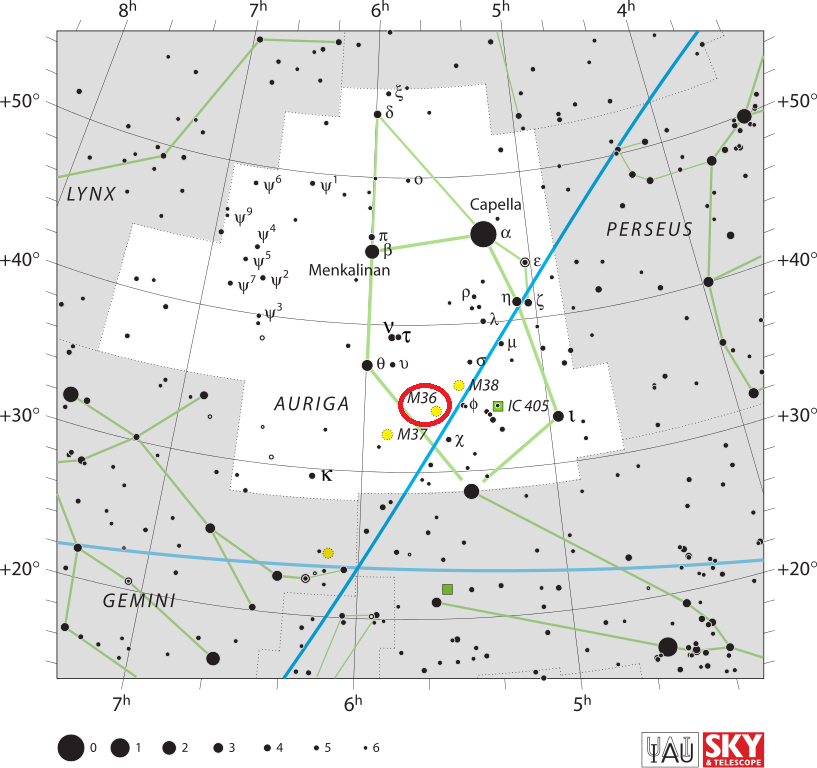
M36 is one of the fainter open clusters in the Messier Catalogue but can be easily seen with binoculars and small telescopes.
With binoculars M36 appears as a faint fuzzy patch of light. Small telescopes at low power reveal just over a dozen of the brightest stars.
The best time of year to view M36 is during the winter months.
Platesolve
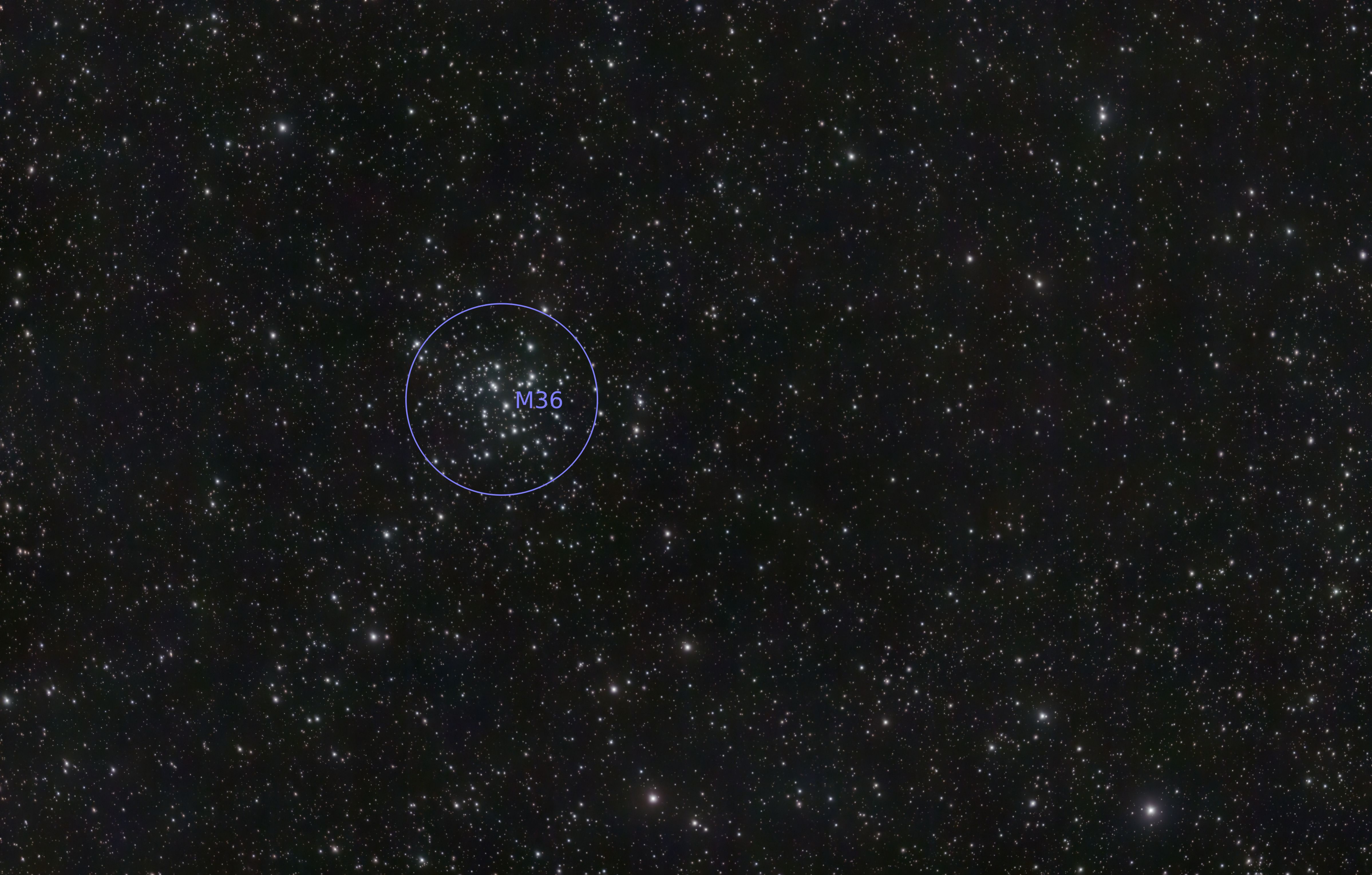
M36 Open Cluster

Imaging Details
Click to Return to Home Page